
Surgical Robots Market Trends & Outlook 2025–2033: How Robotics Is Redefining Modern Surgery
From precision-guided procedures to faster patient recovery, surgical robots are transforming global healthcare—and the market is racing ahead.

Surgical Robots Market: A New Era of Precision in Healthcare
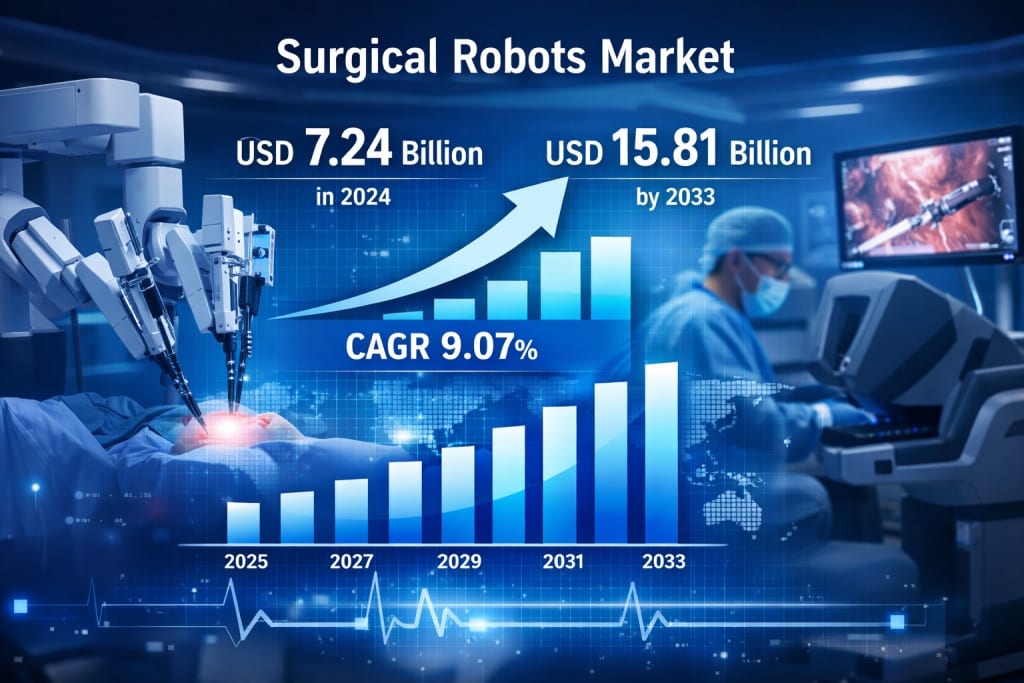
The global healthcare industry is undergoing a profound transformation, driven by rapid technological innovation and an increasing focus on patient-centric care. Among the most impactful advancements is the rise of surgical robots—sophisticated systems designed to assist surgeons in performing highly precise, minimally invasive procedures. According to Renub Research, the Surgical Robots Market was valued at USD 7.24 billion in 2024 and is expected to reach USD 15.81 billion by 2033, expanding at a CAGR of 9.07% during 2025–2033.
This impressive growth is being fueled by several converging trends: rising demand for minimally invasive surgeries, continuous improvements in robotic-assisted technologies, and increasing investments in healthcare infrastructure worldwide. Beyond the numbers, surgical robots are reshaping how operations are performed—improving accuracy, reducing recovery times, and opening new possibilities across multiple medical specialties.
Understanding Surgical Robots: Technology Meets the Operating Room
Surgical robots are advanced robotic systems engineered to support surgeons during complex procedures. Typically, these systems consist of robotic arms, high-definition 3D cameras, and a control console that allows surgeons to operate with enhanced precision. One of the most well-known examples is the da Vinci Surgical System, which has become widely used in laparoscopic and robotic-assisted surgeries across the globe.
These systems do not replace surgeons; instead, they augment human capability. By filtering hand tremors, providing magnified high-resolution views, and enabling extremely fine movements, surgical robots help physicians perform intricate procedures that would be far more challenging with conventional techniques. The result is smaller incisions, reduced blood loss, fewer complications, and quicker recovery times for patients.
Today, surgical robots are used across a wide range of specialties, including orthopedics, urology, gynecology, neurosurgery, cardiology, and general surgery. As artificial intelligence, machine learning, and real-time imaging continue to advance, the role of robotics in the operating room is expected to expand even further.
Key Growth Drivers Powering the Market
1. Rising Demand for Minimally Invasive Surgeries
Minimally invasive surgery (MIS) has become the gold standard for many procedures due to its clear benefits: less postoperative pain, shorter hospital stays, quicker recovery, and minimal scarring. Surgical robots are uniquely suited to MIS because they offer superior precision and control in confined surgical spaces.
Patient awareness is also rising. More individuals today actively seek treatment options that promise faster recovery and fewer complications. At the same time, healthcare providers are under pressure to improve outcomes and efficiency—making robotic-assisted surgery an increasingly attractive solution.
The growing volume of surgeries worldwide further supports this trend. For example, cardiac surgery volumes in the United States alone exceed hundreds of thousands of procedures annually, with expectations of continued growth in the coming years. In parallel, rising road accidents globally are contributing to higher demand for complex surgical interventions. In India, government data for 2022 reported over 460,000 road accidents, resulting in significant numbers of injuries and fatalities—an unfortunate reality that also increases the need for advanced surgical care. This expanding patient pool is expected to drive sustained demand for surgical robots over the forecast period.
2. Technological Advancements in Robotic Surgery
Technology is at the heart of the surgical robots market. Continuous innovations—such as artificial intelligence, 3D visualization, haptic feedback, augmented reality, and real-time data analytics—are making robotic systems smarter, safer, and more versatile.
These advancements allow surgeons to plan procedures more effectively, execute complex maneuvers with greater confidence, and monitor outcomes in real time. For instance, preoperative planning tools and modeling services are now being integrated into robotic platforms, helping tailor surgeries to individual patient anatomy. Such innovations not only improve clinical outcomes but also increase surgeon confidence and adoption rates.
With ongoing research and development, next-generation robotic systems are expected to become more compact, more affordable, and even more capable—further accelerating market growth.
3. Increasing Healthcare Spending and Hospital Adoption
Governments and private healthcare providers around the world are investing heavily in modern medical technologies. The establishment of robotic surgery centers within hospitals is becoming more common, particularly in developed markets. Favorable reimbursement policies in several countries, along with strategic partnerships between medical device companies and healthcare institutions, are also helping expand access to robotic-assisted procedures.
As hospitals compete to offer advanced treatment options and attract skilled surgeons, surgical robots are increasingly viewed not as a luxury, but as a strategic investment in the future of healthcare delivery.
Challenges and Market Constraints
Despite its strong growth outlook, the surgical robots market faces some notable challenges.
High Cost of Acquisition and Maintenance
One of the biggest barriers is the high upfront cost of robotic surgical systems. Purchasing the equipment, training staff, and maintaining the systems require substantial financial resources. For small and medium-sized hospitals—especially in developing countries—these costs can be prohibitive. This limits widespread adoption and creates an uneven distribution of robotic surgery capabilities across regions.
Shortage of Skilled Professionals and Training Limitations
While the technology is advancing rapidly, its effective use depends heavily on trained professionals. Robotic-assisted surgery comes with a steep learning curve, and comprehensive training programs are essential. Many healthcare institutions struggle to provide adequate training, which slows down adoption. Additionally, concerns about system malfunctions and the need for manual intervention in certain situations continue to make some practitioners cautious.
Market Segmentation: Where Growth Is Happening
By Component
Surgical Systems:
These form the core of robotic surgery setups, including robotic arms, control consoles, and imaging systems. Demand for these systems is rising globally as hospitals expand their robotic surgery capabilities.
Accessories:
This segment includes robotic instruments, imaging tools, and disposable components. Accessories are critical for daily operations and represent a recurring revenue stream for manufacturers.
Services:
Maintenance, software updates, and training services are becoming increasingly important as the installed base of robotic systems grows worldwide.
By Area of Surgery
Gynecological Surgery:
Robotic systems are widely used for procedures such as hysterectomies and myomectomies, offering better visualization and precision while reducing patient recovery time.
Cardiovascular Surgery:
Robotic-assisted heart surgeries enable greater accuracy in complex procedures like valve repairs and bypass surgeries, contributing to improved patient outcomes.
Neurosurgery and Orthopedic Surgery:
These fields benefit significantly from the high precision and stability offered by robotic systems, particularly in delicate and high-risk procedures.
Laparoscopy and Urology:
Robotic laparoscopy is increasingly used for general, gastrointestinal, and urological surgeries, driven by the demand for minimally invasive treatment options.
Regional Insights: A Global Market with Local Dynamics
United States
The U.S. remains the largest market for surgical robots, supported by advanced healthcare infrastructure, high adoption rates, and strong investment in medical technology. Leading companies such as Intuitive Surgical, Medtronic, and Stryker continue to drive innovation. Favorable reimbursement policies and robust R&D funding further strengthen the country’s market position.
France
France is emerging as a key player in the European surgical robots market. Government initiatives promoting healthcare digitization and investments in robotic surgery facilities are encouraging adoption, particularly in gynecology, urology, and orthopedics. The country is steadily becoming an attractive market for robotic surgery technology providers.
India
India’s surgical robots market is gaining momentum due to rising healthcare investments, growing medical tourism, and increasing awareness of minimally invasive procedures. While cost remains a challenge, top-tier hospitals are rapidly adopting robotic-assisted surgeries. Government efforts to modernize healthcare infrastructure and the development of indigenous robotic systems are expected to further boost market growth.
Brazil
Brazil represents a steadily growing market, driven by rising demand for advanced medical procedures and increasing healthcare expenditure. Adoption is currently concentrated in private hospitals and specialty centers, but ongoing investments in infrastructure and training programs are likely to expand access over time.
Competitive Landscape: Innovation at the Core
The surgical robots market is highly competitive and innovation-driven. Major players are focusing on expanding product portfolios, improving system capabilities, and strengthening global distribution networks. Key companies operating in this space include:
Intuitive Surgical Inc.
Stryker Corporation
Johnson & Johnson
Medtronic PLC
Smith & Nephew PLC
Zimmer Biomet
Renishaw PLC
Accuray Incorporated
Titan Medical Inc.
These companies are being evaluated across multiple dimensions, including company overviews, leadership, recent developments, product portfolios, and revenue performance. Strategic acquisitions, partnerships, and continuous R&D investments are shaping the competitive dynamics of the market.
Surgical Robots Market Segments at a Glance
By Component:
Surgical System
Accessory
Service
By Area of Surgery:
Gynecological Surgery
Cardiovascular
Neurosurgery
Orthopedic Surgery
Laparoscopy
Urology
Other Areas of Surgery
By Region:
North America: United States, Canada
Europe: France, Germany, Italy, Spain, United Kingdom, Belgium, Netherlands, Turkey
Asia Pacific: China, Japan, India, Australia, South Korea, Thailand, Malaysia, Indonesia, New Zealand
Latin America: Brazil, Mexico, Argentina
Middle East & Africa: South Africa, Saudi Arabia, UAE
The Road Ahead: What the Future Holds
Looking ahead, the future of the surgical robots market appears exceptionally promising. As technology continues to evolve, robotic systems are expected to become more intelligent, more affordable, and more widely accessible. The integration of AI, real-time data analytics, and advanced imaging will further enhance surgical precision and patient safety.
At the same time, growing healthcare needs driven by aging populations, increasing chronic diseases, and higher surgical volumes will continue to support market expansion. While challenges related to cost and training remain, ongoing innovation and supportive healthcare policies are likely to gradually lower these barriers.
Final Thoughts
The global surgical robots market is no longer a niche segment—it is fast becoming a cornerstone of modern healthcare. With the market projected to grow from USD 7.24 billion in 2024 to USD 15.81 billion by 2033 at a CAGR of 9.07%, the momentum is unmistakable.
Driven by the rise of minimally invasive surgeries, rapid technological advancements, and increasing healthcare investments, surgical robots are redefining what is possible in the operating room. As adoption spreads across regions and specialties, these systems will play an ever-greater role in improving patient outcomes and shaping the future of surgery worldwide.
About the Creator
The Saddest Thing - The Billionaires Who Rule America Aren't Even Enjoying Themselves
This single post says more about our ruling class than a thousand policy papers. The saddest thing about today's system is that the men robbing the rest of us - sabotaging our economic prospects, our pensions, our access to affordable healthcare - are not even happy.
By Scott Christenson🌴6 days ago in The Swamp
Can Mountain Lions Survive as Humans Close In?
California’s mountain lions, also called cougars or pumas, once roamed vast stretches of wilderness with little interference. Today, their world is shrinking. Highways, neighborhoods, and urban sprawl are fragmenting their habitats, forcing these iconic predators into an uneasy coexistence with humans. The pressing question is: Can mountain lions survive as our cities expand—and if so, how?
By Aqib Hussaina day ago in The Swamp
The Pride Flag and the Diversion
For nearly a decade, the LGBTQIA Pride Flag rippled in the wind at Christopher Park, a kaleidoscope of color staked into the soil of America’s first national monument to LGBTQIA+ liberation. That flag came down this week. Federal officials, citing new guidance from the Trump Administration, silently lowered the rainbow flag from its pole across the street from the Stonewall Inn. The birthplace of the modern gay rights movement now flies only the United States flag.
By Tim Carmichaela day ago in Pride




Comments
There are no comments for this story
Be the first to respond and start the conversation.