
Supreme Court Denies Robert F. Kennedy Jr.'s
Bid for New York Ballot Placement

In a recent development, the U.S. Supreme Court declined to reinstate Robert F. Kennedy Jr. on New York’s 2024 presidential ballot, a setback for the political candidate who had been disqualified after a state judge found discrepancies in his campaign paperwork. The court’s decision, issued without a detailed explanation or dissent, upheld the ruling of a lower court that Kennedy had provided an improper address on his nominating petition.
Kennedy had petitioned the Supreme Court to intervene following the state judge’s ruling, which deemed that he had used a false residential address in the official paperwork required to secure his spot on the New York ballot. His appeal hinged on the argument that New Yorkers should have the right to cast their votes for him, even though he had suspended his campaign and endorsed former President Donald J. Trump. His legal team argued that a suspension did not equate to a termination of his campaign, and thus he should still be allowed to run in the state.
Address Dispute and Legal Grounds
At the heart of the controversy was Kennedy’s listing of an address in Katonah, New York, a town in Westchester County, on his nominating petition. However, Kennedy primarily resides in Los Angeles with his wife, actress Cheryl Hines. His legal team admitted that he only occasionally stayed in a spare bedroom rented from a childhood friend at the Katonah address, and had only stayed overnight once.
Despite this, Kennedy asserted his long-standing connection to New York, declaring in a sworn affidavit that he considered himself a New Yorker and intended to return to the state when his wife retired. This claim, however, did not sway the New York court. A group of local residents, backed by a Democratic-aligned political action committee called Clear Choice, challenged Kennedy’s residency claim, arguing that it failed to meet New York’s legal requirements for candidacy.
Under New York law, candidates are required to list their "fixed, permanent, and principal home," defined as the residence they always intend to return to. Justice Christina L. Ryba, who presided over the case in the New York state court, found that Kennedy’s claim of residence in the spare bedroom to be far from credible. "Given the size and appearance of the spare bedroom as shown in the photographs admitted into evidence," Justice Ryba wrote, "the court finds Kennedy’s testimony that he may return to that bedroom to reside with his wife, family members, multiple pets, and all of his personal belongings to be highly improbable, if not preposterous."
Following the ruling, Kennedy's team appealed to higher state courts, but those courts allowed the lower court’s decision to stand. In a final attempt, his legal team sought the intervention of the U.S. Supreme Court, but the justices declined to take up the case, effectively barring Kennedy from appearing on the ballot.
Political Implications and Democratic Concerns
The disqualification of Robert F. Kennedy Jr. is seen as part of a broader effort by Democrats to prevent third-party or independent candidates from siphoning off votes in crucial battleground states. In previous polls, Kennedy was shown to have the potential to pull votes from both Trump and President Biden, with some more recent surveys indicating he would attract more support from Trump’s base than from Biden’s.
By keeping Kennedy off the ballot, Democrats hope to reduce the risk of a split in votes that could weaken their chances of winning the state in the 2024 presidential election. However, Kennedy's supporters argued that this was an unfair tactic aimed at limiting voter choice.
Security and Legal Concerns
In their appeal to the Supreme Court, Kennedy's legal team also raised concerns over the personal safety risks associated with disclosing a candidate’s home address, particularly for high-profile and controversial figures like Kennedy. They argued that revealing such information could expose Kennedy and his family to potential harassment, demonstrations, or even violence, as well as impose an unnecessary burden on a presidential candidate.
"Disclosure of a controversial public figure’s home address can put that individual and his family in danger," the lawyers wrote. "It can result in round-the-clock demonstrations outside his house, attacks on his home, and harassment of his family, including his children. This is a severe burden to impose on a presidential candidate on pain of exclusion from the ballot."
State Response and Final Ruling
Representing New York’s state elections officials, Barbara D. Underwood, the state’s solicitor general, argued that Kennedy’s request to remain on the ballot was perplexing given that he had already suspended his campaign and endorsed Trump. Underwood questioned why Kennedy would continue to fight for ballot access when he was no longer actively pursuing the presidency.
"Kennedy has suspended his campaign for president, endorsed one of the major-party candidates, and is litigating to remove his name from many states’ general election ballots," she wrote. "There is little irreparable harm to Kennedy from being removed from the ballot for an office he no longer seeks."
Underwood also emphasized the importance of enforcing the state’s residency laws to ensure election integrity and prevent fraud. She stressed that the requirement for candidates to accurately disclose their residence was a fundamental part of ensuring fairness in the electoral process.
The Supreme Court’s refusal to intervene in the case means that Kennedy’s disqualification from the New York ballot remains in effect. This ruling highlights the challenges faced by third-party and independent candidates in navigating complex election laws, while also underscoring the tensions between campaign rules and voter choice.
About the Creator
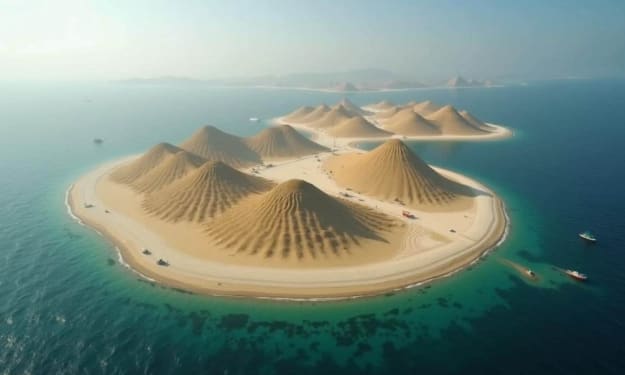
By Dumping Tonnes of Sand into the Ocean for 12 Years, China Has Created Brand New Islands from Scratch
Imagine looking out over the South China Sea and seeing islands that weren’t there a decade ago. That’s exactly what’s happening. For 12 years, China has been dredging millions of tonnes of sand from the seabed and dumping it onto shallow reefs. The result? Massive artificial islands with runways, harbors, and even radar systems — entirely built from scratch. It’s an extraordinary engineering achievement. But it’s also a deeply controversial story that touches on geopolitics, environmental damage, and international law. How Do You Build an Island From the Ocean? The process is intense, complicated, and massive in scale. Specialized ships called cutter-suction dredgers scoop up sand and crushed coral from the seabed. That slurry is pumped through pipelines onto reefs, layer by layer, until the area rises above the high-tide line. Once land starts forming, engineers reinforce it with rock and concrete to protect it from storms. Roads, runways, and harbors soon appear, along with radar and communication systems. What was once just a coral reef becomes a fully functional island capable of hosting military aircraft and ships. From a technical standpoint, it’s impressive. From an environmental and geopolitical standpoint, it’s far more complex. Why These Islands Matter The South China Sea is one of the most strategic waterways in the world. About one-third of global maritime shipping passes through here every year, and the sea is rich in oil, gas, and fish. Several countries — including Vietnam, the Philippines, Malaysia, Brunei, and Taiwan — have claims in the region. China, however, claims almost the entire South China Sea under the so-called “nine-dash line.” Artificial islands give China a physical presence in contested waters, turning submerged reefs into military and logistical hubs. Once an island has a runway or a port, it changes the balance of power. It’s no longer just sand; it’s a foothold that can influence maritime traffic, regional security, and international diplomacy. From Coral Gardens to Concrete Islands There’s a darker side to this story. These islands are built on coral reefs — ecosystems that took thousands of years to form. Dredging and dumping sand destroys these reefs almost instantly. Sediment plumes cloud the water, smothering coral and blocking sunlight. Fish nurseries vanish, and entire marine ecosystems collapse. Nearby fishing communities in countries like the Philippines and Vietnam report lower catches as fish populations decline. What was once a thriving marine environment becomes, for many species, a barren landscape. Geopolitical Tensions Artificial islands aren’t just about sand and concrete; they’re about power projection. Once they host ports, airstrips, and radar systems, they act like permanent military outposts in the middle of contested waters. Even after a 2016 international tribunal ruled that China’s expansive claims were legally invalid, Beijing continued construction. Its neighbors are responding: Vietnam has built its own artificial islands, and the U.S. conducts freedom-of-navigation operations to challenge China’s dominance. These islands are flashpoints for tension, with ships and planes moving constantly to assert influence. What began as an engineering project has become a high-stakes geopolitical chessboard. Legal Questions According to the United Nations Convention on the Law of the Sea (UNCLOS), artificial islands do not generate territorial waters or exclusive economic zones. So technically, China cannot claim surrounding seas just because it built land there. But in practice, perception matters. Once an island is equipped with infrastructure and personnel, it becomes a de facto presence that is difficult to ignore. Countries, ships, and planes start operating around it, effectively shifting influence without officially changing borders. International law is struggling to keep up with technological possibilities. Creating new land from the ocean wasn’t something lawmakers imagined when defining maritime rights. Environmental and Strategic Impacts The environmental consequences are serious: coral reefs, fish populations, and coastal ecosystems are destroyed. Yet these islands also reshape the geopolitical map. They allow China to extend its reach in the South China Sea, assert military presence, and strengthen supply chains across contested waters. This raises a broader question: how should the world balance technological innovation with environmental protection and international norms? Artificial islands like these may be an engineering triumph, but they come with costs that ripple across oceans and generations. The Takeaway China’s decade-long project to create islands from the sea is more than a feat of engineering. It’s a story about power, ambition, and the lengths nations will go to secure influence. These islands are now military bases, geopolitical tools, and environmental scars all at once. As technology advances, creating land where none existed will become easier. But the lessons of the South China Sea are clear: reshaping the earth may give a country strategic advantages, but it also disrupts ecosystems, challenges international law, and sparks regional tension. Sand and sea may seem endless, but the consequences of building on top of them will last for generations.
By Muhammad Hassan6 days ago in The Swamp
Trump Suspends Immigrant Visas for 75 Countries: Who’s Affected?
In a sweeping move, President Donald Trump’s administration has announced a pause on immigrant visa processing for citizens of 75 countries. The new policy, effective January 21, 2026, applies to family-based and employment-based green cards. It’s one of the broadest immigration actions in recent U.S. history and has raised questions worldwide about who exactly will be affected.
By Aqib Hussain6 days ago in The Swamp

Comments
There are no comments for this story
Be the first to respond and start the conversation.