
By Dumping Tonnes of Sand into the Ocean for 12 Years, China Has Created Brand New Islands from Scratch
An engineering marvel with major geopolitical, environmental, and legal consequences

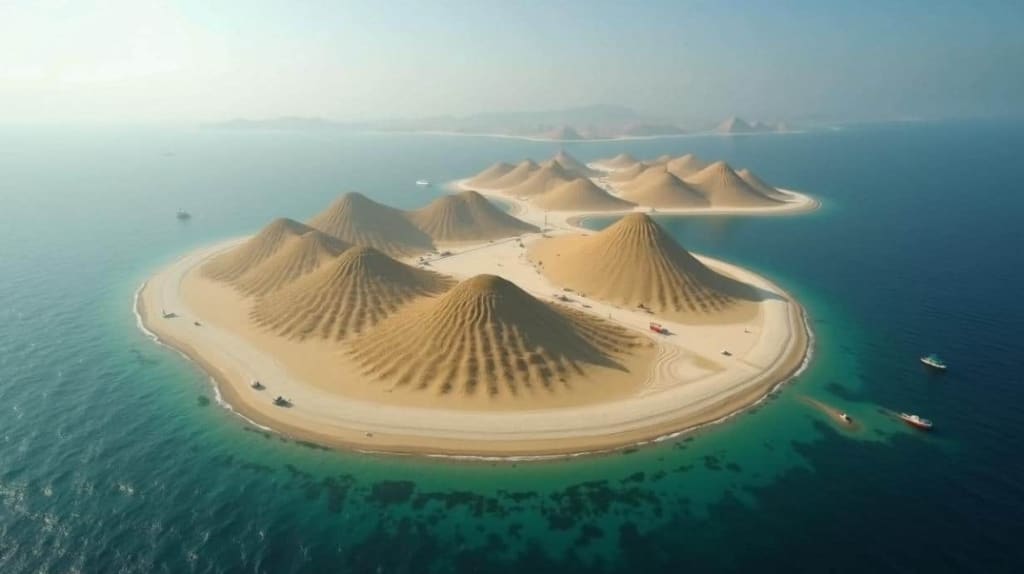
Imagine looking out over the South China Sea and seeing islands that weren’t there a decade ago. That’s exactly what’s happening. For 12 years, China has been dredging millions of tonnes of sand from the seabed and dumping it onto shallow reefs. The result? Massive artificial islands with runways, harbors, and even radar systems — entirely built from scratch.
It’s an extraordinary engineering achievement. But it’s also a deeply controversial story that touches on geopolitics, environmental damage, and international law.
How Do You Build an Island From the Ocean?
The process is intense, complicated, and massive in scale. Specialized ships called cutter-suction dredgers scoop up sand and crushed coral from the seabed. That slurry is pumped through pipelines onto reefs, layer by layer, until the area rises above the high-tide line.
Once land starts forming, engineers reinforce it with rock and concrete to protect it from storms. Roads, runways, and harbors soon appear, along with radar and communication systems. What was once just a coral reef becomes a fully functional island capable of hosting military aircraft and ships.
From a technical standpoint, it’s impressive. From an environmental and geopolitical standpoint, it’s far more complex.
Why These Islands Matter
The South China Sea is one of the most strategic waterways in the world. About one-third of global maritime shipping passes through here every year, and the sea is rich in oil, gas, and fish.
Several countries — including Vietnam, the Philippines, Malaysia, Brunei, and Taiwan — have claims in the region. China, however, claims almost the entire South China Sea under the so-called “nine-dash line.” Artificial islands give China a physical presence in contested waters, turning submerged reefs into military and logistical hubs.
Once an island has a runway or a port, it changes the balance of power. It’s no longer just sand; it’s a foothold that can influence maritime traffic, regional security, and international diplomacy.
From Coral Gardens to Concrete Islands
There’s a darker side to this story. These islands are built on coral reefs — ecosystems that took thousands of years to form. Dredging and dumping sand destroys these reefs almost instantly.
Sediment plumes cloud the water, smothering coral and blocking sunlight. Fish nurseries vanish, and entire marine ecosystems collapse. Nearby fishing communities in countries like the Philippines and Vietnam report lower catches as fish populations decline. What was once a thriving marine environment becomes, for many species, a barren landscape.
Geopolitical Tensions
Artificial islands aren’t just about sand and concrete; they’re about power projection. Once they host ports, airstrips, and radar systems, they act like permanent military outposts in the middle of contested waters.
Even after a 2016 international tribunal ruled that China’s expansive claims were legally invalid, Beijing continued construction. Its neighbors are responding: Vietnam has built its own artificial islands, and the U.S. conducts freedom-of-navigation operations to challenge China’s dominance.
These islands are flashpoints for tension, with ships and planes moving constantly to assert influence. What began as an engineering project has become a high-stakes geopolitical chessboard.
Legal Questions
According to the United Nations Convention on the Law of the Sea (UNCLOS), artificial islands do not generate territorial waters or exclusive economic zones. So technically, China cannot claim surrounding seas just because it built land there.
But in practice, perception matters. Once an island is equipped with infrastructure and personnel, it becomes a de facto presence that is difficult to ignore. Countries, ships, and planes start operating around it, effectively shifting influence without officially changing borders.
International law is struggling to keep up with technological possibilities. Creating new land from the ocean wasn’t something lawmakers imagined when defining maritime rights.
Environmental and Strategic Impacts
The environmental consequences are serious: coral reefs, fish populations, and coastal ecosystems are destroyed. Yet these islands also reshape the geopolitical map. They allow China to extend its reach in the South China Sea, assert military presence, and strengthen supply chains across contested waters.
This raises a broader question: how should the world balance technological innovation with environmental protection and international norms? Artificial islands like these may be an engineering triumph, but they come with costs that ripple across oceans and generations.
The Takeaway
China’s decade-long project to create islands from the sea is more than a feat of engineering. It’s a story about power, ambition, and the lengths nations will go to secure influence. These islands are now military bases, geopolitical tools, and environmental scars all at once.
As technology advances, creating land where none existed will become easier. But the lessons of the South China Sea are clear: reshaping the earth may give a country strategic advantages, but it also disrupts ecosystems, challenges international law, and sparks regional tension.
Sand and sea may seem endless, but the consequences of building on top of them will last for generations.
About the Creator
Muhammad Hassan
Muhammad Hassan | Content writer with 2 years of experience crafting engaging articles on world news, current affairs, and trending topics. I simplify complex stories to keep readers informed and connected.
Keep reading
More stories from Muhammad Hassan and writers in The Swamp and other communities.
Greenland and Denmark Say Trump Set on ‘Conquering’ Territory After Meeting
When you think of international disputes, Greenland might not be the first place that comes to mind. But in January 2026, this icy island became the center of an unusual geopolitical storm. Denmark and Greenland are publicly accusing U.S. President Donald Trump of being intent on “conquering” Greenland—a bold claim that has sent shockwaves across Europe, the U.S., and the Arctic. Here’s what happened, why it matters, and what it could mean for the future of global diplomacy. The Meeting That Changed Everything On January 14, 2026, Danish Foreign Minister Lars Løkke Rasmussen and Greenlandic Foreign Minister Vivian Motzfeldt visited the White House for talks with U.S. officials, including Vice President J.D. Vance and Secretary of State Marco Rubio. The goal? To ease tensions over Trump’s repeated remarks about Greenland. But the meeting didn’t go as planned. Instead of finding common ground, Rasmussen walked away warning that Trump was still “set on conquering” Greenland. That single statement has dominated international headlines and sparked concerns among NATO allies about the stability of one of the world’s most strategically important regions. Trump’s Perspective: Strategy or Obsession? Trump has made his interest in Greenland very clear. His main arguments include: Strategic location: Greenland sits at the gateway to the Arctic, making it a key military and shipping hub. Resources: The island has untapped minerals and rare earth metals essential for electronics and green tech. Security concerns: Trump claims that controlling Greenland would give the U.S. an advantage against competitors like China and Russia. He even posted publicly that anything “less than the United States acquiring Greenland is unacceptable.” Naturally, this hasn’t gone over well with Denmark, Greenland, or much of the world. Denmark and Greenland: Standing Their Ground From Copenhagen to Nuuk, the message is clear: Greenland is not for sale. Greenland, though an autonomous territory of Denmark, has its own government and people who are proud of their sovereignty. Prime Minister Jens-Frederik Nielsen made it clear: if Greenlanders had a choice today, they would choose Denmark over becoming part of the United States. Denmark has also warned that any attempt to seize Greenland would be unprecedented and could jeopardize NATO itself. European allies, including France and Germany, have pledged support to Denmark and Greenland, reinforcing their defense and sovereignty. Why Greenland Matters You might wonder why an icy island matters so much. Here’s the breakdown: Strategic location: Greenland controls key Arctic sea routes and offers proximity to North America and Europe. Natural resources: Rare earth metals and minerals found in Greenland are increasingly valuable for technology and renewable energy. Climate change: Melting ice is opening new shipping lanes, making Greenland more accessible and geopolitically important. Even with all this strategic value, Denmark and Greenland insist that cooperation with the U.S. should never come at the expense of their sovereignty. International Reactions The reaction has been almost universally critical. In the U.S., members of Congress from both parties condemned Trump’s remarks, calling them “appalling.” European leaders rallied around Denmark, offering military and diplomatic support. NATO is watching closely, aware that such rhetoric can strain alliances and create uncertainty about collective defense. Experts note that Trump’s statements have shaken the norms of how allies interact, raising questions about diplomacy, trust, and the future of international agreements. What Happens Next While no military conflict is expected, the situation highlights the tension between sovereignty and strategic interests. Currently: Denmark and Greenland are strengthening Arctic defense within NATO, rejecting any unilateral U.S. control. The U.S. and Denmark have agreed to a working group to explore cooperation on defense and security, even if disagreements persist. Greenland emphasizes democratic autonomy, standing firm against annexation. The Takeaway Greenland may be frozen, but the geopolitics surrounding it are heating up. The recent standoff shows that even allies can clash when strategic interests, resources, and political ambitions collide. For Denmark and Greenland, sovereignty is non-negotiable. For the U.S., strategic concerns are paramount. And for the world, the Greenland crisis is a reminder that in today’s interconnected era, no territory—even one covered in ice—exists in isolation. The Arctic isn’t just about icebergs and polar bears anymore; it’s a stage for diplomacy, strategy, and global power plays. And Greenland is right at the center of it.
By Muhammad Hassan5 days ago in The Swamp
It’s Not Monday, But It’s Not Friday Yet Either
There is a peculiar emotional space in the middle of the week. It’s not Monday, with its fresh starts and reluctant alarm clocks. But it’s also not Friday, with its promise of rest, release, and reward. It’s the in-between—the stretch of time where momentum exists, but excitement feels distant.
By Aarif Lashari4 days ago in The Swamp




Comments
There are no comments for this story
Be the first to respond and start the conversation.