
Storms Tear Through Tents in Gaza, Exposing Palestinians to the Elements
Winter weather turns displacement into a fight for survival
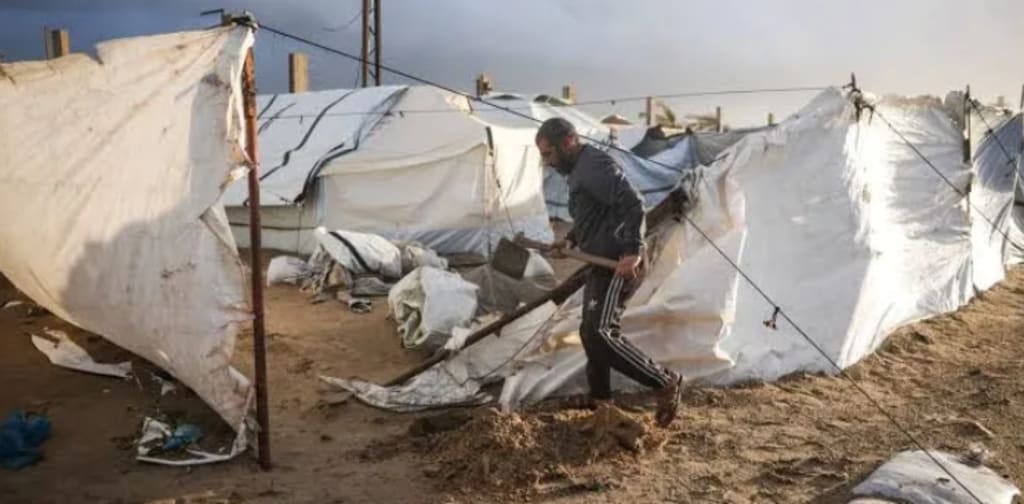
Winter storms sweeping across the Gaza Strip have transformed an already dire humanitarian crisis into a daily struggle against nature itself. Heavy rains, fierce winds, and dropping temperatures are ripping apart tents that thousands of displaced Palestinians rely on for shelter, leaving families exposed to cold, flooding, and illness.
For many, these tents are the last refuge after homes were destroyed by years of conflict. Now, even that fragile protection is failing.
When Temporary Shelters Collapse
Across Gaza, vast stretches of land are covered with makeshift camps—rows of tents built from thin tarpaulin, fabric scraps, and wooden poles. Designed for short-term use, these shelters are no match for winter storms.
Strong winds tear through campgrounds, snapping support poles and lifting tents from the ground. Rain pours in through holes and seams, soaking bedding, clothing, and food supplies. In low-lying areas, floodwater collects beneath tents, turning floors into cold pools of mud.
Families describe nights spent standing rather than sleeping, holding tent walls together to prevent them from collapsing. Others wake to find their shelter gone entirely, carried away by the wind.
Children and the Elderly Suffer the Most
The cold does not affect everyone equally. Infants, young children, and elderly Palestinians are at the greatest risk. With no heating, insulation, or dry clothing, hypothermia has become a real and deadly threat.
Reports from Gaza tell heartbreaking stories of newborns and young children falling ill after nights spent in freezing, water-logged tents. Respiratory infections are spreading rapidly as damp conditions weaken immune systems. For families already struggling with malnutrition and limited medical care, even a minor illness can become life-threatening.
Parents face impossible choices: use scarce fuel to warm children or save it for cooking food. Many have neither option.
Flooding Brings New Health Dangers
Beyond the cold, flooding poses serious health risks. Overflowing water mixes with waste in overcrowded camps, increasing the likelihood of waterborne diseases. Aid workers warn of rising cases of diarrhea, skin infections, and respiratory problems, particularly among children.
Sanitation systems in many displacement areas are either damaged or nonexistent. When stormwater floods these camps, contamination spreads quickly. With limited access to clean water and medical supplies, preventing outbreaks becomes nearly impossible.
Winter weather doesn’t just make life uncomfortable—it actively threatens survival.
A Massive Shelter Shortage
The scale of displacement in Gaza is staggering. With much of the region’s housing destroyed or damaged, hundreds of thousands of Palestinians have been forced into temporary shelters. Tents, once considered an emergency solution, have become long-term homes.
Humanitarian agencies warn that tents alone cannot withstand Gaza’s winter climate. What’s needed are winterized shelters—structures with insulation, solid flooring, and weather resistance. Yet the number of available shelters falls far short of demand.
Thousands of tents have already been destroyed or severely damaged by recent storms, leaving families with nowhere to go but open ground or overcrowded shelters shared with relatives.
Barriers to Aid Make Things Worse
One of the most critical challenges facing displaced Palestinians is limited access to humanitarian aid. Relief organizations have repeatedly called for increased entry of shelter materials, winter clothing, blankets, and heating supplies.
However, political restrictions, border closures, and logistical obstacles have significantly slowed the delivery of essential aid. Even when supplies are approved, distribution is difficult due to damaged infrastructure and ongoing insecurity.
Aid workers stress that without immediate improvements in access, winter will continue to claim lives—not because of a lack of solutions, but because of delays in delivering them.
Life Inside the Storm
Behind every statistic is a family trying to endure another night. Parents describe wrapping children in plastic sheets to keep them dry. Elderly relatives sit motionless to conserve warmth. Children learn to sleep through the sound of wind ripping at the tent walls.
Storms bring fear as much as cold. Each gust raises the question: Will the tent still be standing in the morning?
For displaced Palestinians, winter storms are not a temporary inconvenience—they are a recurring trauma layered onto an already painful reality.
Why This Crisis Demands Attention
The devastation caused by winter storms in Gaza highlights a broader truth: humanitarian crises don’t pause for weather. In fact, extreme conditions often make them deadlier.
Exposure to the elements is not inevitable. With sufficient shelter materials, fuel, medical support, and unhindered humanitarian access, many of these deaths and illnesses could be prevented.
What’s happening in Gaza is not just about rain and wind. It’s about vulnerability, displacement, and the consequences of prolonged instability.
Final Thoughts
As storms continue to batter Gaza, tents are being torn apart—and with them, the fragile sense of safety that displaced families cling to. Winter has exposed the limits of temporary solutions and the urgent need for lasting humanitarian action.
For Palestinians living in these camps, survival now depends not only on enduring conflict, but on weathering the storm—literally.
Until meaningful aid and durable shelter arrive, every rainfall is another test of resilience in a place where resilience has already been pushed to its limits.
About the Creator
Keep reading
More stories from Aqib Hussain and writers in The Swamp and other communities.
Hamas Says It Will Dissolve Its Gaza Government Upon New Palestinian Body Taking Over
For the first time since taking control of Gaza in 2007, Hamas has announced its willingness to dissolve its governing authority in the Gaza Strip—but only once a newly formed Palestinian body assumes administrative control. This announcement has sparked global attention, as it may signal a turning point in Gaza’s long-standing political and humanitarian crisis.
By Aqib Hussain2 months ago in The Swamp
The Saddest Thing - The Billionaires Who Rule America Aren't Even Enjoying Themselves
This single post says more about our ruling class than a thousand policy papers. The saddest thing about today's system is that the men robbing the rest of us - sabotaging our economic prospects, our pensions, our access to affordable healthcare - are not even happy.
By Scott Christenson🌴28 days ago in The Swamp
Oil Shipments in Persian Gulf Already Disrupted by Iran Attack
Oil markets and global shipping routes have been thrown into disarray following the recent U.S. and Israeli military strikes on Iran, with major disruptions already reported in the Persian Gulf — a region that handles a substantial share of the world’s energy exports. The attacks have sent shockwaves through global shipping, forcing oil companies and tanker operators to halt or reroute shipments, at least temporarily, raising questions about supply security and broader economic impact. Strait of Hormuz Under Strain At the centre of the disruption is the Strait of Hormuz, a narrow waterway between Iran and Oman that links the Persian Gulf to the Gulf of Oman and the open sea. It is one of the most strategically important maritime chokepoints in the world: roughly 20% of global crude oil and a similar share of liquefied natural gas (LNG) exports pass through it every day. In the aftermath of the strikes, Iranian authorities — including elements of the Islamic Revolutionary Guard Corps — reportedly broadcast radio warnings telling all vessels that no ship is allowed to pass through the strait, effectively asserting a ban on navigation through the key trade route. Although these broadcasts are not legally binding, they have dramatically raised fears among shipowners and insurers alike. Shipping Suspensions and Vessel Backups Major oil companies, global trading houses, and tanker operators have responded by suspending shipments of crude oil, refined fuels, and LNG through the Strait of Hormuz. Several vessels that were en route are now idling near ports such as Fujairah in the United Arab Emirates, with satellite tracking imagery showing congestion at key anchorage points. A top trading desk executive told Reuters that many ships are expected to remain in port for several days until the situation stabilises. Additionally, international advisories from naval and maritime security bodies — including warnings that the U.S. Navy cannot guarantee safe passage through the region — have prompted Greek, British, and Japanese ship owners to recommend avoiding the Persian Gulf, Gulf of Oman, and Hormuz until further notice. Japanese shipping companies, among others, have temporarily halted operations in the region, instructing crews to stay in safer waters as a precaution, since there are no viable alternative routes for the vast quantities of oil that typically transit the strait. Impact on Oil Markets The disruptions present significant risks to global energy markets. Because such a large share of crude and LNG shipments passes through the strait, any sustained interruption — even temporarily — has the potential to tighten supply, drive up wholesale prices and increase volatility in energy derivatives markets. Traders and analysts have already noted sharp increases in war-risk premiums for tankers operating in the region, with some insurers cancelling policies or raising costs sharply to reflect heightened risk. War-risk insurance prices in the Gulf and Hormuz corridor could increase by up to 50%, significantly raising the cost of transporting oil by sea and reflecting growing concern about the possibility of a broader conflict extending to commercial shipping. Broader Logistical and Economic Consequences Even before a potential full closure of the strait, tanker operators are making decisions that will have ripple effects on shipping schedules and supply chains. Some vessels have halted or reversed course, while others are delaying entry into the area altogether. According to tracking data, some tankers carrying crude from Gulf producers like Saudi Arabia, Iraq, and the UAE have stopped outside the Gulf of Oman rather than risk navigating a contested waterway. Experts warn that the longer these conditions persist, the more likely it is that buyers will seek alternative supply routes or sources, which could involve lengthier voyages around the southern tip of Africa or other strategic adjustments — all of which are costlier and slower. That, in turn, could put upward pressure on refined fuel and shipping costs globally. Regional Dynamics and Future Risk Why the disruption is taking place now is directly tied to the broader military confrontation involving Iran, the United States, and Israel — hostilities that have introduced new layers of risk into maritime trade. Tehran’s reprisals, warnings to shipping, and the perceived risk of escalation are collectively affecting operational decisions by energy companies and shipowners. The situation also highlights the geopolitical sensitivity of the Strait of Hormuz: any escalation that is perceived to threaten security along this narrow sea lane almost immediately resonates in oil markets and the global economy at large. Policymakers and oil market watchers are closely monitoring developments, especially as the impact of sustained disruptions could extend far beyond the region.
By Fiaz Ahmed 6 days ago in The Swamp
The Piggy Project
I’ve had so many names in this life I lose track of which ones were ever really mine and which ones I wore because someone needed me to. Some were handed to me before I had words to refuse them, before I knew what they meant, before I knew I could say no. Most weren’t meant to hurt. That doesn’t mean they didn’t leave marks. Marks that told me who I belong to, who I am by way of who claims me, recognizes me in the good and bad, who walks beside me.
By Fatal Serendipity2 days ago in Confessions



Comments
There are no comments for this story
Be the first to respond and start the conversation.