
Squished Between Chairs’ on a Train: How Some Passengers Survived a Crane Collapse
When steel met steel and panic filled the air, a handful of ordinary commuters found themselves in an extraordinary fight for survival.
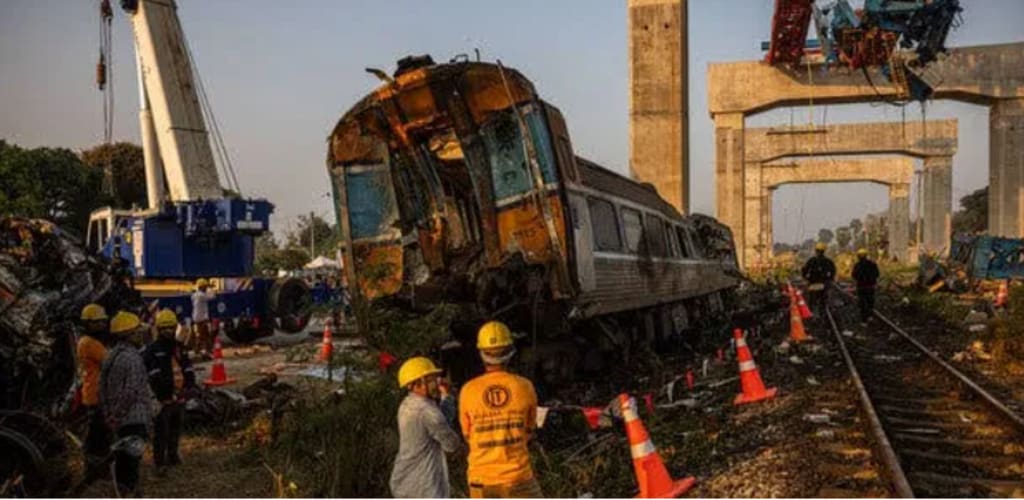
The train was supposed to be uneventful. A routine journey. Phones out, headphones in, coffee cups balanced on fold-down trays. No one on board expected that, within seconds, a normal commute would turn into a scene of chaos, fear, and raw human instinct.
Then came the sound.
Passengers later described it as a deep metallic crack, followed by a violent jolt that threw bodies forward. A construction crane near the tracks had collapsed, its massive arm crashing down onto several cars of the passing train. Windows shattered. Lights flickered. Screams echoed through the compartment.
And in the middle of it all, some passengers survived in the most unlikely way—squished between chairs.
The Moment Everything Changed
According to survivors, the collapse happened without warning. One second the train was moving at a steady pace, the next it was grinding to a halt under crushing force. The impact sent luggage flying and tossed unbelted passengers into seats, walls, and one another.
“I didn’t even have time to stand up,” one passenger recalled. “I just felt myself shoved forward, and suddenly there was no space to move.”
For several people seated in tightly packed rows, the violence of the crash forced them down and inward—wedged between rows of chairs, pinned by bent metal and the weight of collapsing structures. What sounded like a nightmare scenario became, paradoxically, a shield.
Trapped, but Alive
Emergency responders later noted that the reinforced seats and narrow spacing between rows helped absorb some of the impact. While uncomfortable and terrifying, those cramped pockets prevented passengers from being thrown across the car or crushed directly by falling debris.
“I was stuck between two seats,” said another survivor. “My chest was pressed so hard I could barely breathe, but nothing hit my head. I couldn’t move, but I was alive.”
For minutes—some say longer—it was impossible to tell how severe the damage was. Dust filled the air. The smell of metal and insulation burned the lungs. Some passengers shouted for help; others sat in stunned silence, afraid that any movement might cause more collapse.
The Psychological Toll of Waiting
Physical injuries were only part of the story. Being trapped, immobilized, and unsure whether help was coming pushed many to the brink of panic.
One commuter described counting breaths to stay calm. Another said they stared at a single crack in the ceiling, convinced it would widen and fall at any moment.
“When you’re squished like that, time stops making sense,” a survivor explained. “Every second feels like ten.”
Yet amid the fear, there were moments of humanity. Passengers who could move checked on others. A man used his phone flashlight to reassure those stuck behind him. Someone held a stranger’s hand through the gap between seats.
Rescue in Pieces
First responders arrived to a dangerous scene. The crane’s unstable remains made rescue slow and methodical. Firefighters and paramedics worked carefully, cutting through twisted metal and removing seats one section at a time.
For those trapped between chairs, extraction was delicate. Any sudden movement could worsen injuries or destabilize the car. Some passengers were freed within minutes; others waited far longer, listening to tools grind and voices shout instructions from outside.
When they were finally pulled free, many were shaking—not just from pain, but from shock.
“I didn’t realize how tense my body was until they lifted me out,” one survivor said. “I just started crying.”
Why Some Survived
Experts later explained that survival often comes down to positioning and force distribution. Being wedged between chairs, while uncomfortable, helped spread the impact across stronger parts of the train’s interior.
Seats acted like buffers. Narrow spaces limited how far bodies could be thrown. In contrast, passengers standing or walking at the moment of impact were more vulnerable to severe injury.
It was not luck alone—but a combination of design, physics, and circumstance.
Life After the Collapse
In the days following the incident, survivors struggled with more than bruises and sore muscles. Many reported difficulty sleeping, anxiety on public transportation, and flashbacks triggered by loud noises or sudden stops.
“I still ride the train,” one commuter admitted, “but I sit differently now. I notice everything.”
Some passengers have since connected with one another, bound by a shared experience no one ever wants but few can truly understand. Their stories serve as a reminder of how quickly normal life can change—and how resilience often shows up in unexpected forms.
A Narrow Space Between Life and Death
Being “squished between chairs” doesn’t sound like a miracle. It sounds like something to fear. But on that train, in that moment, those narrow gaps became lifesaving shelters.
Steel collapsed. Glass shattered. Panic surged. Yet within the wreckage, ordinary people survived—pressed tight, holding their breath, and clinging to life until help arrived.
Sometimes, survival isn’t about having room to run.
Sometimes, it’s about enduring the smallest space between disaster and hope.
About the Creator
Keep reading
More stories from Aqib Hussain and writers in The Swamp and other communities.
Time to Dump Trump? Europeans Whisper Last-Resort Options to Save Greenland
For years, the idea of the United States “buying” Greenland sounded like political theater — a headline-grabbing curiosity that few took seriously. But as global power dynamics shift and the Arctic becomes a strategic hotspot, Europe is no longer laughing. Behind closed doors in Brussels, Copenhagen, Paris, and Berlin, uncomfortable conversations are taking place. The question no one wants to say aloud — but many are thinking — is this: Is it time for Europe to distance itself from Donald Trump to save Greenland?
By Aqib Hussain2 months ago in The Swamp
The Saddest Thing - The Billionaires Who Rule America Aren't Even Enjoying Themselves
This single post says more about our ruling class than a thousand policy papers. The saddest thing about today's system is that the men robbing the rest of us - sabotaging our economic prospects, our pensions, our access to affordable healthcare - are not even happy.
By Scott Christenson🌴29 days ago in The Swamp
Russia Is Providing Iran Intelligence to Target U.S. Forces, Officials Say
Growing military cooperation between Moscow and Tehran raises fears of a wider global confrontation The geopolitical tensions surrounding the Middle East conflict have intensified after reports emerged that Russia may be providing Iran with intelligence that could help target American military forces. According to several U.S. officials familiar with classified assessments, Moscow has allegedly shared sensitive information about the locations of American military assets across the region, including warships, aircraft, and bases. � Reuters +1 If confirmed, the revelation represents a significant escalation in the evolving relationship between Russia and Iran. It also raises concerns that the conflict could expand beyond the Middle East and become entangled in the broader power struggle between major global powers. What the Intelligence Reports Claim According to officials who spoke to journalists on condition of anonymity, Russia has provided Iran with information that could help identify U.S. military positions in the Middle East. This reportedly includes data about American warships and aircraft operating in strategic locations. � Reuters Such intelligence could dramatically improve Iran’s ability to launch targeted missile or drone attacks against American forces. Analysts note that real-time or near-real-time intelligence can significantly increase the accuracy of military operations. Reports suggest that the intelligence sharing began after the latest round of hostilities between the United States and Iran intensified. In recent weeks, U.S. and allied forces have conducted large-scale strikes against Iranian military infrastructure, prompting retaliatory missile and drone attacks from Tehran. � The Economic Times While officials say the full extent of Russia’s involvement remains unclear, the intelligence exchange is seen as a sign of growing strategic alignment between the two countries. Why Russia Might Be Helping Iran Russia and Iran have developed closer military and political ties in recent years. Their partnership expanded significantly during the war in Ukraine, where Iran supplied drones and other military equipment to support Russian forces. In return, analysts believe Russia may now be offering intelligence or technical support to Tehran. Some experts view the alleged cooperation as a form of geopolitical retaliation. The United States and its allies have provided Ukraine with intelligence, weapons, and financial support to counter Russia’s invasion. From Moscow’s perspective, helping Iran challenge U.S. military operations could serve several strategic goals: Distracting Washington with another major conflict Weakening American influence in the Middle East Strengthening Russia’s alliance with Iran Additionally, Russia has long maintained diplomatic and economic ties with Iran despite Western sanctions. The two countries also signed agreements in recent years aimed at expanding defense and economic cooperation. The Potential Impact on the Conflict If Russia is indeed providing targeting intelligence, the implications could be serious. Intelligence sharing can make military strikes more precise and potentially more deadly. According to reports, the data allegedly includes coordinates or positional information about American military assets. � Wall Street Journal For U.S. forces operating in the region, this could increase the risk of attacks on ships, aircraft, and military bases. American troops are stationed in multiple Middle Eastern countries, including Iraq, Syria, and several Gulf states. Military analysts warn that such intelligence support could prolong the conflict and make it more unpredictable. It could also complicate U.S. military planning, as commanders may need to assume that Iran has access to outside intelligence sources. U.S. Response to the Allegations American officials have acknowledged the reports but emphasized that the U.S. military is aware of the situation and adjusting its strategies accordingly. Defense leaders say they are closely monitoring communications and movements involving Russia and Iran. According to U.S. officials, military planners are factoring the possibility of foreign intelligence assistance into operational decisions. At the same time, the White House has attempted to reassure the public that American forces remain capable of defending themselves and maintaining strategic dominance in the region. Still, lawmakers and analysts in Washington have raised concerns that the situation could represent a dangerous expansion of the conflict. Russia’s Position Russia has not publicly confirmed that it is sharing intelligence with Iran. Kremlin officials have largely avoided direct responses to the allegations, though they have acknowledged maintaining dialogue with Iranian leadership. Moscow has also criticized the U.S. military campaign against Iran, describing it as an act that could destabilize the region. Russian leaders have repeatedly argued that Western military interventions in the Middle East often worsen conflicts rather than resolve them. Because intelligence operations are typically classified, it may be difficult to independently verify the extent of Russia’s involvement. A Wider Geopolitical Struggle The reported intelligence sharing highlights a broader trend in global politics: the emergence of increasingly interconnected conflicts. What begins as a regional war can quickly draw in outside powers pursuing their own strategic interests. For years, Russia and the United States have competed for influence across multiple regions, from Eastern Europe to the Middle East. If Moscow is actively assisting Iran against U.S. forces, it would mark one of the most direct confrontations between the two powers in recent decades. Experts warn that the situation could escalate further if additional countries become involved. The Middle East already hosts a complex network of alliances and rivalries, making it particularly vulnerable to wider geopolitical tensions. What Happens Next? For now, many questions remain unanswered. The precise scale of Russia’s intelligence support, the methods used to share information, and the impact on Iranian military operations are still unclear. However, the reports alone have already intensified concerns about the trajectory of the conflict. If major powers continue to intervene—directly or indirectly—the risk of a broader international crisis could grow. As the situation evolves, the world will be watching closely. The decisions made in Washington, Moscow, and Tehran in the coming weeks may determine whether the conflict remains regional—or becomes something far larger.
By Jameel Jamaliabout 15 hours ago in The Swamp



Comments
There are no comments for this story
Be the first to respond and start the conversation.