
Shock and Anger in Minneapolis: Protests Erupt After Woman Killed by U.S. Immigration Agent
A fatal shooting reignites debate over law enforcement power, immigration policy, and accountability in America

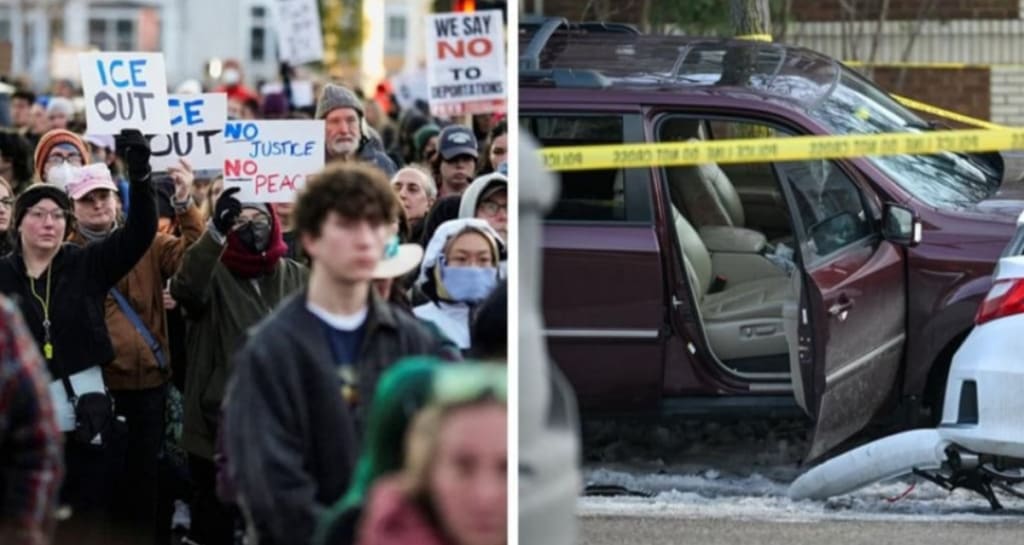
The city of Minneapolis once again found itself at the center of national attention after protests erupted following the fatal shooting of a woman by a U.S. immigration agent. Demonstrators poured into the streets demanding answers, accountability, and justice, as grief and anger spread through communities already sensitive to issues of policing and federal enforcement.
The incident has not only shaken the local community but has also reopened broader debates about the role of immigration authorities, the use of force, and the fragile trust between law enforcement and the public in the United States.
What Happened?
According to preliminary official statements, the woman was shot during an encounter involving a U.S. immigration enforcement officer. Authorities have confirmed her death but have released limited details about the circumstances, citing an ongoing investigation.
Witness accounts and early reports vary, contributing to public frustration and suspicion. What is clear, however, is that the involvement of a federal immigration agent — rather than local police — has intensified scrutiny and raised urgent questions about jurisdiction, oversight, and operational conduct.
In the hours following the shooting, news of the woman’s death spread rapidly through Minneapolis, triggering spontaneous gatherings that soon grew into organized protests.
Protests Fill the Streets
By evening, demonstrators had taken to major intersections and public spaces across Minneapolis. Protesters carried signs reading “Justice Now,” “No More Killings,” and “End Violent Enforcement,” while chanting demands for transparency and the release of body-camera footage.
Community organizers emphasized that the protests were not only about one incident but about longstanding fears surrounding immigration enforcement practices, particularly in communities of color.
While the demonstrations were largely peaceful, the emotional weight was undeniable. For many residents, the shooting reopened wounds left by previous high-profile deaths involving law enforcement in the city.
Why Immigration Enforcement Is Under the Spotlight
U.S. immigration agencies, such as Immigration and Customs Enforcement (ICE), primarily focus on civil enforcement — detentions, deportations, and investigations related to immigration status. Unlike local police departments, they often operate with less public visibility.
Critics argue that this lack of transparency creates dangerous gaps in accountability, especially when enforcement actions intersect with everyday community life.
The fatal shooting in Minneapolis has intensified concerns about:
Rules governing the use of deadly force by immigration agents
Oversight of federal officers operating within cities
Coordination — or lack thereof — between federal and local authorities
The psychological impact of aggressive enforcement on immigrant communities
Supporters of strict enforcement counter that agents face unpredictable and sometimes dangerous situations, but protesters argue that this cannot justify loss of civilian life.
A City Shaped by History
Minneapolis carries a unique historical context when it comes to police violence and public protest. The city became a global symbol of racial justice movements following the 2020 killing of George Floyd.
That history has shaped how residents respond to incidents involving law enforcement. There is deep public sensitivity, a heightened expectation of accountability, and little patience for delayed or incomplete explanations.
For many protesters, the shooting by an immigration agent felt like a continuation of a broader pattern, rather than an isolated tragedy.
Official Responses and Investigations
Federal authorities have stated that the shooting is under investigation and that standard procedures are being followed. Local officials have called for calm while acknowledging the community’s right to protest.
Civil rights groups, however, are urging an independent investigation, arguing that internal reviews alone are insufficient to restore public trust.
Elected officials at both city and state levels have demanded clarity on:
Whether the agent was acting alone or as part of a task force
What threat, if any, prompted the use of lethal force
Whether body cameras or surveillance footage exist
So far, the lack of detailed information has only fueled speculation and anger.
Immigration Policy Meets Public Safety
The incident arrives at a time when immigration policy remains one of the most divisive issues in American politics. Debates over border security, deportations, and federal enforcement powers dominate national discourse.
For immigrant communities, the presence of federal agents is often associated with fear rather than protection. Advocates argue that aggressive enforcement strategies discourage people from cooperating with authorities, even in emergencies.
The Minneapolis shooting underscores how immigration enforcement is no longer just a policy issue — it is a public safety issue with real human consequences.
Community Voices and Grief
Vigils have been held in honor of the woman who was killed, with candles, flowers, and handwritten messages lining sidewalks. Speakers at these gatherings emphasized compassion for the victim’s family and called for systemic change rather than temporary outrage.
Faith leaders, activists, and local residents have urged authorities to listen rather than react defensively.
“This isn’t just about one woman,” one protester said. “It’s about whether our lives are treated as disposable.”
What Comes Next?
As investigations continue, the future impact of the shooting remains uncertain. Protests are expected to continue until authorities provide clearer answers and demonstrate accountability.
Legal experts note that the case could influence future policy discussions about:
Limits on federal enforcement operations in cities
Mandatory body cameras for immigration agents
Stronger civilian oversight mechanisms
Whether meaningful reform follows will depend largely on transparency — and on whether officials respond to public demands with action rather than rhetoric.
Final Thoughts
The death of a woman at the hands of a U.S. immigration agent has once again forced Minneapolis — and the nation — to confront difficult questions about power, accountability, and human dignity.
In a city already shaped by protest and pain, the message from the streets is clear: justice delayed is justice denied.
As demonstrators continue to march, one truth remains unavoidable — without trust, enforcement becomes fear, and without accountability, tragedy repeats itself.
About the Creator
Muhammad Hassan
Muhammad Hassan | Content writer with 2 years of experience crafting engaging articles on world news, current affairs, and trending topics. I simplify complex stories to keep readers informed and connected.
Keep reading
More stories from Muhammad Hassan and writers in The Swamp and other communities.
“Always an Option”: Trump, Greenland, and the Return of Hard Power Politics
When a White House official suggested that the use of the U.S. military is “always an option” for President Donald Trump in any attempt to acquire Greenland, the comment sent a sharp jolt through diplomatic circles. What might once have sounded unthinkable — the idea of military leverage being linked to territorial acquisition — suddenly felt disturbingly plausible in a world where great-power competition is back in full force. The remark has reopened old wounds from Trump’s earlier interest in buying Greenland, but this time, the tone feels far more serious. It raises uncomfortable questions about sovereignty, international law, and the future of the Arctic as a zone of cooperation or confrontation. Greenland: Vast, Icy, and Strategically Priceless Greenland is not just the world’s largest island; it is one of the most strategically significant pieces of land on the planet. Located between North America and Europe, it sits astride critical Arctic shipping routes and hosts valuable rare-earth minerals, untapped natural resources, and advanced military positioning opportunities. The United States already maintains a military presence there through Thule Air Base (now known as Pituffik Space Base), a cornerstone of U.S. missile-warning and space-surveillance systems. As climate change melts Arctic ice, Greenland’s importance is only growing. In that context, Trump’s long-standing interest in Greenland reflects a broader shift in U.S. strategic thinking: the Arctic is no longer a frozen backwater — it is a geopolitical frontier. From Real Estate Logic to Military Language Trump’s fascination with Greenland first emerged publicly during his previous presidency, when he openly floated the idea of purchasing the island from Denmark. The proposal was widely mocked at the time, dismissed as a throwback to 19th-century imperialism. Denmark responded firmly, stating that Greenland is not for sale, and Greenland’s own leaders emphasized their right to self-determination. What has changed now is not the object of interest, but the language surrounding it. The suggestion that military force is “always an option” shifts the conversation from eccentric diplomacy to something far more unsettling. Even if the comment was meant rhetorically, it signals a worldview in which power precedes consent. Sovereignty and International Law at Stake Under international law, Greenland is an autonomous territory within the Kingdom of Denmark. Any attempt to acquire it without consent would violate fundamental principles of sovereignty and self-determination. The idea that a U.S. president could even theoretically consider military force for territorial acquisition alarms allies and adversaries alike. It undermines decades of post-World War II norms designed to prevent exactly this kind of behavior. For smaller nations, such statements are especially worrying. If powerful states openly suggest that military options remain on the table, it weakens the entire framework of international law that protects less powerful actors. What This Means for U.S.–Europe Relations Denmark is a NATO ally. So is the United States. The mere suggestion of coercive action against allied territory strains the credibility of NATO’s foundational promise: collective defense based on mutual trust. European leaders have already expressed discomfort with Trump’s revived rhetoric. For them, Greenland is not a bargaining chip, but a matter of legal ownership, democratic governance, and regional stability. If alliances are built on shared values, comments like these test whether those values still hold. The Arctic as the New Great-Power Chessboard Behind the controversy lies a larger reality: the Arctic is becoming a key arena in global competition. Russia has expanded its Arctic military infrastructure. China has declared itself a “near-Arctic state” and invested heavily in polar research and infrastructure. The U.S., wary of falling behind, is recalibrating its Arctic strategy. In this environment, Greenland looks less like a distant island and more like a strategic keystone. The danger is that competition may slide into confrontation, especially if leaders frame geopolitical interests in zero-sum terms. Domestic Politics and Trump’s Leadership Style Trump’s leadership has always emphasized strength, leverage, and unpredictability. Supporters argue that such rhetoric projects deterrence and keeps rivals guessing. Critics counter that it erodes trust and escalates tensions unnecessarily. The White House official’s remark fits this pattern. Whether meant as a serious policy position or a maximalist negotiating posture, it reflects a governing philosophy that views military power as a legitimate tool in almost any context. For Trump’s base, this reinforces the image of a president unwilling to be constrained by diplomatic niceties. For others, it raises fears of recklessness. Greenland’s Voice Often Overlooked Lost in much of the debate is the perspective of Greenlanders themselves. Greenland has been steadily increasing its autonomy and discussing eventual independence. Its population has repeatedly made clear that their future should be decided in Nuuk, not Washington or Copenhagen. Any conversation about acquiring Greenland that ignores its people risks repeating the very colonial logic that modern international norms were meant to dismantle. A Dangerous Signal to the World Perhaps the most significant impact of the statement is symbolic. When a superpower publicly suggests that military force remains an option for territorial gain, it sends a message far beyond Greenland. It tells the world that rules are flexible, norms are negotiable, and power still speaks loudest. In an era already marked by war, territorial disputes, and eroding trust, that message is profoundly destabilizing. Final Thoughts The idea that the U.S. military could be used to acquire Greenland may never move beyond rhetoric. But rhetoric matters — especially when it comes from the White House. Greenland is not just ice and rock; it is a test case for whether the 21st century will be governed by cooperation or coercion. As global tensions rise and the Arctic heats up — politically and environmentally — how leaders speak about power may shape the future as much as how they use it. In a world struggling to hold onto shared rules, even the suggestion that force is “always an option” carries consequences far beyond one island.
By Muhammad Hassan2 days ago in The Swamp
Ukraine calls on allies to raise pressure as Russia fires Oreshnik missile
As the war in Ukraine grinds on with no clear end in sight, Kyiv is urging its international partners to significantly intensify pressure on Moscow following Russia’s reported use of the Oreshnik missile, a weapon Ukrainian officials describe as both symbolically and strategically alarming. The latest strike underscores the evolving nature of the conflict, where military escalation is increasingly paired with diplomatic messaging aimed at shaping global opinion. A Missile With a Message Ukrainian authorities say the Oreshnik missile was launched during a recent wave of Russian attacks targeting infrastructure and military positions. While details about the missile remain limited, analysts believe Oreshnik represents a newer or modified system designed to test Ukrainian air defenses and signal Russia’s ability to adapt despite sanctions and battlefield losses. For Kyiv, the missile’s use is not just another attack—it is a deliberate escalation meant to demonstrate resilience and intimidate both Ukraine and its allies. Ukrainian defense officials argue that Moscow is using advanced or unfamiliar weaponry to pressure Western governments into slowing or limiting military aid. “This is not just about destruction,” a senior Ukrainian official said in a briefing. “It is about sending a message that Russia believes it can outlast international resolve.” Ukraine’s Call for Stronger Action In response, Ukraine has renewed its appeal to allies across Europe and North America to increase military, economic, and diplomatic pressure on the Kremlin. Officials argue that incremental support is no longer enough as Russia adapts its tactics and continues to mobilize resources for a prolonged conflict. Kyiv is specifically asking for: Faster delivery of advanced air defense systems Longer-range weapons to deter missile launches Tighter enforcement of sanctions Stronger action against countries and entities helping Russia bypass restrictions Ukrainian leaders stress that every delay in assistance increases the human and economic cost of the war, not just for Ukraine but for regional stability as a whole. What Is the Oreshnik Missile? Although Russia has not released full technical details, defense experts suggest the Oreshnik missile may be designed for precision strikes with enhanced maneuverability, making interception more difficult. Whether entirely new or an upgraded variant of existing systems, its reported use highlights Russia’s ongoing investment in missile technology despite years of international sanctions. Military analysts caution that even limited deployment of such weapons can force Ukraine to expend valuable air defense resources, creating vulnerabilities elsewhere. This, they argue, is part of a broader strategy to stretch Ukrainian defenses thin while testing Western commitment. A Test of Western Unity The missile strike comes at a sensitive time for Ukraine’s allies. Political divisions, election cycles, and economic pressures have complicated long-term support commitments. Ukraine fears that Russia is deliberately escalating at moments when Western unity appears fragile. European leaders have condemned the attack, reiterating support for Ukraine’s sovereignty. However, debates continue behind closed doors about how far military assistance should go, particularly regarding weapons capable of striking deep into Russian territory. For Kyiv, the concern is clear: hesitation sends the wrong signal. Ukrainian officials warn that failing to respond decisively now could encourage further escalation not just in Ukraine, but in other regions where authoritarian states may test international resolve. The Human Cost Behind the Headlines Beyond strategic calculations, the missile strike has once again disrupted civilian life. Power outages, damaged infrastructure, and psychological trauma remain daily realities for millions of Ukrainians. Each new weapon introduced into the conflict deepens fears among civilians who have endured years of air raid sirens and uncertainty. Human rights groups continue to document the impact of missile attacks on non-military targets, calling for accountability and renewed diplomatic efforts to protect civilians. What Comes Next? As Ukraine pushes for stronger action, the coming weeks may prove pivotal. Decisions made by NATO members and key partners could shape the next phase of the conflict—either deterring further escalation or emboldening Moscow to press ahead. For Ukraine, the message is urgent and unambiguous: the war is evolving, and so must the response. The use of the Oreshnik missile is being framed not as an isolated incident, but as a warning of what continued inaction could invite. In a conflict increasingly defined by endurance as much as firepower, Ukraine is betting that renewed international pressure can still alter the trajectory of the war—before escalation becomes the new normal.
By Fiaz Ahmed a day ago in The Swamp


Comments
There are no comments for this story
Be the first to respond and start the conversation.