
“Always an Option”: Trump, Greenland, and the Return of Hard Power Politics
Why a White House remark about military force has reignited global debate over sovereignty, security, and America’s role in the Arctic


When a White House official suggested that the use of the U.S. military is “always an option” for President Donald Trump in any attempt to acquire Greenland, the comment sent a sharp jolt through diplomatic circles. What might once have sounded unthinkable — the idea of military leverage being linked to territorial acquisition — suddenly felt disturbingly plausible in a world where great-power competition is back in full force.
The remark has reopened old wounds from Trump’s earlier interest in buying Greenland, but this time, the tone feels far more serious. It raises uncomfortable questions about sovereignty, international law, and the future of the Arctic as a zone of cooperation or confrontation.
Greenland: Vast, Icy, and Strategically Priceless
Greenland is not just the world’s largest island; it is one of the most strategically significant pieces of land on the planet. Located between North America and Europe, it sits astride critical Arctic shipping routes and hosts valuable rare-earth minerals, untapped natural resources, and advanced military positioning opportunities.
The United States already maintains a military presence there through Thule Air Base (now known as Pituffik Space Base), a cornerstone of U.S. missile-warning and space-surveillance systems. As climate change melts Arctic ice, Greenland’s importance is only growing.
In that context, Trump’s long-standing interest in Greenland reflects a broader shift in U.S. strategic thinking: the Arctic is no longer a frozen backwater — it is a geopolitical frontier.
From Real Estate Logic to Military Language
Trump’s fascination with Greenland first emerged publicly during his previous presidency, when he openly floated the idea of purchasing the island from Denmark. The proposal was widely mocked at the time, dismissed as a throwback to 19th-century imperialism.
Denmark responded firmly, stating that Greenland is not for sale, and Greenland’s own leaders emphasized their right to self-determination.
What has changed now is not the object of interest, but the language surrounding it. The suggestion that military force is “always an option” shifts the conversation from eccentric diplomacy to something far more unsettling.
Even if the comment was meant rhetorically, it signals a worldview in which power precedes consent.
Sovereignty and International Law at Stake
Under international law, Greenland is an autonomous territory within the Kingdom of Denmark. Any attempt to acquire it without consent would violate fundamental principles of sovereignty and self-determination.
The idea that a U.S. president could even theoretically consider military force for territorial acquisition alarms allies and adversaries alike. It undermines decades of post-World War II norms designed to prevent exactly this kind of behavior.
For smaller nations, such statements are especially worrying. If powerful states openly suggest that military options remain on the table, it weakens the entire framework of international law that protects less powerful actors.
What This Means for U.S.–Europe Relations
Denmark is a NATO ally. So is the United States. The mere suggestion of coercive action against allied territory strains the credibility of NATO’s foundational promise: collective defense based on mutual trust.
European leaders have already expressed discomfort with Trump’s revived rhetoric. For them, Greenland is not a bargaining chip, but a matter of legal ownership, democratic governance, and regional stability.
If alliances are built on shared values, comments like these test whether those values still hold.
The Arctic as the New Great-Power Chessboard
Behind the controversy lies a larger reality: the Arctic is becoming a key arena in global competition.
Russia has expanded its Arctic military infrastructure. China has declared itself a “near-Arctic state” and invested heavily in polar research and infrastructure. The U.S., wary of falling behind, is recalibrating its Arctic strategy.
In this environment, Greenland looks less like a distant island and more like a strategic keystone. The danger is that competition may slide into confrontation, especially if leaders frame geopolitical interests in zero-sum terms.
Domestic Politics and Trump’s Leadership Style
Trump’s leadership has always emphasized strength, leverage, and unpredictability. Supporters argue that such rhetoric projects deterrence and keeps rivals guessing. Critics counter that it erodes trust and escalates tensions unnecessarily.
The White House official’s remark fits this pattern. Whether meant as a serious policy position or a maximalist negotiating posture, it reflects a governing philosophy that views military power as a legitimate tool in almost any context.
For Trump’s base, this reinforces the image of a president unwilling to be constrained by diplomatic niceties. For others, it raises fears of recklessness.
Greenland’s Voice Often Overlooked
Lost in much of the debate is the perspective of Greenlanders themselves.
Greenland has been steadily increasing its autonomy and discussing eventual independence. Its population has repeatedly made clear that their future should be decided in Nuuk, not Washington or Copenhagen.
Any conversation about acquiring Greenland that ignores its people risks repeating the very colonial logic that modern international norms were meant to dismantle.
A Dangerous Signal to the World
Perhaps the most significant impact of the statement is symbolic.
When a superpower publicly suggests that military force remains an option for territorial gain, it sends a message far beyond Greenland. It tells the world that rules are flexible, norms are negotiable, and power still speaks loudest.
In an era already marked by war, territorial disputes, and eroding trust, that message is profoundly destabilizing.
Final Thoughts
The idea that the U.S. military could be used to acquire Greenland may never move beyond rhetoric. But rhetoric matters — especially when it comes from the White House.
Greenland is not just ice and rock; it is a test case for whether the 21st century will be governed by cooperation or coercion. As global tensions rise and the Arctic heats up — politically and environmentally — how leaders speak about power may shape the future as much as how they use it.
In a world struggling to hold onto shared rules, even the suggestion that force is “always an option” carries consequences far beyond one island.
About the Creator
Muhammad Hassan
Muhammad Hassan | Content writer with 2 years of experience crafting engaging articles on world news, current affairs, and trending topics. I simplify complex stories to keep readers informed and connected.
Keep reading
More stories from Muhammad Hassan and writers in The Swamp and other communities.
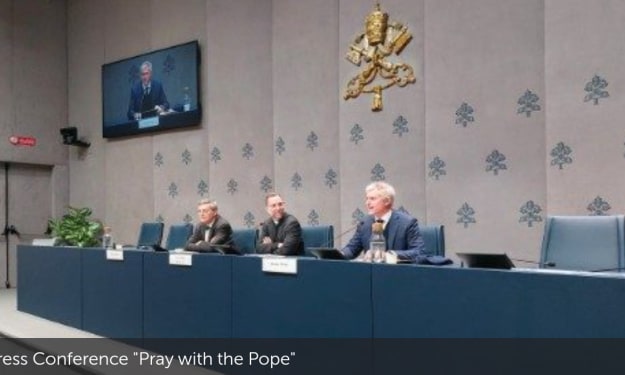
“Pray With the Pope”: A Living Network of Communion in a Divided World
In a world increasingly shaped by conflict, polarisation, and digital noise, the simple invitation to pray together may seem almost radical. Yet that is precisely what “Pray with the Pope” represents — a global initiative that has grown into a real network of spiritual communion, uniting millions of people across continents in moments of shared reflection, hope, and intention. At a time when societies feel fragmented and trust in institutions is eroding, this movement offers something profoundly countercultural: silence instead of shouting, unity instead of division, and prayer instead of performance. What Does “Pray With the Pope” Mean? “Pray with the Pope” is not a slogan or a marketing campaign. It is an open invitation issued through the Pope’s Worldwide Prayer Network, encouraging people to join the Pope each month in prayer for specific global intentions — ranging from peace and justice to climate responsibility, migration, families, and the dignity of human life. These intentions are shared publicly, often accompanied by short reflections or videos, but the heart of the movement lies elsewhere: in private homes, churches, hospital rooms, classrooms, refugee camps, and quiet corners where individuals pause to pray at the same time, for the same purpose. This shared rhythm transforms prayer into a collective act of solidarity. A Network Without Borders Unlike traditional institutions, this network has no headquarters filled with people checking attendance or enforcing participation. Its strength lies in its invisibility. Participants come from every continent. Some are lifelong Catholics, others are new to faith, and many do not even belong formally to the Church. What connects them is not ideology but intention — the desire to lift the world’s wounds into a space of hope. In a divided world marked by war, political polarisation, and social fragmentation, “Pray with the Pope” functions as a quiet counter-network — one that refuses to mirror the world’s fractures. Prayer as a Response to Global Division Pope Francis has consistently framed prayer not as an escape from reality, but as a way of entering more deeply into it. His monthly intentions often focus on the most painful issues of our time: armed conflict, poverty, environmental degradation, loneliness, and the suffering of migrants. Critics sometimes dismiss prayer as passive. But for participants, praying together becomes an act of moral attention — a refusal to look away. In this sense, the movement challenges the idea that change only happens through loud action. It suggests that interior transformation is also a force — one capable of shaping compassion, responsibility, and long-term commitment. Digital Faith in a Disconnected Age Ironically, the network thrives through digital tools. Social media, mobile apps, and online videos allow people separated by oceans and cultures to feel part of a shared moment. Yet unlike most online spaces, this one does not thrive on outrage or instant reaction. Instead, it invites slowness. A person in Manila may pray at sunrise, while someone in São Paulo joins hours later. The time zones differ, but the intention remains the same. In a culture of constant updates, this rhythm introduces a sense of sacred continuity. Beyond Religion: A Human Language Although rooted in Catholic tradition, “Pray with the Pope” speaks a language that goes beyond doctrine. Its themes — peace, care for the Earth, dignity, reconciliation — resonate with universal human concerns. This inclusiveness matters. In a world where religion is often portrayed as a source of division, this initiative demonstrates another possibility: faith as a bridge rather than a boundary. Many participants describe feeling connected not only to God, but to one another — even to people they will never meet. Communion in a Time of Crisis The concept of “communion” has deep theological roots, but here it takes on a modern meaning. Communion is not uniformity. It does not require agreement on everything. It means choosing connection despite difference. As wars continue, climate anxiety grows, and social trust weakens, the idea of a spiritual network committed to shared concern becomes increasingly relevant. “Pray with the Pope” does not promise quick solutions. Instead, it cultivates something slower and arguably more durable: empathy. A Quiet Form of Resistance In a world driven by speed, productivity, and visible results, taking time to pray can feel almost rebellious. This movement resists the pressure to constantly react. It resists the idea that only those with power or platforms matter. It reminds participants that even unseen acts — when multiplied — can shape the moral climate of the world. In that sense, “Pray with the Pope” is not just spiritual. It is deeply human. Why It Matters Today The world does not lack opinions. It lacks listening. It does not lack information. It lacks wisdom. By inviting people into shared silence and intention, this global prayer network offers a different way of being present to the world’s pain — one that neither denies reality nor becomes consumed by it. In a divided world, communion itself becomes a message. Final Reflection “Pray with the Pope” reminds us that unity does not always arrive through agreement, and change does not always begin with noise. Sometimes, it begins with millions of ordinary people pausing — wherever they are — to hold the same fragile hope. In that shared pause, a divided world finds a moment of communion.
By Muhammad Hassan3 days ago in The Swamp
Mette Frederiksen: Greenland isn't Yours!
Trump has always been obsessed with Greenland. During his first term, he mentioned it then. Now, in his second coming, President Trump stated the US needs Greenland for defence. Mentioning Russian and Chinese ships that pass that way. Of course, one has to take into account the minerals that lie under the snow that covers Greenland. So is Trump's interest merely for defence or business or both? The irony of it is that Greenland already has a US military base there with the permission of Denmark.
By Nicholas Bishop5 days ago in The Swamp
'20/20'
"Do It Again" the track that would ultimately open the Beach Boys final album on Capitol Records which was released on February 10th 1969 had originally been released as a single in August of 1968. The track was the first of many post-Pet Sounds era throwbacks to the early Beach Boys sound which would become continually more cliched and eventually lead the Beach Boys to the level of self-parody they would eventually succumb to in the 1980s while their closest contemporaries The Beatles nearing the end of their run in 1969 would go on to be viewed as the most influential band of all time. However, the song itself is not bad on its surface, and it opens with a futuristic sounding (for 1969) drumbeat captured by then-Beach Boys engineer Stephen Desper using tape delays on the drums performed by Dennis Wilson and John Guerin. The song has been re-recorded numerous times over the years on various Beach Boys-related projects most notably the 2011 re-recording at Capitol studios featuring the five surviving Beach Boys at the time backed instrumentally by various members of both the Brian Wilson Band and Mike Loves touring "Beach Boys" to promote the then upcoming Beach Boys 50th Anniversary reunion tour in 2012. The hammering and power drill sound at the end of the song was an excerpt from a track called "Workshop" that was to be a part of the uncompleted "SMiLE" album.
By Sean Callaghan5 days ago in Beat


Comments
There are no comments for this story
Be the first to respond and start the conversation.