
Secrets of the Swamp: Nature's Hidden Paradise
Discover the vibrant life, beauty, and mystery thriving in one of Earth’s most misunderstood ecosystems
Secrets of the Swamp: Nature’s Hidden Paradise
Most people pass by swamps with little more than a glance, often imagining them as dark, muddy, mosquito-filled wastelands. But step into the heart of a healthy wetland, and a whole new world unfolds—one that hums, buzzes, and blooms with more life than you might ever expect.
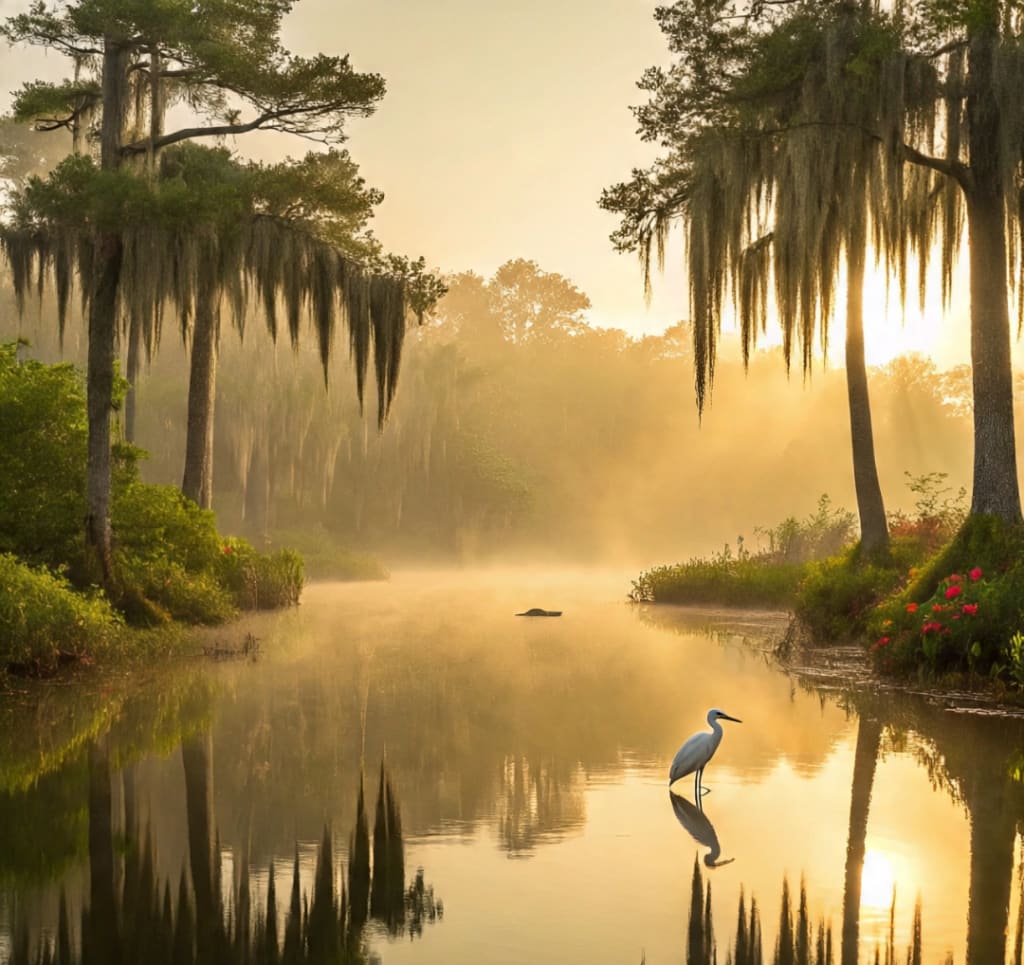
It was just after dawn when I first set foot into Cypress Hollow Swamp, a protected wetland in the southeastern United States. The air was thick with the earthy scent of damp leaves and still water. Spanish moss draped over towering cypress trees like silver lace, swaying gently in the morning breeze. Mist curled along the water’s surface, glowing golden in the rising sun. It was quiet—but not silent. A symphony of birds, frogs, and insects welcomed the day.
Our guide, a local naturalist named Carla, motioned for us to pause. “This swamp,” she said softly, “is more than meets the eye. It’s a water purifier, a nursery for wildlife, and one of the richest ecosystems on Earth.”
She wasn’t exaggerating.
As we continued on the boardwalk trail, we spotted life at every turn. A bright green tree frog clung to the bark of a cypress trunk. Dragonflies darted over the water like living jewels, their wings shimmering with every color of the rainbow. A white egret stood poised like a statue, one leg lifted, waiting for just the right moment to strike at an unsuspecting fish.
“Swamps filter water naturally,” Carla explained. “All those plants—reeds, grasses, trees—trap pollutants and sediments. By the time water passes through, it’s much cleaner. Nature’s own filtration system.”
What struck me most wasn’t just the abundance of life, but the balance of it. Alligators basked lazily on logs, turtles sunned beside them, and songbirds darted overhead. It was wild and untamed, yet harmonious. Swamps like this one are home to hundreds of species, from tiny insects to large mammals, each playing its role in the web of life.
But swamps aren’t just biological wonderlands—they’re also buffers against climate change and natural disasters. Carla pointed out that during heavy rains and hurricanes, swamps act like giant sponges, soaking up excess water and preventing floods downstream.
“They’re protectors,” she said. “But they’re often misunderstood and undervalued.”
Historically, swamps were drained for farmland or development, seen as useless or dangerous. Over the last century, nearly half of the world’s wetlands have disappeared. But attitudes are beginning to shift. People are recognizing the value of preserving these unique environments—not just for the animals, but for ourselves.
As the sun rose higher, the swamp seemed to come alive even more. We watched a group of otters playing in a shaded pool, tumbling and splashing with infectious energy. Nearby, a pileated woodpecker hammered at a dead tree, searching for insects. Everywhere I looked, there was motion, color, and purpose.
One of the most surprising moments came when we reached a quieter section of the swamp. A gentle ripple in the water caught our eye. Carla hushed us and pointed. Just beneath the surface, the snout of an alligator glided by, smooth as silk. It was close—closer than I expected—but not threatening. It reminded me that the swamp is not ours. We’re guests here.
As our walk came to an end, I found myself reluctant to leave. The swamp had cast its spell: a place once dismissed in my mind as murky and monotonous had revealed itself to be vibrant, essential, and breathtakingly beautiful.
“Most people think of swamps as dead zones,” Carla said, “but they’re the opposite. They’re full of life, full of stories. You just have to slow down and look.”
She was right. Swamps aren’t places to rush through or avoid—they’re places to explore, to respect, and most of all, to protect.
---
Author’s Note:
Next time you see a swamp on a map or in a nature documentary, don’t dismiss it. Think of the ancient cypress trees, the chorus of frogs at dusk, the elegant dance of egrets above still waters. Think of nature’s filters, nurseries, and climate defenders. Swamps are more than mud and mystery—they’re miracles in slow motion.
About the Creator
Keep reading
More stories from Muhammad Saad and writers in The Swamp and other communities.
Secrets of the Swamp: Nature’s Hidden Wonder
Most people think of swamps as eerie, murky places teeming with bugs and danger. But beneath the surface of this misunderstood reputation lies one of the most vital and vibrant ecosystems on Earth. Swamps, with their tangled roots and still waters, are not just wild and mysterious—they are also rich with life, deeply complex, and essential to the health of our planet. At dawn, a swamp begins to stir. Mist clings to the surface of the water like a delicate veil. The air is thick and fragrant with the scent of wet earth and vegetation. Towering cypress trees rise from the water, their trunks gnarled and ancient, draped in soft tendrils of Spanish moss. A great blue heron glides silently across the sky, scanning the shallow waters below for its breakfast. Frogs croak from unseen perches, and dragonflies dance like tiny helicopters over the surface. To the trained eye, the swamp is a masterpiece of balance. Everything has its role. The trees, especially cypress and mangrove in coastal swamps, are expert survivors, adapted to grow in wet, oxygen-poor soils. Their roots form natural dams and barriers, helping to filter water, prevent erosion, and shield inland areas from storms and floods. In fact, swamps often act as buffers during hurricanes, absorbing excess water like natural sponges. Below the surface, the mud is alive. Decaying leaves and organic matter feed an intricate web of microorganisms that, in turn, support fish, amphibians, and insects. Small creatures feed larger ones—turtles, birds, otters, and even alligators—all part of a food chain that’s as ancient as the land itself. One of the most overlooked aspects of the swamp is its role in fighting climate change. Swamps are carbon sinks. The vegetation stores massive amounts of carbon dioxide, which would otherwise be released into the atmosphere. Peat swamps, in particular, can store more carbon per acre than forests. Destroying them not only eliminates this storage capacity—it also unleashes stored greenhouse gases. Yet, for all their ecological importance, swamps are often drained, filled in, or paved over. For centuries, they were seen as useless land—wastelands to be conquered or converted for farming and development. In the United States alone, over half of the original wetlands have disappeared. This loss has had devastating effects: increased flooding, habitat destruction, water pollution, and reduced biodiversity. But hope is not lost. Around the world, communities and scientists are beginning to recognize the value of wetlands, including swamps. Conservation efforts are underway to protect remaining swamps, restore those that have been damaged, and educate the public about their importance. In Louisiana’s Atchafalaya Basin, the largest swamp in the U.S., conservation groups are working to maintain the health of the wetlands through reforestation, levee management, and education. In the Florida Everglades—a vast subtropical wetland system—massive restoration projects aim to return natural water flow and bring back native species. Globally, nations are committing to wetland conservation through agreements like the Ramsar Convention, which protects over 2,000 wetland sites worldwide. Beyond their environmental role, swamps hold cultural and historical significance. Indigenous peoples lived in and around swamps for thousands of years, learning to navigate and thrive in these rich environments. Stories, legends, and folklore often grew from these mysterious landscapes—swamps became the setting for tales of lost civilizations, mythical creatures, and spiritual journeys. Even today, swamps continue to inspire awe and wonder. For nature lovers, they offer unparalleled opportunities for birdwatching, kayaking, and photography. For scientists, they’re living laboratories of adaptation, resilience, and biodiversity. And for all of us, swamps offer a quiet reminder: that sometimes, the most extraordinary places are the ones we’ve been taught to overlook. So the next time you hear the word "swamp," don’t picture something dark and dangerous. Instead, imagine a place where life thrives in slow-moving silence. Picture the reflection of trees in glassy water, the flash of a turtle slipping beneath the surface, or the echo of a heron’s call in the early morning light. Picture a world full of secrets and stories, waiting to be discovered. Because in the heart of the swamp, beauty and balance endure—and the more we learn, the more we realize how much we need them.
By Muhammad Saad 7 months ago in The Swamp
The Forsyth House Fire
Since 1851, Forsyth House has stood on the corner of Union Street and Gordon Street in the heart of Glasgow. Its iconic, or was... because on Sunday 8th of March, 2026, a fire broke out in a small, seemingly un-named shop in the building and tore all that history down. As I write, the rubble is still unsettled and the street is still blocked off. Central Station is quiet on the upper level, and around 30 small businesses have quite literally gone up in smoke.
By S. A. Crawford3 days ago in The Swamp
600 Israelis arrive home on two flydubai flights that land in Tel Aviv
Around 600 Israeli citizens returned home on Sunday after two special flights operated by the airline Flydubai landed at Ben Gurion Airport near Tel Aviv. The flights marked one of the first organized efforts to repatriate Israelis who had been stranded abroad following disruptions caused by the escalating conflict in the Middle East.
By Fiaz Ahmed 7 days ago in The Swamp


Comments
There are no comments for this story
Be the first to respond and start the conversation.