
Secrets of the Swamp: Nature’s Hidden Wonder
Uncovering the Beauty, Balance, and Vital Role of One of Earth’s Most Misunderstood Ecosystems
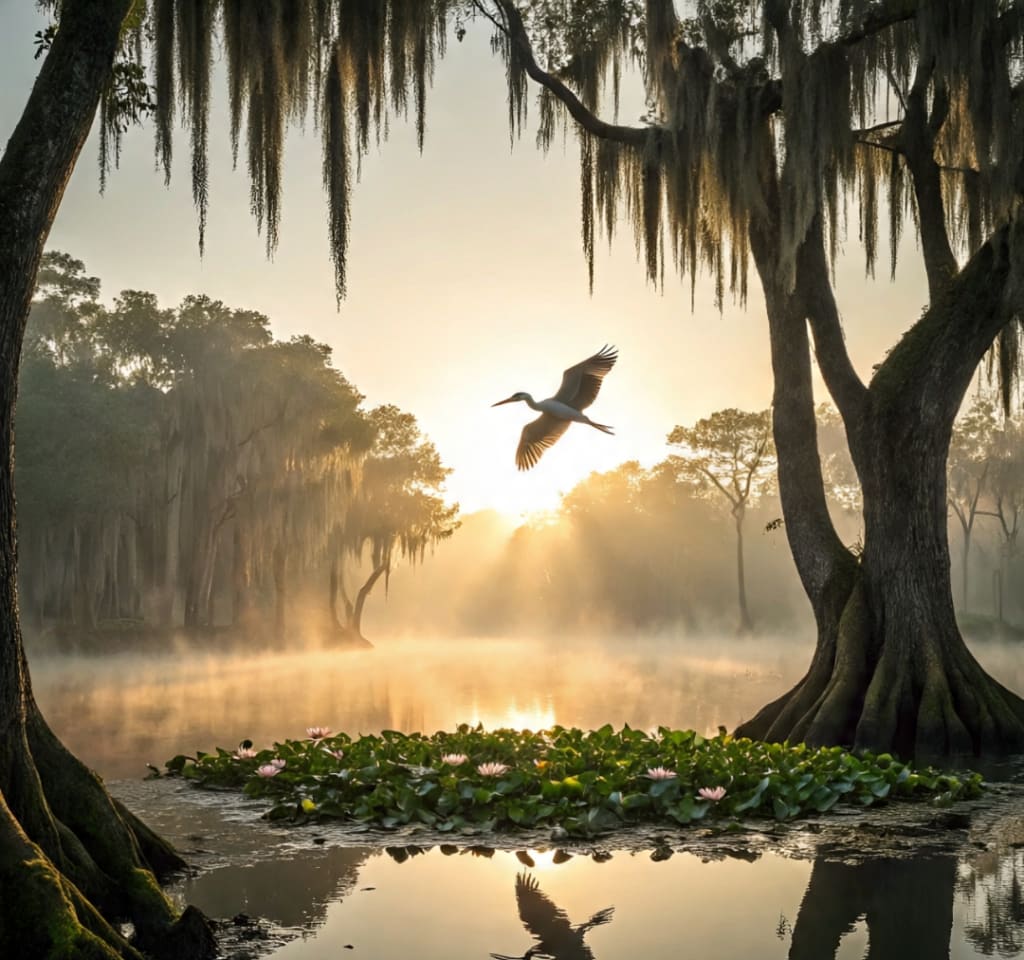
Most people think of swamps as eerie, murky places teeming with bugs and danger. But beneath the surface of this misunderstood reputation lies one of the most vital and vibrant ecosystems on Earth. Swamps, with their tangled roots and still waters, are not just wild and mysterious—they are also rich with life, deeply complex, and essential to the health of our planet.
At dawn, a swamp begins to stir. Mist clings to the surface of the water like a delicate veil. The air is thick and fragrant with the scent of wet earth and vegetation. Towering cypress trees rise from the water, their trunks gnarled and ancient, draped in soft tendrils of Spanish moss. A great blue heron glides silently across the sky, scanning the shallow waters below for its breakfast. Frogs croak from unseen perches, and dragonflies dance like tiny helicopters over the surface.
To the trained eye, the swamp is a masterpiece of balance. Everything has its role. The trees, especially cypress and mangrove in coastal swamps, are expert survivors, adapted to grow in wet, oxygen-poor soils. Their roots form natural dams and barriers, helping to filter water, prevent erosion, and shield inland areas from storms and floods. In fact, swamps often act as buffers during hurricanes, absorbing excess water like natural sponges.
Below the surface, the mud is alive. Decaying leaves and organic matter feed an intricate web of microorganisms that, in turn, support fish, amphibians, and insects. Small creatures feed larger ones—turtles, birds, otters, and even alligators—all part of a food chain that’s as ancient as the land itself.
One of the most overlooked aspects of the swamp is its role in fighting climate change. Swamps are carbon sinks. The vegetation stores massive amounts of carbon dioxide, which would otherwise be released into the atmosphere. Peat swamps, in particular, can store more carbon per acre than forests. Destroying them not only eliminates this storage capacity—it also unleashes stored greenhouse gases.
Yet, for all their ecological importance, swamps are often drained, filled in, or paved over. For centuries, they were seen as useless land—wastelands to be conquered or converted for farming and development. In the United States alone, over half of the original wetlands have disappeared. This loss has had devastating effects: increased flooding, habitat destruction, water pollution, and reduced biodiversity.
But hope is not lost. Around the world, communities and scientists are beginning to recognize the value of wetlands, including swamps. Conservation efforts are underway to protect remaining swamps, restore those that have been damaged, and educate the public about their importance.
In Louisiana’s Atchafalaya Basin, the largest swamp in the U.S., conservation groups are working to maintain the health of the wetlands through reforestation, levee management, and education. In the Florida Everglades—a vast subtropical wetland system—massive restoration projects aim to return natural water flow and bring back native species. Globally, nations are committing to wetland conservation through agreements like the Ramsar Convention, which protects over 2,000 wetland sites worldwide.
Beyond their environmental role, swamps hold cultural and historical significance. Indigenous peoples lived in and around swamps for thousands of years, learning to navigate and thrive in these rich environments. Stories, legends, and folklore often grew from these mysterious landscapes—swamps became the setting for tales of lost civilizations, mythical creatures, and spiritual journeys.
Even today, swamps continue to inspire awe and wonder. For nature lovers, they offer unparalleled opportunities for birdwatching, kayaking, and photography. For scientists, they’re living laboratories of adaptation, resilience, and biodiversity.
And for all of us, swamps offer a quiet reminder: that sometimes, the most extraordinary places are the ones we’ve been taught to overlook.
So the next time you hear the word "swamp," don’t picture something dark and dangerous. Instead, imagine a place where life thrives in slow-moving silence. Picture the reflection of trees in glassy water, the flash of a turtle slipping beneath the surface, or the echo of a heron’s call in the early morning light. Picture a world full of secrets and stories, waiting to be discovered.
Because in the heart of the swamp, beauty and balance endure—and the more we learn, the more we realize how much we need them.
About the Creator
Keep reading
More stories from Muhammad Saad and writers in The Swamp and other communities.
Soaring High: The Joy of Skydiving
Soaring High: The Joy of Skydiving An Uplifting Dive into the Freedom, Fun, and Facts of Life Above the Clouds --- The small propeller plane buzzed like a determined insect as it climbed steadily into the sky. Beneath it, the earth stretched out like a patchwork quilt—green fields, winding rivers, and tiny rooftops disappearing into haze. For Maya, pressed against the open doorway with wind whipping past her face, the world had never felt so vast… or so inviting. This was it. Her first skydive. Only a month ago, Maya had never imagined she’d be here. She wasn’t a thrill-seeker or an adrenaline junkie. She worked as a graphic designer, spent most weekends curled up with books and coffee, and thought roller coasters were risky enough. But something about skydiving had tugged at her lately—a desire to break free, to rise above life’s noise and look at everything from a new angle. So when her friend Carlos, an experienced jumper, invited her to try it, she surprised them both by saying yes. “Ready?” Carlos shouted, his voice nearly lost in the roar. Maya looked at him, then at the clouds outside, and nodded. They leapt. For the first few seconds, there was no fear, no thought—just sensation. The wind howled like a wild symphony in her ears. Her stomach flipped and danced. And then came something she hadn’t expected: clarity. Falling through the sky at 120 miles per hour, Maya felt more weightless than she ever had in water. Her limbs floated, the air pressed against her skin like a living thing. And as the earth rushed up toward her in slow, surreal motion, she laughed. Skydiving wasn’t just a plunge—it was a release. It wasn’t until the parachute deployed with a firm tug that time returned. The rapid freefall gave way to a gentle drift. Now she could see everything clearly: the sun warming the curve of the horizon, the clouds like floating cities, the distant roads and rivers mapping out her world far below. Carlos glided nearby, giving her a thumbs-up. She wanted to stay up here forever. Skydiving, she’d later learn, is much more than an adrenaline rush. The sport has deep roots, dating back to the 18th century when André-Jacques Garnerin, a French balloonist, made the first recorded parachute jump in 1797. Since then, it’s evolved into a worldwide phenomenon. Today, more than three million jumps happen every year globally, with people of all ages leaping for fun, therapy, or to overcome fear. And the skydivers themselves? They’re a unique tribe. In the community, newcomers are affectionately called “whuffos”—as in “Whuffo you jumping out of a perfectly good airplane?” But that light teasing hides a tight-knit group defined by trust, precision, and passion. Skydivers train relentlessly, often logging hundreds of jumps a year. They study meteorology, gear mechanics, body positioning—all to make each jump not just thrilling, but safe. Maya’s instructor, for instance, had over 2,000 jumps to his name. “Skydiving teaches you two things,” he’d said with a grin. “How to let go… and how to focus like your life depends on it.” After her first jump, Maya understood what he meant. She kept coming back. One jump turned into five, then ten. Each time, she learned more—how to arch her back in freefall, how to spot landing zones from 10,000 feet up, how to fold a parachute with the care of an origami artist. And each time, that same joy returned. There’s a meditative quality to falling, she realized. In the sky, there’s no phone ringing, no deadlines, no worries about bills or broken hearts. Just the wind, your breath, and the wide-open sky. Months later, Maya stood again at the plane door, now in her own jumpsuit, with her own gear. She was about to complete her fiftieth jump—a milestone for solo skydivers. Below her, the fields waited. Above her, endless blue. She smiled. Jumping out of a plane might seem like a crazy thing to do. But for Maya, and for countless others, it’s not about danger. It’s about freedom. It’s about learning to trust yourself, to surrender to the moment, and to soar. Because sometimes, to find your place in the world, you have to step outside it—and fall into the sky. --- Fun Fact Box Average speed during freefall: 120 mph Typical jump altitude: 10,000–14,000 feet Time in freefall: 45–60 seconds Safest record: Over 99.9% of tandem jumps occur without serious incident Oldest skydiver: Rut Linnéa Ingegärd Larsson, age 103 (as of 2022) So next time you look up and see a speck floating in the sky, remember—it might just be someone discovering their joy, one dive at a time.
By Muhammad Saad 6 months ago in The Swamp
Europe and South America Seal a Trade Pact for the Trump Era
A Deal Decades in the Making After more than two decades of negotiations, Europe and South America have finally moved closer to sealing one of the world’s largest trade agreements: the EU–Mercosur pact. Covering the European Union and the Mercosur bloc—Brazil, Argentina, Uruguay, and Paraguay—the agreement represents a market of nearly 780 million people. But what makes this moment especially significant is timing. The deal is being framed, openly and strategically, as preparation for a potential return of Donald Trump-era trade policies. In a world where tariffs, trade wars, and “America First” rhetoric reshaped global commerce, Europe and South America are signaling that they want stability, predictability, and diversification—before geopolitical shocks force their hand again. Why the Trump Era Still Shapes Global Trade Even years after leaving office, Donald Trump’s approach to trade continues to influence global economic planning. His presidency normalized aggressive tariffs, skepticism toward multilateral agreements, and a willingness to weaponize trade for political goals. With Trump once again a central figure in U.S. politics, governments around the world are preparing for renewed uncertainty. For the EU, the lesson was clear: overdependence on any single market—especially the United States—creates vulnerability. For South American economies long reliant on commodity exports and limited trade partners, the risk is even greater. The EU–Mercosur pact is, in many ways, a hedge against a future where access to the U.S. market becomes more restricted or unpredictable. What the EU–Mercosur Agreement Promises At its core, the agreement aims to eliminate tariffs on more than 90% of goods traded between the two regions. European exporters—particularly carmakers, machinery producers, and pharmaceutical companies—stand to gain improved access to South American markets. In return, Mercosur countries would benefit from easier entry for agricultural exports such as beef, soy, sugar, and poultry into Europe. Beyond tariffs, the pact includes provisions on: Rules of origin, making it easier for businesses to qualify for preferential treatment Public procurement, opening government contracts to foreign companies Intellectual property protections, important for European brands Sustainable development commitments, including labor rights and environmental standards Supporters argue that this combination creates a modern, rules-based trade framework that strengthens both regions economically and politically. The Environmental and Political Backlash Despite its economic promise, the agreement remains controversial—especially in Europe. Environmental groups and some EU member states argue that increased agricultural exports from South America could accelerate deforestation in the Amazon. French farmers, in particular, fear being undercut by cheaper South American beef produced under looser environmental and animal welfare standards. These concerns stalled ratification for years. What has changed now is political urgency. European leaders increasingly view the pact as a strategic necessity, even if it requires side agreements, enforcement mechanisms, or sustainability add-ons to address critics. In short, geopolitical pressure is outweighing political hesitation. South America’s Strategic Calculation For Mercosur nations, the deal is about more than trade—it’s about relevance. South America has often found itself caught between major powers: the United States, China, and the European Union. By deepening ties with Europe, Mercosur countries gain leverage, diversification, and access to technology and investment. Brazil, the bloc’s largest economy, sees the pact as a way to modernize its industrial base and attract European capital. Argentina, struggling with inflation and debt, hopes expanded exports will stabilize its economy. Smaller members like Uruguay and Paraguay view the agreement as a gateway to global markets they otherwise struggle to reach. Importantly, the pact also reduces overreliance on China, which has become South America’s dominant trading partner over the past decade. A Message to Washington While no official statement names the United States, the message is unmistakable. Europe and South America are preparing for a world where U.S. trade policy may once again turn inward. By locking in long-term access to each other’s markets, they are insulating themselves from sudden tariff shocks or political bargaining. This doesn’t mean cutting ties with the U.S.—far from it. Instead, it reflects a broader shift toward a multipolar trade system, where regions rely less on a single economic superpower. If Trump-era policies return, Washington may find that its traditional partners have already adapted. Challenges Still Ahead Sealing the deal politically is not the same as implementing it smoothly. Ratification still requires approval from EU institutions and member states, some of which remain skeptical. Monitoring environmental commitments will be crucial, as failure could reignite opposition and undermine public trust. There is also the risk that domestic politics—on either side of the Atlantic—could derail progress. Elections, leadership changes, and economic downturns all have the power to slow or reshape the agreement. Yet compared to previous years, momentum now appears stronger than resistance. What This Means for Global Trade If finalized, the EU–Mercosur pact would be one of the largest trade agreements in history. More importantly, it would signal that multilateral trade deals are not dead—even in an era of nationalism and protectionism. For businesses, it means new supply chains and investment opportunities. For governments, it offers a template for balancing economic growth with environmental responsibility. And for the global system, it represents a quiet but firm pushback against trade isolationism. Final Thoughts Europe and South America sealing a trade pact for the Trump era is not about the past—it’s about the future. It reflects a world learning from recent disruptions and choosing cooperation over confrontation. Whether the agreement lives up to its promise will depend on enforcement, trust, and political will. But one thing is clear: as uncertainty looms, regions are no longer waiting to react. They are preparing in advance—and reshaping global trade without asking Washington for permission.
By Muhammad Hassan6 days ago in The Swamp
A Dart at Dusk
Seconds ago, the sullen sun set on the two of us… my exuberant furry companion and me. A fresh breeze embraces us, delivering welcome relief from the day’s oppressive heat. His typical stumbling and staggering along — apace with a sloth — has turned into trip-trapping, high-stepping, almost skipping along.
By Angie the Archivist 📚🪶4 days ago in Petlife


Comments
There are no comments for this story
Be the first to respond and start the conversation.