
Russia's 'imminent' invasion of Ukraine: truth or costly lie?
If the reports issued by Washington and London are true, then the Russian invasion of Ukraine will take place today. If it does not start today
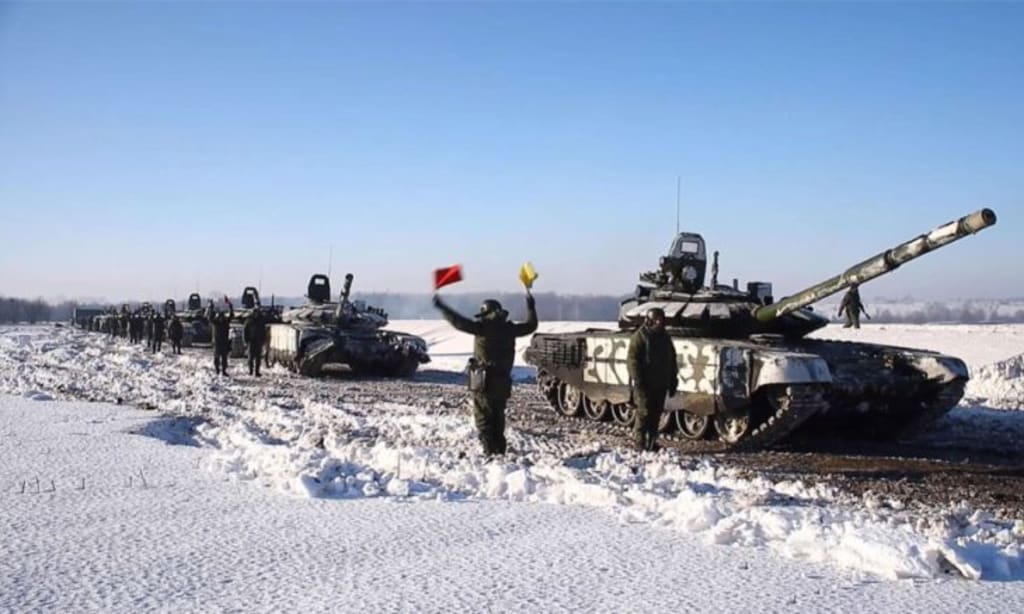
If the reports issued by Washington and London are true, then the Russian invasion of Ukraine will take place today. If it does not start today, it will be tomorrow, and if it does not happen, it will be the day after tomorrow. British Foreign Secretary Liz Trust confirmed that the invasion is imminent, as did her American counterpart Anthony Blinken, and before them, US President Joseph Biden. Others consider that the talk about the "imminent invasion" is just a heavy lie that Biden launched, and then the pro-war media excelled in promoting it and stirring up unrest in the world.
On the contrary, if you believe Russian President Vladimir Putin, you will sleep assured, because his forces will not cross the Ukrainian border unless they are attacked by Ukraine, and that the current forces there are participating in maneuvers and will return at the end. But Putin could turn around with his tanks and storm Ukraine, says British Defense Secretary Ben Wallace.
Zelensky's message: Celebrate Valentine's Day
The Ukrainian president himself does not believe the warning of an "imminent invasion", so he and his wife celebrated Valentine's Day on Monday, exchanging greetings and roses on television in front of millions, in a message telling Ukrainians: "Rest assured, and live your life normally." It also decided to declare today a "national unity holiday" in which villages and cities are adorned with flags, and individuals wear badges in the color of the flag, and music plays the national anthem and millions sing it at ten in the morning. Zelensky himself does not believe Western reports of the "imminent Russian invasion" because if he believed them, he would have had to put on military clothes and head to the battlefront, calling on his people to take up arms to defeat the coming invasion.
Zelensky is not the only one who does not believe the American and British reports. Many others are skeptical, including French President Emmanuel Macron, United Nations Secretary-General Antonio Guterres, the Italian President and others. Macron made strong statements, after visiting Kyiv and Moscow, in which he denied the possibility of an "imminent invasion" and said that he had found "no evidence to confirm this." China also does not believe the "imminent invasion" and told its citizens in Ukraine that their country's embassy is operating as usual in Kyiv, no withdrawal of diplomats and no closure of the embassy, as the United States did.
The sane media also does not believe the “imminent invasion.” An American journalist asked the White House spokesperson about the justifications for that warning. The American official replied that the Biden administration has information in this regard. He asked the journalist about the source of the information, but the spokesman did not provide an explanation. In a similar incident, a presenter on the BBC’s morning program directly asked the Foreign Secretary why the warning of the “imminent attack” had been repeated, while Ukraine itself neither said nor repeated it, so the minister’s explanation was that Britain had Powerful information devices! This means that Britain has information services that know about Ukraine what it doesn't know about its security, and it doesn't share that information with it, at least until it's ready.
Global economic cost
Despite the warning messages issued by Ukraine, Germany, France, Italy and China about the danger of exaggerating the Russian threat to Ukraine, the United States is still leading the process of intimidation and intimidation to the point that the Ukrainian economy actually began to bleed, not because of the war but because of the exaggeration of the warning Of which. But the American merciful hand offered to provide Ukraine sovereign bank guarantees worth $1 billion. These are guarantees that Kyiv may actually accept because of its need for money due to the bleeding that the economy suffers from and caused a shortage of goods, an increase in prices, a downgrade of the credit rating of the government's ability to pay its obligations abroad, and the suspension of some airlines' flights between Ukraine and the world as a result of the increase in the cost of insurance and the high risk. Germany also announced financial assistance to the Ukrainian government, and Canada did the same.
And it is not only Ukraine that pays the price for promoting the idea of an "imminent invasion." The energy and grain markets have been shaken severely in recent weeks, because Russia is one of the world's largest energy exporters, and Russia and Ukraine are among the world's largest exporters of food grains. Rising energy and wheat prices are hurting the whole world. The United States knows this, and because of its global responsibility, it should not publish information around the world that leads to unjustified market disruption. What is surprising is that the United States is benefiting from the high prices of oil and wheat, and that Europe is the biggest victim of the rise in oil and gas prices because it depends on importing about 43 percent of its energy needs from Russia. Some analysts say that in promoting its exaggerations about the Russian threat, the United States is deliberately weakening Europe, with the exception of Britain, which imports only 3 percent of its needs from Russia. It is also reported that the United States is running a political process to return the European Union to the fold of obedience to the United States, especially after the scope of mutual relations between the European Union and Russia and China has expanded. America's policy of intimidation targets not only Ukraine, but Europe as well.
The real crisis
However, all the scenes that we see on the world political stage today regarding the “imminent Russian invasion of Ukraine” hide behind an undisguised fact that there is a historical defect in relations between Ukraine and Russia. Ukraine has lived since the eighteenth century as an extension of Tsarist Russia, and then became part of the Soviet Union. Now there is a strong desire among Ukrainians, especially in the western regions, to belong to the North Atlantic Treaty Organization (NATO). This was stipulated in the new constitution of the country, which was one of the reasons for the Crimean War in 2014, which resulted in the annexation of the Crimea to Russia, and the unilateral declaration of the secession of the Donbas region, by establishing two independent republics, one in Donetsk. The second in Luhansk enjoy indirect support from Russia. There is therefore a historical problem in the Russian-Ukrainian relations, which appears strongly in eastern and southeastern Ukraine, that needs to be resolved. Russia also considers Ukraine's accession to NATO a direct threat to its national security. If the Minsk agreements reached through a dialogue between Russia, France, Germany and Ukraine represent a consensual solution to the Donbass crisis, the issue of Ukraine's desire to join NATO remains a major obstacle to peace in Ukraine. It is useful to note here that the forces that seek peace and not war, including the Ukrainian government itself along with the rest of the “Minsk” parties, Germany and France, are currently trying to find a solution to the security dilemma of NATO. The Ukrainian ambassador to London revealed that one of the ideas put forward is to conclude bilateral security agreements between Ukraine and some NATO countries such as Britain, and to postpone the idea of joining the alliance. If the Minsk agreements reached through a dialogue between Russia, France, Germany and Ukraine represent a consensual solution to the Donbass crisis, the issue of Ukraine's desire to join NATO remains a major obstacle to peace in Ukraine. It is useful to note here that the forces that seek peace and not war, including the Ukrainian government itself along with the rest of the “Minsk” parties, Germany and France, are currently trying to find a solution to the security dilemma of NATO. The Ukrainian ambassador to London revealed that one of the ideas put forward is to conclude bilateral security agreements between Ukraine and some NATO countries such as Britain, and to postpone the idea of joining the alliance. If the Minsk agreements reached through a dialogue between Russia, France, Germany and Ukraine represent a consensual solution to the Donbass crisis, the issue of Ukraine's desire to join NATO remains a major obstacle to peace in Ukraine. It is useful to note here that the forces that seek peace and not war, including the Ukrainian government itself along with the rest of the “Minsk” parties, Germany and France, are currently trying to find a solution to the security dilemma of NATO. The Ukrainian ambassador to London revealed that one of the ideas put forward is to conclude bilateral security agreements between Ukraine and some NATO countries such as Britain, and to postpone the idea of joining the alliance. It is useful to note here that the forces that seek peace and not war, including the Ukrainian government itself along with the rest of the “Minsk” parties, Germany and France, are currently trying to find a solution to the security dilemma of NATO. The Ukrainian ambassador to London revealed that one of the ideas put forward is to conclude bilateral security agreements between Ukraine and some NATO countries such as Britain, and to postpone the idea of joining the alliance. It is useful to note here that the forces that seek peace and not war, including the Ukrainian government itself along with the rest of the “Minsk” parties, Germany and France, are currently trying to find a solution to the security dilemma of NATO. The Ukrainian ambassador to London revealed that one of the ideas put forward is to conclude bilateral security agreements between Ukraine and some NATO countries such as Britain, and to postpone the idea of joining the alliance.
Kissinger's point of view
Former US Secretary of State Henry Kissinger opposes Ukraine joining NATO. He expressed this after the last Crimean War of 2014, in an article he published in the Washington Post on March 5, 2014, in which he warned against using the Ukrainian issue to ignite a fire in European-Russian relations, and expressed his disagreement with those who demand Ukraine's accession to NATO. The Atlantic, saying that this country should remain a bridge of communication between East and West and not an arena for war barricades between the two parties. Indeed, the fox of American diplomacy in the twentieth century demanded that Ukraine recognize the subordination of the Crimea to Russia, firstly because 60 percent of its population are Russians, and secondly because the annexation of Crimea to Ukraine came by a decision of Nikita Khrushchev, the leader of the Soviet Communist Party in the fifties of the last century, and thirdly because Crimea is part of Russia's political and religious history, and fourthly because it is Russia's route from the Black Sea to the Mediterranean and the warm waters. Kissinger also demanded that the Donbass region, which includes the Donetsk and Lugansk regions in eastern Ukraine, be autonomous. Perhaps this vision presented by Kissinger at that time was the basis of the Minsk Accords. The solution to the Ukrainian crisis is therefore within reach: the implementation of the Minsk agreements, regardless of the idea of Ukraine joining NATO at the present time, with the possibility of compensating for this by signing bilateral defense agreements between Ukraine and some neighboring European countries.
About the Creator
Carney’s China Embrace Widens Gap With US in Trump’s Tariff Era
Canada is making waves on the global stage, and not necessarily where the U.S. wants. Prime Minister Mark Carney’s embrace of China is widening a gap with Washington at a time when President Trump’s tariff policies are shaking up international trade. What was once unthinkable — Canada leaning toward Beijing — now looks like a pragmatic move in a world of rising tariffs and disrupted supply chains.
By Aqib Hussaina day ago in The Swamp
Silver Screen Magic with Mae West
American actress and singer Mae West became a popular film actress during the Great Depression. She started entertaining in vaudeville, then performed on Broadway, and finally went to Hollywood. She signed up with Paramount Pictures and made her debut in the 1932 film “Night After Night.” She also starred in musicals, comedies, and crime dramas. The American Film Institute named her one of the best classic Hollywood actresses.
By Rasma Raisters6 days ago in Geeks


Comments
There are no comments for this story
Be the first to respond and start the conversation.