
President Asif Ali Zardari Meets Iraq’s Caretaker Prime Minister Mohammed Shia Al-Sudani at Government Palace
President Asif Ali Zardari Meets Iraq’s Caretaker Prime Minister Mohammed Shia Al-Sudani at Government Palace
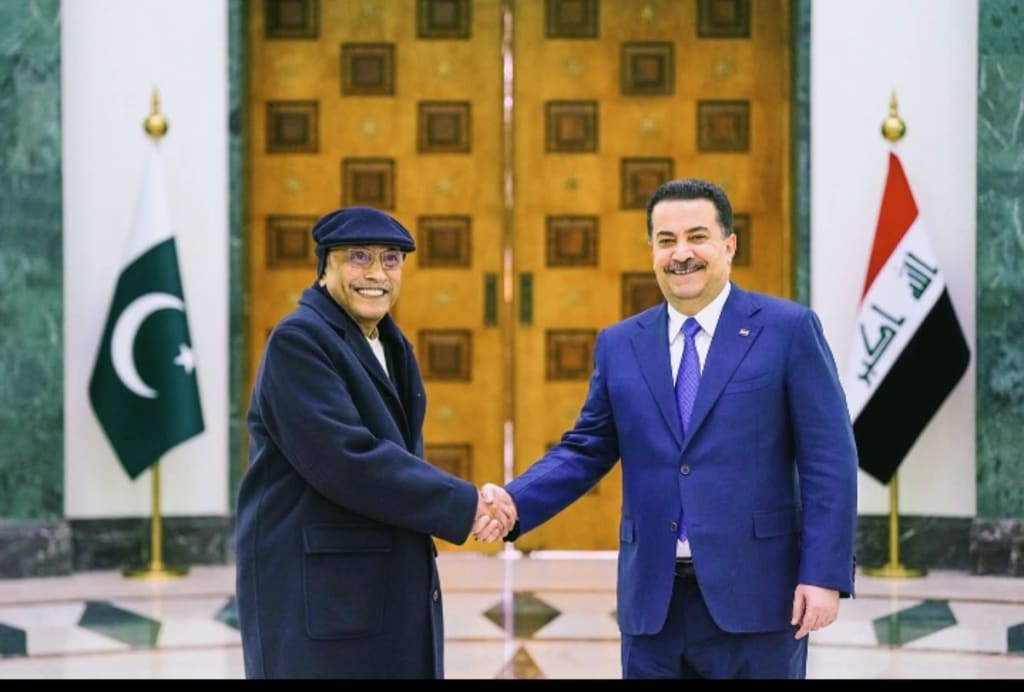
The meeting between President Asif Ali Zardari of Pakistan and Mr. Mohammed Shia Al-Sudani, the Caretaker Prime Minister of Iraq, held at the Government Palace, marks a significant moment in the evolving diplomatic relationship between Pakistan and Iraq. This high-level interaction reflects both nations’ commitment to strengthening bilateral ties, fostering regional cooperation, and addressing shared challenges in an increasingly complex geopolitical landscape.
Such meetings are more than ceremonial gestures; they represent a convergence of political vision, strategic dialogue, and mutual respect between two important Muslim-majority countries with deep historical, cultural, and diplomatic roots.
A Meeting of Diplomatic Significance
President Asif Ali Zardari, known for his experience in statecraft and diplomacy, arrived at the Government Palace amid official protocols and warm reception. His meeting with Prime Minister Mohammed Shia Al-Sudani was characterized by cordiality and constructive dialogue, symbolizing the mutual desire to enhance cooperation between Pakistan and Iraq.
Both leaders acknowledged the importance of maintaining regular high-level engagements, especially at a time when the Middle East and South Asia face evolving political, economic, and security challenges.
Strengthening Pakistan–Iraq Relations
Pakistan and Iraq share longstanding ties rooted in shared religious, cultural, and historical connections. Over the years, both countries have supported each other at various international forums, including the Organization of Islamic Cooperation (OIC) and the United Nations.
During the meeting, discussions reportedly focused on:
Enhancing bilateral trade and economic cooperation
Expanding energy collaboration
Strengthening people-to-people exchanges
Cooperation in education, health, and cultural sectors
President Zardari emphasized Pakistan’s willingness to support Iraq’s reconstruction and development efforts, particularly in areas where Pakistan has expertise, such as infrastructure development, healthcare services, and skilled manpower.
Regional Stability and Shared Concerns
One of the key themes of the discussion was regional stability. Both leaders expressed concern over ongoing conflicts, political uncertainty, and security challenges affecting the broader region. President Zardari reaffirmed Pakistan’s stance in favor of dialogue, peaceful coexistence, and respect for sovereignty as guiding principles in international relations.
Prime Minister Mohammed Shia Al-Sudani highlighted Iraq’s efforts to stabilize its internal political landscape and rebuild institutions after years of conflict. He acknowledged Pakistan’s constructive role in promoting peace and moderation in the Muslim world.
Economic Cooperation and Trade Opportunities
Economic collaboration featured prominently in the talks. Both sides recognized that bilateral trade between Pakistan and Iraq remains below its true potential. The leaders discussed ways to encourage private-sector engagement, ease trade regulations, and explore joint ventures.
Key sectors identified for cooperation included:
Energy and petroleum
Agriculture and food security
Pharmaceuticals
Construction and engineering services
President Zardari noted that Pakistan’s growing industrial base and skilled workforce could contribute positively to Iraq’s economic revival.
Cultural and Religious Ties
Cultural and religious connections between Pakistan and Iraq hold deep significance, particularly due to religious tourism. Every year, thousands of Pakistani pilgrims travel to Iraq to visit holy sites. Both leaders discussed measures to improve facilities, security, and coordination for pilgrims, ensuring a smoother and safer experience.
Strengthening cultural exchanges, academic cooperation, and media collaboration were also highlighted as ways to bring the people of both nations closer together.
Pakistan’s Vision for Diplomatic Engagement
President Asif Ali Zardari reiterated Pakistan’s broader diplomatic vision—one rooted in peaceful coexistence, economic diplomacy, and regional connectivity. He stressed that Pakistan seeks to build partnerships based on mutual respect and shared interests, rather than short-term political gains.
His engagement with Iraq’s caretaker leadership underscores Pakistan’s intent to remain actively involved in Middle Eastern affairs while maintaining balanced relations with all regional stakeholders.
A Message of Unity and Cooperation
The meeting concluded on a positive note, with both leaders expressing optimism about the future of Pakistan–Iraq relations. The exchange of views at the Government Palace served as a reminder that diplomacy remains a powerful tool for addressing challenges, building trust, and shaping a cooperative future.
In an era marked by uncertainty and rapid geopolitical shifts, such high-level engagements reinforce the importance of dialogue, understanding, and collaboration among nations.
Conclusion
The meeting between President Asif Ali Zardari and Caretaker Prime Minister Mohammed Shia Al-Sudani was not merely a diplomatic formality—it was a reaffirmation of shared values, mutual respect, and a collective vision for peace and development.
As Pakistan and Iraq continue to navigate regional and global challenges, such interactions pave the way for stronger partnerships, deeper cooperation, and a more connected Muslim world built on dialogue and diplomacy.
About the Creator
Keep reading
More stories from Zahid Hussain and writers in The Swamp and other communities.
Humanity May Reach Singularity Within Just 4 Years, Trend Shows
The idea of technological singularity—a point when artificial intelligence (AI) surpasses human intelligence and transforms civilization—has long been the realm of science fiction, futurists, and speculative thinkers. But recent trends in AI development suggest that this once-distant milestone could occur much sooner than expected, possibly within the next four years. The notion may sound dramatic, but when examined through the lens of computational progress, investment acceleration, and real-world breakthroughs, the possibility begins to appear less far-fetched and more actionable. What Is Technological Singularity? Technological singularity refers to a hypothetical future in which machine intelligence surpasses human mental capabilities across all domains—scientific reasoning, creativity, emotional intelligence, and strategic decision-making. Beyond that point, AI might be capable of autonomously improving its own architecture and capabilities at an exponential rate. At singularity: AI could solve problems beyond human comprehension Economic, social, and political systems may undergo radical transformation The pace of innovation may become uncontrollable and unpredictable This is not simply smarter computers—it’s a fundamental shift in how intelligence exists and operates. The Trend That Started the Conversation Several researchers, startups, and global institutions track AI development across multiple indicators: computing power, dataset accessibility, training methods, hardware optimization, and investment growth. When these trends are extrapolated, the trajectory points toward an unprecedented acceleration in AI capabilities. The key trend indicators include: 1. Exponential Growth in Compute Power Modern AI training relies on massive computational resources. According to some estimates, the total compute used in the largest AI training runs has been doubling every 6 months, far outpacing traditional Moore’s Law predictions. Higher compute capacity enables: More complex models Faster training cycles Larger datasets This creates a virtuous cycle where more computing power drives better AI, which in turn optimizes future AI development. 2. Investment in AI Has Skyrocketed Governments, tech giants, and venture capital firms are pouring billions into AI research. From OpenAI, Google DeepMind, Microsoft, Meta, and Chinese AI labs to university research programs, the scale of financial commitment has increased dramatically. This investment boom accelerates progress because: More talent is attracted to AI research Projects that were once speculative get serious funding Competition pushes breakthroughs The infusion of capital creates both rapid growth and intense competition—fueling faster innovation cycles. 3. Data Availability Is Exploding AI thrives on data. The universe of digital information—text, audio, visual content—is growing exponentially. More data means better training, which leads to more capable and nuanced AI models. Open datasets, global connectivity, and digital transformation across sectors dramatically increase the raw material AI systems use to learn. What a 4-Year Singularity Would Mean If singularity arrives around 2029–2030, the world may change in ways many cannot yet fully imagine. Some possible outcomes include: 1. AI in Everyday Decision-Making AI could begin making complex decisions in finance, medicine, and governance—areas traditionally guided by human judgment. For example, AI might: Manage global supply chains autonomously Diagnose diseases more accurately than doctors Optimize economic policy using predictive models 2. Automation Beyond Routine Jobs We already see automation replacing repetitive tasks. But singularity-level AI could automate creative, strategic, and cognitive roles—those thought to require uniquely human insight. This could shift employment models and redefine what work means in the 21st century. 3. New Ethical Paradigms When machines outthink humans, ethical frameworks may be reshaped. Questions will arise around: Rights for highly intelligent systems Accountability when AI makes consequential decisions Fair distribution of technological benefits Ethics will need to evolve alongside technical progress. Skepticism and Caution Are Still Important Not everyone agrees that singularity is imminent—or that it is even possible in the way theorists imagine it. Critics point out: 1. AI Still Lacks Common Sense Despite deep learning advances, AI struggles with: Contextual reasoning Generalization across domains Understanding causality beyond patterns Artificial general intelligence (AGI)—a necessary precursor to singularity—remains elusive. 2. Hardware and Energy Limits Scalable compute must also be sustainable. The energy consumption of large AI models is immense, raising questions about environmental cost and hardware feasibility. 3. Technical and Social Constraints Even if AI reaches superintelligence in technical labs, integrating it safely and equitably into society presents major social challenges. Singularity is not only a technical milestone—it's a socioeconomic and ethical transformation. Preparing for a Near-Term Singularity Whether or not singularity occurs in four years, the trend toward more powerful AI is undeniable. Here are key areas that require thoughtful preparation: 1. AI Policy & Regulation Governments must create frameworks that: Ensure transparency Protect individuals’ rights Promote safety in AI development Unregulated innovation can lead to misuse and social harm. 2. Workforce Transition and Education As AI capabilities expand, education systems should: Align with future skills Promote creativity and cognitive flexibility Retrain workers displaced by automation This protects economic resilience. 3. Ethical AI Standards Global collaboration is needed to define: Acceptable AI behaviors Safety protocols Accountability mechanisms Ethics must keep pace with technology. Is Singularity a Threat—or an Opportunity? Public perception of singularity often swings between excitement and fear: Optimistic view: Superintelligent AI may solve humanity’s greatest challenges—disease, climate change, poverty, and inefficiency. Pessimistic view: AI may become uncontrollable, misuse intelligence, or disrupt social order in dangerous ways. The real outcome likely lies somewhere in between, shaped by human choices today. We may not be powerless in the face of singularity—but we must be proactive. Final Thought The idea that humanity may reach singularity within just four years is not a guarantee; it is a trend projection based on current patterns in AI research, computational power, and investment. Whether singularity arrives sooner or later, the conversation it sparks is already transforming how we think about intelligence, work, ethics, and the future of civilization. The world is not waiting for singularity— it is co-creating it. And that may be the most profound realization of all.
By Zahid Hussain21 days ago in The Swamp
The Biggest Factory Powering Russia’s Missiles Comes Under Drone Attack, Video Surfaces
A video circulating online has revealed a dramatic development in Russia’s military infrastructure: the country’s largest factory responsible for producing missile components came under a drone attack, highlighting vulnerabilities in Russia’s defense supply chain. While the exact scale of damage is still being assessed, the incident underscores the growing role of drone warfare in modern conflicts and raises concerns about the resilience of strategic military production facilities. The Targeted Facility The facility in question is a key production hub for Russia’s missile program, reportedly responsible for manufacturing critical components used in both short-range and long-range systems. Analysts note that disruptions to operations at this plant could significantly impact Russia’s ability to sustain missile launches, particularly as tensions with neighboring countries and Western powers remain high. The drone strike, captured in grainy but compelling footage, shows explosions and plumes of smoke rising from the complex, with structural damage evident across multiple sections of the factory. While official Russian sources have downplayed the attack’s impact, independent analysts warn that even minor disruptions can delay production cycles for high-precision missile components, which are notoriously difficult to manufacture. The Rise of Drone Warfare This incident illustrates the increasing use of drones as offensive tools in modern warfare. Small, precise, and relatively inexpensive compared to traditional airstrikes, drones can penetrate heavily defended areas and target high-value facilities with minimal risk to personnel. Over the past several years, military strategists have recognized drones as a game-changer, capable of tipping the balance in conflicts where conventional forces struggle to reach key infrastructure. In this case, the drone attack demonstrates the potential vulnerability of even heavily fortified industrial complexes. It also signals that military planners must now account for aerial threats at all levels of production, from weapons assembly to supply chain logistics. Strategic Implications The attack on Russia’s missile factory has significant strategic implications. First, it puts pressure on Moscow’s military planners to diversify production sites and strengthen defense measures around critical facilities. Reliance on a single, centralized factory for essential missile components increases the risk of operational bottlenecks if targeted again. Second, the strike could temporarily disrupt missile readiness, potentially affecting regional military posturing. While Russia possesses multiple production lines and stockpiles, delays in component manufacturing could slow replenishment cycles for both active deployments and training exercises. In a tense geopolitical environment, even short-term interruptions can influence diplomatic negotiations and military decision-making. Finally, the attack highlights the evolving nature of asymmetric warfare. Smaller, agile forces equipped with drones can strike at the heart of larger powers’ capabilities, leveling the playing field in conflicts where conventional military strength may otherwise dominate. Russia’s Response While Moscow has yet to release detailed assessments of the damage, preliminary reports suggest heightened security measures across other key defense facilities. Military analysts predict that the Russian government will likely accelerate efforts to harden production sites against drone strikes, using technologies such as radar detection systems, anti-drone countermeasures, and dispersed production strategies. Publicly, Russian media has framed the attack as an isolated incident and an external provocation, though the video’s circulation has sparked international debate about the vulnerability of critical military infrastructure. The Russian Ministry of Defense has reportedly initiated an internal review to determine the effectiveness of existing security protocols and explore measures to prevent future incidents. Lessons for Global Military Planning The incident underscores a broader lesson for militaries worldwide: the centralization of strategic production assets can be a liability in the age of drone warfare. Even technologically advanced nations are not immune to attacks on critical infrastructure, and conventional defenses may not suffice against small, precise aerial vehicles. For countries facing ongoing or potential conflict, investing in redundancy, dispersal, and drone countermeasure technologies is now as essential as traditional armor and air defense systems. The attack also demonstrates that transparency, intelligence gathering, and surveillance of vulnerable sites are critical components of national security strategy. Looking Ahead As investigations continue, the global defense community is watching closely. The video of the drone attack has already sparked debates over the evolving nature of warfare, the vulnerability of missile production facilities, and the potential ripple effects on international security. Whether the factory will fully recover, and how Moscow will adapt its military-industrial operations, remains uncertain. What is clear, however, is that the age of drone-enabled precision strikes has arrived, challenging traditional notions of military invulnerability and redefining how nations safeguard their strategic assets. In the coming months, the ramifications of this attack could influence both Russian military operations and broader global defense strategies. For countries seeking to protect critical infrastructure, the message is unmistakable: preparedness against drone threats is no longer optional—it is imperative.
By Fiazahmedbrohi 7 days ago in The Swamp



Comments
There are no comments for this story
Be the first to respond and start the conversation.