
Power Quality Equipment Market Size and Forecast 2025–2033
Ensuring Stable Power in a Digitized and Electrified World

Introduction: Why Power Quality Matters More Than Ever
The global shift toward digitalization, automation, renewable energy, and electrified transportation has transformed electricity from a basic utility into a mission-critical resource. Modern economies now depend on continuous, distortion-free power to keep industries productive, data centers online, hospitals functioning, and smart cities operational. This growing reliance has brought power quality to the center of energy discussions worldwide.
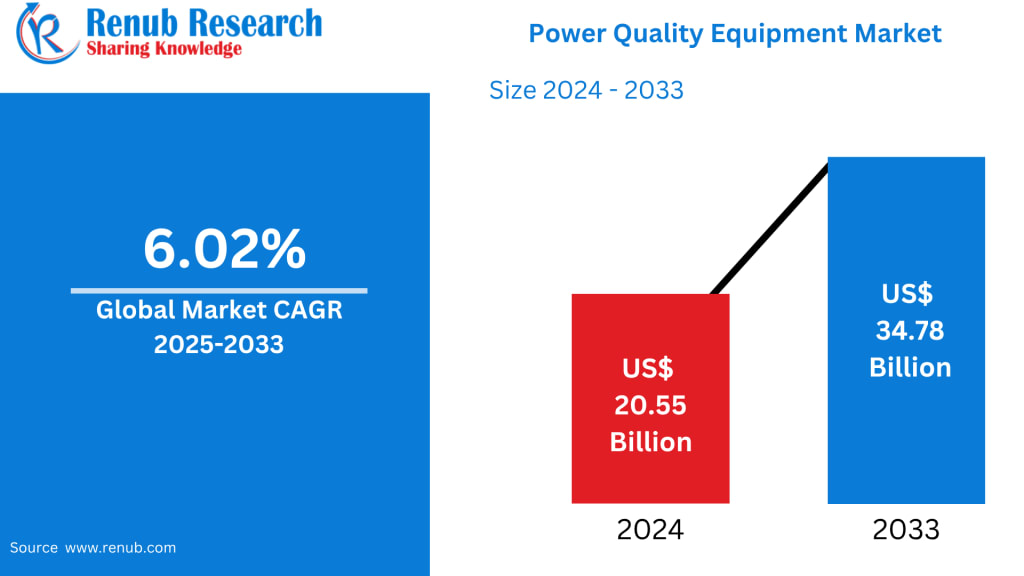
According to Renub Research, the Global Power Quality Equipment Market was valued at US$ 20.55 billion in 2024 and is projected to reach US$ 34.78 billion by 2033, growing at a CAGR of 6.02% during 2025–2033. The market’s expansion is driven by rising industrial automation, increasing use of sensitive electronic equipment, renewable energy integration, and stronger awareness of energy efficiency and downtime costs.
Power quality equipment—including UPS systems, surge protectors, harmonic filters, voltage regulators, and meters—plays a critical role in preventing power disturbances that can lead to data loss, equipment damage, operational delays, and financial losses. As power systems become more complex, ensuring stability and reliability is no longer optional—it is essential.
Power Quality Equipment Market Outlook
Power quality equipment refers to devices and systems that maintain the reliability and efficiency of electrical power by eliminating voltage sags, surges, harmonics, transients, and frequency variations. These disturbances can severely impact sensitive equipment such as servers, automated production lines, medical instruments, and telecommunications networks.
With industries increasingly adopting automation, robotics, artificial intelligence, and IoT-based systems, the tolerance for power interruptions has dropped to near zero. Even minor disturbances can halt operations or corrupt data. As a result, power quality solutions are becoming integral components of electrical infrastructure across industrial, commercial, and residential environments.
The growing penetration of renewable energy sources such as solar and wind—while beneficial for sustainability—has also introduced new power instability challenges. Power quality equipment helps stabilize these variable sources and integrate them smoothly into existing grids, supporting the transition to cleaner energy without compromising reliability.
Key Growth Drivers in the Power Quality Equipment Market
1. Industrial Automation and Digitization
The global transition to Industry 4.0 is accelerating automation across manufacturing, logistics, pharmaceuticals, electronics, and automotive sectors. These industries rely heavily on computer-controlled systems, robotics, and precision machinery that require stable and clean power.
Power quality equipment ensures uninterrupted operations by eliminating voltage fluctuations and harmonic distortions. Even short interruptions can lead to costly downtime and product defects. As automation spreads globally, particularly in Asia-Pacific and North America, demand for power quality equipment is rising sharply.
In May 2025, Schneider Electric showcased its software-defined automation and digital manufacturing technologies at Automate 2025, highlighting the growing need for resilient power systems that support advanced industrial operations.
2. Proliferation of Renewable Energy Integration
The transition toward renewable energy is reshaping global power grids. Solar and wind power, while sustainable, are inherently variable and can cause voltage instability, harmonics, and frequency deviations.
Power quality equipment such as harmonic filters, voltage regulators, and dynamic compensation systems helps stabilize these fluctuations, ensuring grid reliability. As countries increase renewable penetration, investments in power quality solutions become unavoidable.
In February 2025, the Belize Government launched a $58.4 million energy project with support from the World Bank and Canada to enhance power reliability and integrate renewables more efficiently, underscoring the global focus on grid stability.
3. Data Centers and Cloud Infrastructure Expansion
Data centers are the backbone of cloud computing, AI, digital payments, streaming, and enterprise IT services. These facilities require continuous, disturbance-free power to avoid outages that could lead to massive financial losses and security risks.
Power quality equipment—particularly UPS systems, harmonic filters, and voltage stabilizers—ensures uninterrupted operation and protects sensitive servers. The rapid expansion of hyperscale data centers and edge computing facilities is a major growth driver for this market.
In May 2025, Qualcomm Technologies and HUMAIN announced a partnership to develop next-generation AI data centers in Saudi Arabia, reinforcing the need for advanced power reliability solutions in digital infrastructure.
Challenges in the Power Quality Equipment Market
High Initial Investment and Operational Costs
Despite their long-term benefits, power quality systems require significant upfront capital for equipment, installation, maintenance, and skilled labor. For small and medium-sized enterprises, this investment can be difficult to justify, particularly in price-sensitive emerging markets.
While the cost of downtime often exceeds the cost of prevention, limited awareness and budget constraints continue to slow adoption in certain regions.
Lack of Awareness and Skilled Workforce
In many developing economies, power disturbances are still treated reactively rather than proactively. There is also a shortage of trained personnel capable of installing and maintaining sophisticated power quality systems. This gap limits market penetration and highlights the need for education and workforce development programs.
Segment Analysis: Power Quality Equipment Market
UPS Power Quality Equipment Market
Uninterruptible Power Supply (UPS) systems form the backbone of power backup strategies in data centers, hospitals, telecom networks, banks, and industrial facilities. They ensure continuity during outages and protect sensitive equipment from voltage anomalies.
Technological advancements such as modular UPS systems, lithium-ion batteries, and energy-efficient designs are expanding the market. Residential and small commercial demand is also growing due to rising home office setups and electronic appliance usage.
Power Quality Meters Market
Power quality meters enable real-time monitoring of voltage, frequency, harmonics, and disturbances. These devices help utilities and industries identify inefficiencies, prevent equipment damage, and comply with regulatory standards.
The integration of smart grid technologies and IoT has made these meters more intelligent and predictive, supporting preventive maintenance and energy optimization strategies worldwide.
Single Phase Power Quality Equipment Market
Single-phase equipment is widely used in homes and small commercial establishments. With the growth of smart homes, EV chargers, and electronic appliances, demand for voltage stabilizers, surge protectors, and filters is increasing rapidly.
This segment is expected to grow steadily, especially in urban regions of Asia-Pacific and Latin America where residential power instability remains common.
Commercial Power Quality Equipment Market
Commercial buildings—including malls, offices, hospitals, and educational institutions—depend on consistent power for HVAC systems, lighting, elevators, and IT infrastructure. Power quality equipment ensures energy efficiency, reduces maintenance costs, and improves operational reliability.
The rise of smart and green buildings has significantly boosted investment in power quality systems, particularly in metropolitan areas.
Transportation Power Quality Equipment Market
Electric railways, metro systems, and EV charging infrastructure require high-quality power for safe and efficient operation. Harmonic filters, voltage regulators, and compensation devices are critical in maintaining system stability.
With global investment in electric mobility and urban transport infrastructure rising, this segment is expected to witness strong growth through 2033.
Regional Analysis: Power Quality Equipment Market
United States
The United States remains a leading market due to its advanced digital economy, aging grid infrastructure, and strong industrial automation base. Data center expansion, renewable energy investments, and government policies supporting smart grids are driving demand.
In March 2025, JST Power Equipment announced a new padmount transformer factory in Virginia, strengthening domestic manufacturing and supply chain resilience.
France
France’s push toward clean energy and smart grid development has increased demand for power quality solutions. Industries such as manufacturing, telecommunications, and utilities are investing heavily in voltage correction and power monitoring equipment.
Hitachi Energy’s HVDC interconnection project between France and Spain further highlights the country’s commitment to grid modernization and power stability.
India
India faces frequent power quality issues due to rapid urbanization and grid congestion. Demand is rising across IT parks, manufacturing facilities, and residential sectors. Government initiatives like Make in India and infrastructure modernization are accelerating market growth.
In October 2024, Hitachi Energy introduced the Relion REF650 relay to enhance medium-voltage grid reliability, reflecting India’s increasing focus on power quality.
Saudi Arabia
Saudi Arabia’s Vision 2030 initiative is driving massive investments in smart cities, renewables, and industrial infrastructure. Reliable power is critical for these projects, boosting demand for advanced power quality equipment.
In April 2025, the Saudi Electricity Company launched Phase 2 of its BESS development program, adding 2.5 GW of storage capacity to support grid stability and renewable integration.
Market Segmentation Overview
By Equipment
Uninterruptible Power Supply (UPS)
Surge Protection Devices
Voltage Regulators
Power Quality Meters
Harmonic Filters
Others
By Phase
Single Phase
Three Phase
By End Use
Industrial & Manufacturing
Commercial
Utilities
Transportation
Residential
By Geography
North America (US, Canada)
Europe (France, Germany, UK, Italy, Spain, etc.)
Asia-Pacific (China, India, Japan, ASEAN, Australia)
Latin America (Brazil, Mexico, Argentina)
Middle East & Africa (Saudi Arabia, UAE, South Africa)
Competitive Landscape
Leading players are focusing on smart solutions, digital monitoring, and energy-efficient designs to strengthen their market presence. Companies covered in the report include:
Hitachi Energy Ltd
Siemens AG
Eaton Corporation Plc
Emerson Electric Company
Schneider Electric SE
General Electric Company
Toshiba Corporation
Schaffner
Each company has been analyzed across four viewpoints: overview, key persons, recent developments & strategies, and revenue analysis.
Final Thoughts: A Market Built on Reliability
The Power Quality Equipment Market is no longer a niche segment—it is a cornerstone of modern energy infrastructure. As the world becomes more electrified, digital, and interconnected, the cost of poor power quality continues to rise.
From data centers and factories to smart homes and EV charging networks, power quality solutions are enabling the seamless operation of tomorrow’s economy. With strong policy support, renewable energy expansion, and rising awareness, the market is set for sustained growth through 2033.
For utilities, industries, and governments alike, investing in power quality is not just about stability—it is about future-proofing energy systems in a rapidly changing world.
About the Creator
Marthan Sir
Educator with 30+ years of teaching experience | Passionate about sharing knowledge, life lessons & insights | Writing to inspire, inform, and empower readers.
Keep reading
More stories from Marthan Sir and writers in The Swamp and other communities.
Consumer Electronics Repair and Maintenance Market Size, Growth & Forecast 2025–2033
Introduction: The Global Shift from Replacement to Repair The global Consumer Electronics Repair and Maintenance Market is undergoing a profound transformation. Once seen as a secondary service, repair has now become a strategic necessity as consumers, governments, and manufacturers respond to rising device costs, environmental concerns, and sustainability goals.
By Marthan Sir3 days ago in The Swamp
Trump’s Peace Board Charter and the $1 Billion Membership Proposal
In recent days, a draft charter for a newly proposed international body called the Board of Peace has become the subject of intense global discussion. Circulated by the U.S. administration to around 60 countries, the document outlines the structure and purpose of an organization that officials suggest could play a central role in international conflict resolution, starting with the crisis in Gaza. But one element of the proposal has drawn particular scrutiny: a requirement that nations contribute $1 billion in cash if they wish to hold their membership beyond a basic three-year period. What Is the Board of Peace? According to information from the draft charter and related reporting, the Board of Peace is intended as an international body that aims to promote “stability, restore dependable and lawful governance, and secure enduring peace in areas affected or threatened by conflict.” The initiative was first publicly announced by former U.S. President Donald Trump in January 2026 as part of what the U.S. government describes as the second phase of its broader Gaza peace plan. This phase follows an earlier ceasefire and outlines mechanisms for transitional governance and reconstruction in Gaza under international supervision. plomatic figures — including U.S. Secretary of State Marco Rubio, former British Prime Minister Tony Blair, Trump’s son-in-law Jared Kushner, and Middle East envoy Steve Witkoff — have already been named to an executive committee of the board. Invitations are understood to have been sent to leaders from nations such as Argentina, Canada, Egypt, Turkey, and others. The $1 Billion Membership Proposal The feature that has sparked the most international attention is the charter’s apparent provision linking extended membership privileges to a financial contribution. Under the draft charter’s terms, each member state would serve a three-year term, renewable at the board chair’s discretion. However, those countries that provide $1 billion in cash funds to the Board of Peace within the first year would not be subject to this three-year limit and could effectively retain their membership indefinitely. This requirement appears designed to incentivize significant financial involvement, but it has also raised questions about accessibility, equity, and the broader implications for international cooperation. Supporters of the idea argue that substantial funding would ensure the board has the necessary resources to respond effectively to complex crises — from reconstruction to peacebuilding efforts. Critics, however, worry that the high threshold could limit participation to wealthy states and give disproportionate influence to those with deep pockets. Leadership and Control The draft charter positions Trump as the inaugural chairman of the Board of Peace, granting him substantial authority over membership and governance issues. He would reportedly have the power to decide invitations, renew terms, appoint and remove executive board members, and even designate his own successor. Decisions by the larger membership would be determined by majority vote, but all outcomes would remain subject to approval by the chairman. Critics say this centralization of power could undermine principles of shared leadership and transparency in international affairs. Diverse Reactions from Around the World Reactions from global leaders and diplomatic communities have been mixed: Some invited nations have expressed interest or are considering participation, according to reporting on invitations extended by the Trump administration. Israel’s government has publicly objected to certain aspects of the peace plan, including board composition, noting that consultations were insufficient or potentially counter to its policy preferences. Other voices have raised broader strategic questions about the board’s role in comparison to established international institutions like the United Nations. Given Trump’s past criticisms of the U.N., some observers see this new entity as potentially overlapping with or even challenging traditional multilateral mechanisms. At least one nation — Argentina — has reportedly accepted an invitation to be a founding member, while others continue to deliberate. Debate Over the Financial Requirement The proposed $1 billion contribution for extended membership has become a focal point of debate. Supporters of the provision argue that significant financial commitments are necessary for any meaningful peacebuilding effort. International operations — especially those involving reconstruction, governance support, and humanitarian activities — require substantial funds to be effective. From this perspective, the requirement may help create a solid financial foundation for the board’s work. Critics, however, see potential downsides: Equity concerns: A steep financial barrier could exclude poorer nations from sustained involvement in an initiative aimed at global peace. Influence dynamics: There are fears that wealthy contributors could have outsized influence over decision-making, which may not align with wider international priorities. Institutional tension: The proposal could prompt questions about how this board interacts with established international entities like the United Nations and regional organizations. Some governments are reportedly evaluating the proposal and consulting with diplomatic partners to formulate a collective response. Others are observing developments closely before making commitments public. Transparency and Next Steps The White House has pushed back on some interpretations of the charter’s financial provisions, calling certain reports “misleading” and emphasizing that there is no formal “fee” for joining the board. Instead, officials frame extended membership as a reflection of deep commitment to the board’s goals of peace, security, and prosperity. Despite these assurances, the $1 billion figure continues to circulate in diplomatic and media discussions as a significant point of contention and analysis. It remains unclear how many countries will ultimately ratify the charter, whether the Board of Peace will gain broad international legitimacy, and how its operations might interact with other multilateral frameworks. The coming months — especially conversations at international gatherings such as economic forums and U.N. assemblies — could shed more light on these questions. Looking Ahead As this proposal continues to unfold, its long-term impact on international diplomacy and peacebuilding efforts will depend on broad global engagement and the ability to balance financial sustainability with inclusive, equitable participation. While the draft charter’s objectives reflect an ambition to rethink how peace initiatives are structured, the discussions surrounding its provisions — from leadership models to membership conditions — illustrate the complex terrain of contemporary geopolitics. The coming weeks and months will show whether the Board of Peace can secure widespread support without deepening existing tensions within the international community.
By Saboor Brohi 7 days ago in The Swamp
Japan Suspends World’s Largest Nuclear Plant Hours After Restart
Japan made headlines recently when the Kashiwazaki‑Kariwa Nuclear Power Plant, the world’s largest by capacity, had to halt operations just hours after restarting. The sudden suspension has reignited debates over nuclear safety, energy security, and Japan’s path to a carbon-neutral future.
By Aqib Hussain3 days ago in The Swamp


Comments
There are no comments for this story
Be the first to respond and start the conversation.