
Nvidia Set to Relaunch H20 AI Chip Sales in China Following CEO’s High‑Profile Trump Meeting
After a pivotal meeting with Donald Trump, Nvidia secures approval to resume H20 AI chip sales to China—reviving billions in lost revenue, boosting global tech markets, and reshaping U.S.–China AI trade dynamics

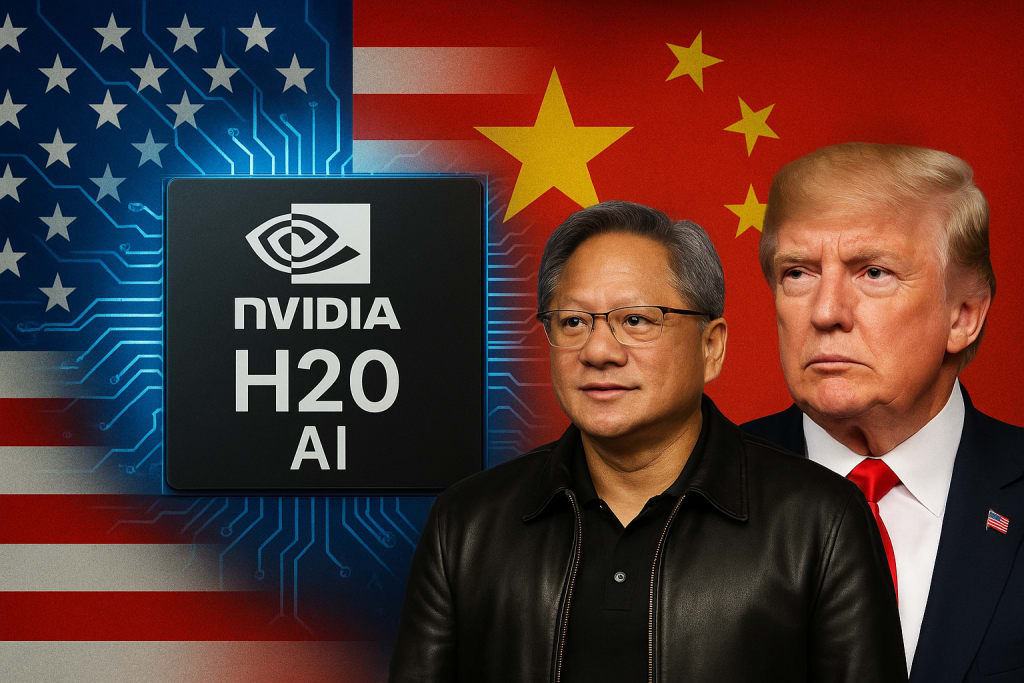
In a pivotal moment for global semiconductor markets and U.S.–China tech relations, Nvidia has been granted permission to resume exports of its H20 AI accelerator chips to China. The breakthrough follows a strategic meeting between CEO Jensen Huang and former President Donald Trump, signaling a major shift in U.S. export policy and opening the door for renewed business in one of Nvidia’s most crucial markets.
🧩 What’s the Big News?
On July 15, 2025, Nvidia announced that the U.S. government has committed to issuing requisite export licenses, effectively lifting a ban that had halted H20 shipments since April . The reversal is attributed to recent policy discussions culminating in Jensen Huang’s White House meeting with Trump, who reportedly green‑lit the resumption .
🚀 Why This Matters
1. Massive Revenue Rebound: China accounted for approximately $17 billion of Nvidia’s annual revenue—about 13% of total sales . The ban had already inflicted an estimated $4.5 billion inventory write‑down and $15 billion in lost sales .
2. Stock Market Reaction: The announcement triggered a significant surge in Nvidia shares—about 4–5% jump—adding an estimated $200 billion to market value .
3. Semiconductor Sector Boost: Nvidia’s success has positive ripple effects for peer companies like AMD and TSMC, which also saw gains amid optimism over eased U.S. export controls .
🏛️ Strategic Diplomacy & Policy Implications
The policy pivot reflects a broader thaw in U.S.–China technology tensions. The Trump administration’s approval is part of a pattern that includes recent concessions on rare earth exports and chip-design software to China . Analysts suggest Nvidia’s case might be tied to trade truce negotiations, with technology export controls used as bargaining leverage .
During his meetings in Washington, Jensen Huang emphasized the necessity of maintaining American competitive advantage in AI while securing global access to American-made chips . In Beijing, he reiterated China’s role in global AI innovation, stating that Nvidia aimed to “establish roots” in the massive and innovative Chinese market .
📦 What Happened to the H20 Chip?
The H20 AI accelerator was specifically tailored to navigate U.S. export limits—it is less powerful than Nvidia’s premium models but fully compliant with prior rules . In April, even this adjusted version was caught in a broader ban, prompting Nvidia to develop the RTX PRO GPU, purpose-built for industrial applications such as digital twins, smart logistics, and compliant with export regulations .
♻️ China Responds
Chinese tech firms, including giants like ByteDance and Tencent, are reportedly rushing to file license applications, eager to regain access to H20 chips and Nvidia’s CUDA software ecosystem . Reuters confirmed that the company is already compiling an approved‑buyer list to streamline the process once licenses are granted .
📈 Market & Industry Impact
Investors are celebrating: Nasdaq futures jumped, with spillover into broader tech indices .
Analysts project a profound tailwind for AI hardware, with Wedbush calling it a “monster win” and Melius Research labeling it a “watershed moment” .
Geopolitical gains: This move may signal warming economic ties and the prospect of renewed high-level meetings, including a likely Trump–Xi summit later this year .
🔍 Final Takeaway
Nvidia’s re‑entry into the Chinese market underscores the complexity of modern geopolitics and tech commerce. It represents a strategic victory—not just for Nvidia, but for U.S. policymakers seeking to balance national security with economic leadership. For global AI development, it ensures that key players in China continue to rely on NVIDIA’s world‑class hardware and software stack. And for investors, it paves the way for robust growth in the powerhouse AI chip sector.
Nvidia’s Own Stock Price Could Surge:
China is a massive market for Nvidia. Resuming H20 AI chip sales can restore billions in lost revenue.
Investors view this as a positive shift in U.S.–China tech trade, boosting long-term confidence.
Analysts have already called this a "monster win" and a "watershed moment" for Nvidia.
✅ Likely effect: Nvidia stock could rally sharply, especially if demand from China rebounds fast.
About the Creator
Waqar Khan
Passionate storyteller sharing life, travel & culture. Building smiles, insights, and real connections—one story at a time. 🌍
Every read means the world—thanks for your support! 💬🖋️
Keep reading
More stories from Waqar Khan and writers in The Swamp and other communities.
HMRC Hits 300,000 Taxpayers With “Trivial” Bills — Why Small Tax Errors Are Becoming a Big Problem
Thousands of people across the UK were surprised — and in many cases frustrated — after receiving unexpected letters from HMRC demanding payment for what many are calling “trivial” tax bills. According to recent reports, around 300,000 taxpayers have been contacted by HM Revenue & Customs over small underpayments, some as low as just a few pounds. While the amounts may seem minor, the impact has been anything but small.
By Waqar Khan13 days ago in The Swamp
Canada and China Reach Initial Trade Deal on Electric Vehicles and Canola
After years of strained relations and trade uncertainty, Canada and China have reached an initial trade agreement focused on two strategically important sectors: electric vehicles (EVs) and canola. While limited in scope, the deal marks a notable step toward stabilizing economic ties between the two countries at a time when global trade is increasingly shaped by geopolitics, supply-chain risks, and climate goals. Officials on both sides have described the agreement as preliminary rather than comprehensive, but its symbolism carries weight. For Canada’s farmers and clean-technology sector — and for China’s rapidly expanding EV market — the deal offers cautious optimism. Why This Deal Matters Now Relations between Canada and China have been tense for much of the past decade, affected by diplomatic disputes, trade restrictions, and growing mistrust between Western nations and Beijing. Agriculture and technology, in particular, have often been caught in the crossfire. Canola has long been a flashpoint. Canada is one of the world’s largest producers and exporters of the crop, while China is one of its most important markets. Past trade disruptions severely affected Canadian farmers, forcing Ottawa to seek alternative buyers. At the same time, electric vehicles have emerged as a new frontier of economic competition. China dominates global EV manufacturing, while Canada is positioning itself as a critical supplier of batteries, minerals, and clean-energy manufacturing. This deal reflects a shared recognition: economic realities are pushing both sides toward cooperation, even amid political differences. What the Agreement Covers While full details have not yet been released, officials confirm that the agreement addresses two key areas: 1. Canola Market Access China has signaled a willingness to ease restrictions on Canadian canola exports, addressing long-standing concerns from Canadian farmers and exporters. Improved access could help stabilize prices and restore confidence in one of Canada’s most valuable agricultural sectors. For producers in provinces like Saskatchewan and Alberta, this represents a potential economic lifeline after years of uncertainty. 2. Electric Vehicles and Clean Technology The deal also opens the door to cooperation in the EV sector. This includes trade discussions around electric vehicles, batteries, and related clean-energy components. Canada has been investing heavily in EV supply chains — from lithium and nickel mining to battery manufacturing — while China remains the world’s largest EV market and producer. The agreement suggests opportunities for investment, technology exchange, and supply-chain collaboration, though significant barriers remain. A Strategic Shift Toward Economic Pragmatism Rather than signaling a full reset in relations, the deal reflects a pragmatic shift. Canadian officials have emphasized that engagement does not mean abandoning concerns over human rights, national security, or foreign interference. Instead, the approach suggests that selective economic cooperation can coexist with political caution. China, meanwhile, benefits from reliable agricultural imports and diversified supply chains at a time when trade relations with the United States and parts of Europe remain strained. In short, both sides appear motivated by mutual economic interest rather than political alignment. Implications for Canadian Farmers For Canada’s agricultural sector, the canola portion of the deal is especially significant. China has historically been one of the largest buyers of Canadian canola, and past restrictions led to financial losses and market instability. Re-entry into the Chinese market could: Increase export volumes Improve farm incomes Reduce dependence on alternative, less predictable markets However, farm groups remain cautious. Many remember how quickly access was lost in the past and are urging the government to diversify export markets rather than rely too heavily on any single buyer. What It Means for the EV Industry The inclusion of electric vehicles highlights how trade priorities are shifting globally. Canada has positioned itself as a future EV powerhouse, leveraging its reserves of critical minerals and close proximity to U.S. manufacturing hubs. China, meanwhile, leads in EV production, battery technology, and consumer adoption. The deal could allow Canadian companies greater access to Chinese markets or supply chains, while Chinese firms may seek investment or partnerships in Canada’s growing clean-tech ecosystem. Still, challenges remain. National security concerns, investment screening rules, and political scrutiny mean that any deeper EV cooperation will be carefully managed. Political Reactions and Caution Reaction in Canada has been mixed. Supporters argue that the deal demonstrates responsible diplomacy — protecting jobs and industries without escalating tensions. Critics warn that economic engagement with China carries risks, particularly in strategically sensitive sectors like clean technology. Opposition parties have called for transparency, urging the government to clearly outline safeguards and ensure Canadian interests are protected. In China, state media has framed the agreement as evidence that cooperation remains possible despite global polarization — a narrative that emphasizes stability and economic growth. A Limited Deal, Not a Full Reset It’s important to note what this agreement does not do. It does not resolve broader diplomatic disputes, nor does it eliminate trade risks overnight. Instead, it establishes a framework for dialogue and incremental progress. Analysts describe it as a confidence-building step — one that tests whether limited cooperation can succeed without triggering political backlash on either side. If successful, it could pave the way for expanded talks in other sectors. If tensions resurface, it may remain an isolated exception. Global Context: Trade in a Fragmented World This deal comes amid a global shift toward strategic trade. Countries are increasingly prioritizing supply-chain security, climate goals, and economic resilience over pure free-market efficiency. In this environment, selective bilateral agreements are becoming more common. Canada’s move reflects an attempt to balance values, alliances, and economic necessity — a challenge facing many middle-power economies navigating rivalry between global giants. Final Thoughts The initial trade deal between Canada and China on electric vehicles and canola is modest in scope but significant in meaning. It signals that, despite deep political differences, economic pragmatism still has a place in international relations. For farmers, manufacturers, and policymakers alike, the agreement offers cautious hope — paired with a clear reminder that diversification and vigilance remain essential. Whether this deal marks the beginning of a broader thaw or remains a narrow exception will depend on how both sides manage trust, transparency, and the inevitable pressures of geopolitics in the months ahead.
By Muhammad Hassan4 days ago in The Swamp



Comments
There are no comments for this story
Be the first to respond and start the conversation.