
Navigating Competing Priorities in the Senate's Tax Debate
The GOP's Battle for Tax Bill Cohesion

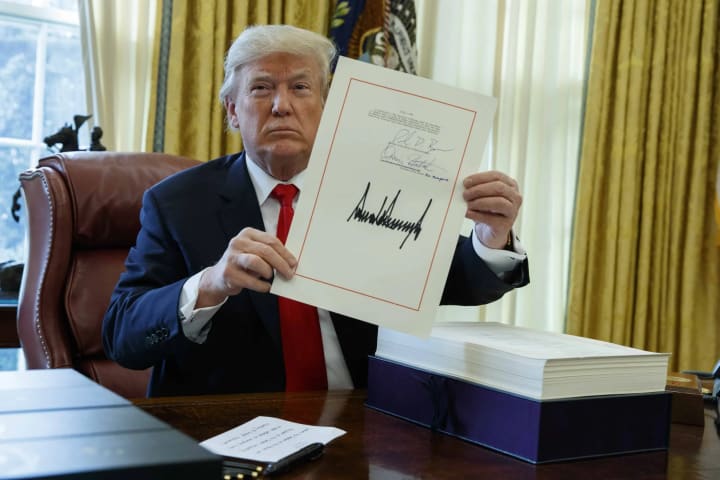
As President Donald Trump's ambitious "Big, Beautiful Bill" landed in the Senate, the Republican Party finds itself at a critical juncture, grappling with a complex web of internal divisions and competing demands. What began as a seemingly unified push for comprehensive tax reform has evolved into a legislative gauntlet, revealing deep ideological rifts and pragmatic concerns within the GOP ranks. The bill, a sprawling collection of tax breaks, spending cuts, and national security initiatives, is intended to make permanent many of the tax cuts from Trump's first term, alongside new proposals that aim to reshape the American economic landscape. However, the path to passage is proving to be anything but smooth, with the looming July 4th deadline amplifying the pressure on Republican leadership.

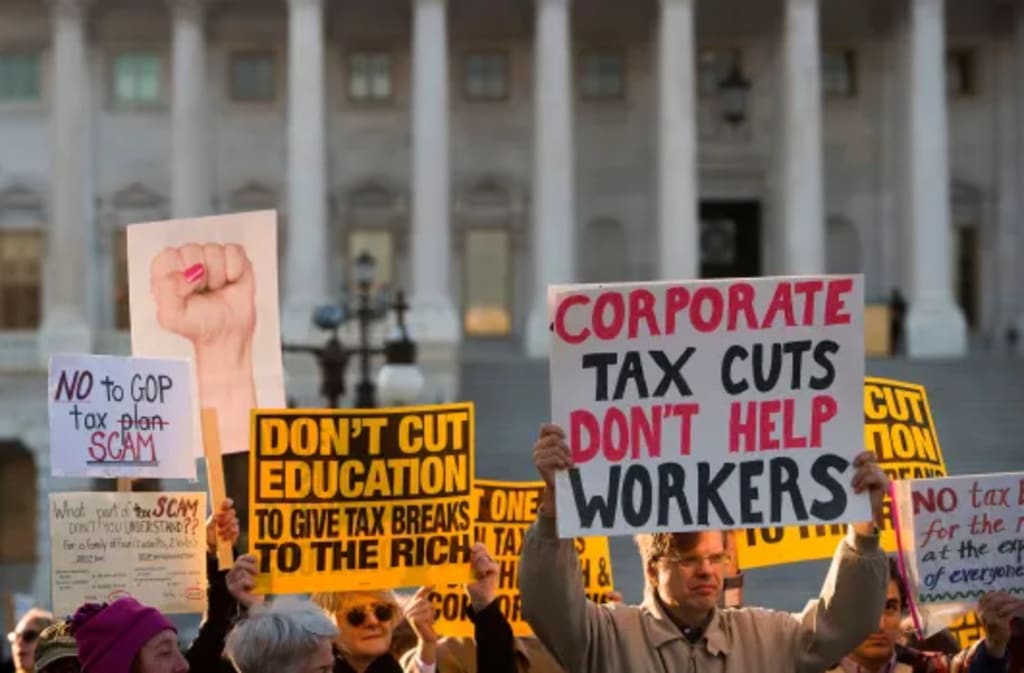
At its core, the legislation seeks to prevent what Republicans warn would be a massive tax hike for American families and businesses as key provisions of the 2017 Tax Cuts and Jobs Act (TCJA) are set to expire at the end of 2025. The Senate draft, clocking in at some 940 pages, proposes roughly $3.8 trillion in tax cuts over the next decade, making existing tax rates and brackets permanent while introducing new breaks on tips, overtime pay, and certain automotive loans. For the wealthiest households, the bill promises significant gains, while middle-income taxpayers could see modest reductions. However, the nonpartisan Congressional Budget Office (CBO) has issued stark warnings, projecting that the bill, in its current form, would add trillions to the national debt and lead to millions losing health coverage and food assistance. These projections have ignited fierce debate, with Democrats united in their opposition, decrying the bill as a "gift to the billionaire class" and accusing Republicans of employing "magic math" to obscure its true costs.
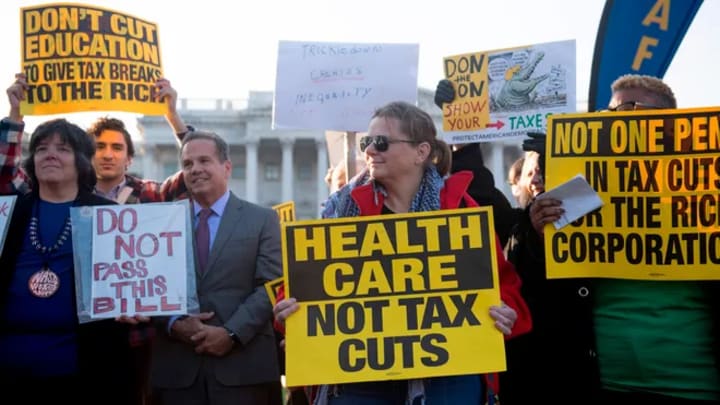
The CBO's analysis highlights one of the most contentious aspects of the bill: its impact on federal deficits and social safety nets. While the House-passed version was estimated to add $2.4 trillion to the debt over a decade, the Senate bill, according to a recent CBO analysis, would increase the deficit by nearly $3.3 trillion from 2025 to 2034. Furthermore, the CBO projects that 11.8 million more Americans would become uninsured by 2034 if the bill becomes law. These figures have fueled concerns among some conservative Republicans, who, despite their desire for tax cuts, are wary of the long-term fiscal implications and the potential political fallout from cuts to popular programs like Medicaid and SNAP.
Indeed, the internal fault lines within the GOP are as varied as the provisions within the bill itself. Fiscal conservatives, often the staunchest advocates for spending reductions, find themselves in a bind, torn between the allure of tax cuts and the ballooning national debt. While many welcome the extension of the TCJA provisions, some are pushing for even deeper cuts to offset the revenue loss, particularly in areas like healthcare. This has led to tense negotiations, with some senators expressing alarm over the potential impact on rural hospitals, which could face significant challenges under proposed Medical restrictions.
Adding another layer of complexity is the ongoing debate over the State and Local Tax (SALT) deduction cap. The 2017 TCJA capped the deduction at $10,000, a move that disproportionately affected residents in high-tax states. While the Senate version proposes an increase to $40,000 for five years, it remains a point of contention. Some conservative Republicans argue this is too generous, while House Republicans from blue states, whose constituents are most impacted by the cap, are pushing for an even higher or permanent increase, threatening to withhold their support without it.
Beyond the numbers, the political dynamics at play are palpable. Republican leaders, holding narrow majorities in both chambers, need almost every lawmaker on board to muscle the legislation through. This delicate balance was on full display during a recent procedural vote in the Senate, which saw a handful of Republican holdouts delay proceedings for hours, requiring direct intervention from President Trump and Vice President JD Vance to keep the bill on track. The President's direct appeals and even threats to campaign against dissenting senators underscore the high stakes involved and the pressure on party members to fall in line.
Democrats, meanwhile, have employed every tool at their disposal to expose what they view as the bill's shortcomings and delay its passage. From forcing a full reading of the 940-page text – a process that took some 16 hours – to preparing dozens of amendments for the upcoming "vote-a-rama," they are determined to "shine a light" on the legislation and its potential consequences for ordinary Americans. Their arguments often center on the distributive effects of the tax cuts, emphasizing that the greatest benefits accrue to the wealthiest, while simultaneously cutting essential services for vulnerable populations.
As the Senate enters what is expected to be a marathon session of debate and amendments, the fate of the "Big, Beautiful Bill" hangs in the balance. The ability of Republican leadership to bridge the chasm between competing demands – from fiscal conservatives to those worried about healthcare access and the SALT cap – will determine whether President Trump can secure this legislative victory by his self-imposed deadline. The current struggle is not merely about tax policy; it is a profound test of party unity, strategic maneuvering, and the very definition of the Republican agenda in the current political climate. The outcome will undoubtedly have far-reaching implications for the American economy, social welfare programs, and the trajectory of future fiscal policy.
About the Creator
Tallgirl
🌟 Hey hey! I'm Tallgirl 👩🦰💃 — standing tall (literally & figuratively) 💁♀️✨
Writer ✍️ | Dreamer ☁️ | Vibes Curator 🎧💫 | Life Observer 👀📓
📚 I write from the heart 💖 and the height 🗼
The Forsyth House Fire
Since 1851, Forsyth House has stood on the corner of Union Street and Gordon Street in the heart of Glasgow. Its iconic, or was... because on Sunday 8th of March, 2026, a fire broke out in a small, seemingly un-named shop in the building and tore all that history down. As I write, the rubble is still unsettled and the street is still blocked off. Central Station is quiet on the upper level, and around 30 small businesses have quite literally gone up in smoke.
By S. A. Crawford3 days ago in The Swamp
Wealthy British nationals fleeing Gulf conflict bypass UK to avoid tax bills
Wealthy British nationals living in the United Arab Emirates (UAE) and neighbouring Gulf states are choosing to relocate to countries such as Ireland and France rather than return to the United Kingdom amid rising conflict in the region — a decision driven largely by concerns over the UK tax system as the current tax year draws to a close. With only a few weeks left before the 2025–26 UK tax year ends on 5 April, many high‑net‑worth individuals who have established non‑resident status are hesitant to risk returning home for fear of triggering significant tax liabilities. The UK’s tax authority, HM Revenue & Customs (HMRC), counts the number of days an individual spends in the UK as a key determinant of tax residency; exceeding allowable days could make a non‑resident liable for UK income tax and capital gains tax on worldwide income and gains. Conflict prompts decisions rooted in tax, not safety The rising conflict in the Gulf region has forced many Britons to contemplate where to regroup. Rather than risk being treated as UK tax residents by spending too much time in Britain — and potentially face retroactive taxation — they are instead flying to countries perceived as more tax favourable until the new UK tax year begins. Ireland and France have become popular temporary destinations, offering a buffer until Britons can return without altering their tax status. A wealthy business owner, speaking to The Guardian, said he was spending time in Dublin to avoid returning prematurely to London, which could have triggered capital gains tax on assets or businesses that had been sold while he was abroad. “I’m happy to pay income tax and tax on investments next tax year, but I don’t want the sale of a business that I sold years ago to fall within UK capital gains tax,” he said. Exceptional circumstances relief unlikely Some expatriates hoped that current travel advisories related to the conflict might qualify them for HMRC’s “exceptional circumstances” rule — a provision that, in the past (notably during the COVID‑19 pandemic), allowed flexibility over residency tests for people unable to leave certain regions. But tax professionals warn that HMRC is unlikely to be sympathetic, noting that governments generally don’t consider advisory alerts sufficient to trigger tax‑year leniency. Nimesh Shah, chief executive of tax advisory firm Blick Rothenberg, told The Guardian that the current situation around the Gulf does not meet the stringent criteria HMRC applies for exceptional circumstances. “In HMRC’s mind they’ve chosen to go [to the UAE] to not pay tax in the UK,” he said, adding that those leaning on that provision may be disappointed. Tax rules and residency traps Under UK tax law, the Statutory Residence Test governs whether an individual is considered a UK resident for tax purposes. Spending too many days in the UK — typically more than 90 or 120 in a year, depending on circumstances — can trigger residency status. Once deemed resident, individuals may face income tax on worldwide earnings and capital gains tax (CGT) on gains realised abroad, including sales of businesses or investment assets. Those who have been non‑resident for fewer than five full tax years are particularly vulnerable. If they return and restart UK residency status, the UK’s Temporary Non‑Residence (TNR) rules could subject them to CGT on gains made while they were outside the country — even if those gains occurred years earlier. Broader context: wealthy Britons and tax migration This latest bout of relocation sits within a wider debate over the UK’s changing tax landscape. In recent years, reforms to the so‑called “non‑domiciled” tax regime and moves to tax worldwide income more comprehensively have prompted some wealthy individuals to reconsider their tax affairs and, in some cases, their residency. While broader “millionaire exodus” claims are contested and likely exaggerated, these current moves reflect how tightly the timing and interpretation of tax laws influence where the wealthy choose to live during periods of geopolitical stress. Public reaction and policy implications Reaction among the public and on social media has been mixed. Some commentators argue that if wealthy Britons benefit from UK services — including evacuation support — they should contribute to the tax base. Others take a more laissez‑faire view, noting that existing residency rules allow people latitude in where they live and pay tax, and that individuals often make these choices for legal, financial reasons rather than a disdain for their home country. For policymakers, these developments highlight ongoing tensions between tax competitiveness and fairness — a debate that is likely to continue as the UK navigates the post‑Brexit economic and political landscape. Subtitle: Wealthy British expatriates displaced by Gulf conflict are avoiding returning to the UK to protect tax‑favourable status, choosing alternative European destinations to evade potentially costly tax residency rules.
By Fiaz Ahmed 2 days ago in The Swamp




Comments
There are no comments for this story
Be the first to respond and start the conversation.