
NATO Chief Wishes ‘Good Luck’ to Those Who Think Europe Can Defend Itself Without U.S. Help
Why NATO’s blunt message is shaking Europe’s defense debate
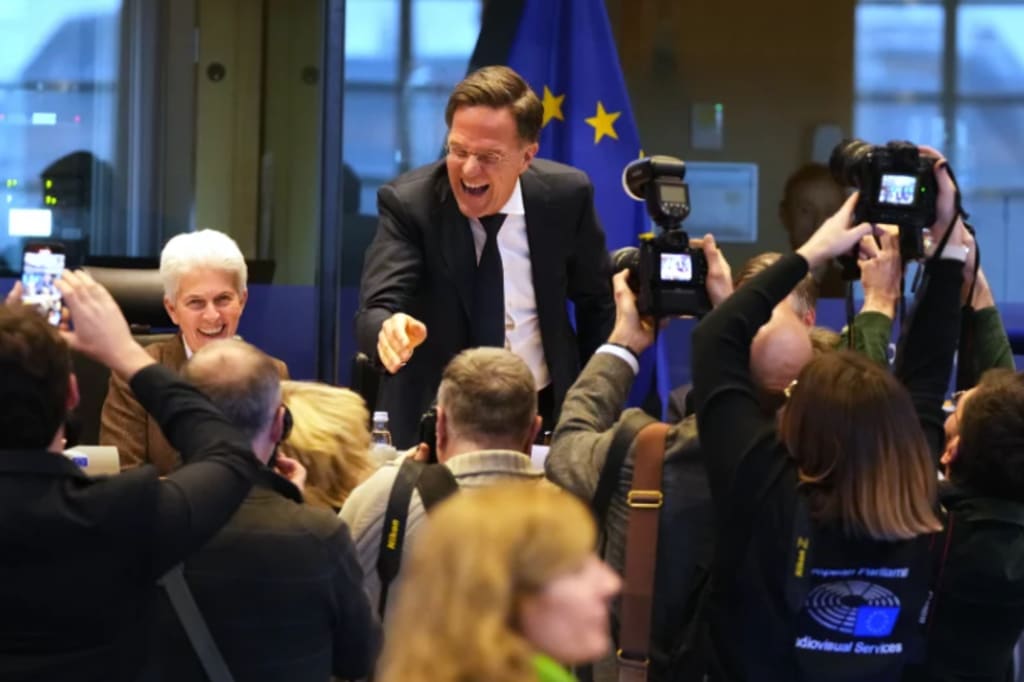
When NATO’s Secretary General bluntly tells Europe “good luck” if it believes it can defend itself without the United States, it’s more than just a sarcastic remark — it’s a wake-up call.
That’s exactly what happened when NATO chief Mark Rutte addressed European lawmakers, dismissing the idea that Europe could realistically secure itself without American military backing. His comments have since sparked intense debate about European strategic autonomy, NATO’s future, and whether Europe is truly prepared to stand on its own in an increasingly unstable world.
So, is Europe dreaming — or is NATO underestimating Europe’s potential? Let’s break it down.
A Blunt Reality Check From NATO’s Top Boss
Speaking in Brussels, Rutte didn’t mince words. He warned that any belief Europe could defend itself independently of the U.S. is deeply unrealistic.
His now-viral comment — wishing “good luck” to those who believe otherwise — reflects NATO’s core position: Europe’s security still relies heavily on American power. From advanced military technology to nuclear deterrence and logistics, the U.S. remains the backbone of NATO’s defense capabilities.
According to Rutte, even dramatic increases in European defense spending wouldn’t be enough to fully replace what the U.S. brings to the table.
Why Europe Still Depends on the United States
Despite recent efforts to boost military budgets, Europe lacks several critical components needed for independent defense:
Nuclear deterrence: The U.S. provides the majority of NATO’s nuclear umbrella.
Advanced intelligence and surveillance: American satellites, intelligence systems, and reconnaissance capabilities are unmatched.
Logistics and rapid deployment: U.S. forces can mobilize faster and at a larger scale than any European counterpart.
Command and coordination: NATO’s military structure is deeply integrated with U.S. leadership.
Rutte emphasized that even if European countries met ambitious defense spending goals — such as allocating 5% of GDP — it still wouldn’t be enough to fully replace U.S. involvement. To go completely solo, Europe would need to spend closer to 10% of GDP, along with developing its own nuclear deterrent — an enormously expensive and politically complex task.
The Growing Push for European Strategic Autonomy
The idea of Europe defending itself without the U.S. isn’t new. For years, leaders — especially in France — have argued for European strategic autonomy.
Supporters believe Europe should:
Reduce dependence on unpredictable U.S. politics
Build a stronger, unified European defense industry
Act independently in crises where U.S. interests may differ
The war in Ukraine, rising tensions with Russia, and uncertainty over future U.S. administrations have only intensified these calls.
But while the ambition is bold, critics argue the reality gap is massive.
Politics, Trump, and Transatlantic Tensions
Rutte’s remarks didn’t happen in a vacuum.
They come amid renewed uncertainty surrounding U.S. commitment to NATO, especially under President Donald Trump, who has repeatedly questioned why America should shoulder Europe’s defense burden.
Trump’s controversial statements — including hints that the U.S. might reconsider defending allies who don’t spend enough on defense — have rattled European capitals. Add to that diplomatic tensions over issues like Greenland, and it’s clear why Europe feels uneasy relying so heavily on Washington.
Ironically, Rutte himself helped calm recent tensions involving Greenland through diplomatic negotiations, highlighting NATO’s continued role as a stabilizing force — even when politics get messy.
Is Europe Truly “Dreaming”?
That’s where opinions divide.
Critics of Rutte say:
Europe can build credible defense capabilities — but it requires time, unity, and sustained investment. They argue NATO leaders underestimate Europe’s industrial capacity and political will.
Supporters argue:
Rutte is simply stating the obvious. Europe’s military fragmentation, lack of unified command, and slow decision-making make full independence unrealistic — especially in the short to medium term.
The truth likely sits somewhere in between.
The Cost of Going It Alone
One of Rutte’s strongest points was financial.
Creating a fully independent European defense system would require:
Massive long-term defense spending
Development of nuclear deterrence
Integrated European command structures
Expansion of defense manufacturing
All of this would cost hundreds of billions of euros — and that’s before political disagreements enter the picture.
For many European governments already struggling with inflation, public debt, and social spending, such costs would be difficult to justify.
What This Means for NATO’s Future
Rather than pushing Europe away from NATO, Rutte’s comments appear aimed at reinforcing a key message: Europe should strengthen itself within NATO, not outside it.
Most defense experts agree the most realistic path forward is:
Higher European defense spending
Fairer burden-sharing within NATO
Continued U.S. engagement
Stronger European capabilities that complement, not replace, NATO
This approach maintains alliance unity while addressing European concerns about over-dependence.
Final Thoughts: A Wake-Up Call, Not an Insult
Rutte’s “good luck” comment may sound dismissive, but it’s better understood as a strategic warning rather than a put-down.
Europe faces a critical choice:
Chase full independence at enormous cost and risk, or
Strengthen transatlantic cooperation while building real capabilities
In a world shaped by conflict, power politics, and uncertainty, one thing is clear — Europe’s security future will depend not just on ambition, but on realism, unity, and smart partnerships.
And for now, NATO believes that partnership still starts with the United States.
About the Creator
Keep reading
More stories from Aqib Hussain and writers in The Swamp and other communities.
UK’s Starmer Heads to China to Repair Ties as He Navigates Tensions with the US
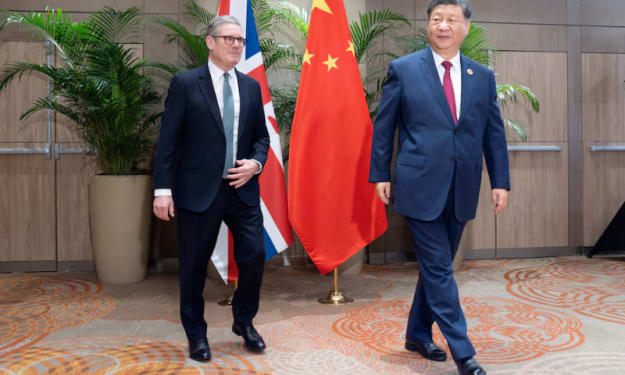
When British Prime Minister Sir Keir Starmer stepped onto Chinese soil this week, it wasn’t just another overseas visit — it was a signal. A signal that the United Kingdom is rethinking how it engages with the world’s major powers at a time when global alliances feel more fragile than ever. Starmer’s trip to China, the first by a UK leader in nearly eight years, comes amid strained relations with the United States, rising geopolitical uncertainty, and growing pressure to revive Britain’s economic prospects. Walking this diplomatic tightrope won’t be easy, but Starmer seems determined to prove that the UK doesn’t have to choose sides in an increasingly polarized world. Why This Visit Matters China is the world’s second-largest economy and the UK’s fourth-largest trading partner, with annual trade nearing £100 billion. Despite that, political relations between London and Beijing have been frosty in recent years, weighed down by concerns over human rights, cybersecurity, Hong Kong, and alleged espionage. Starmer’s visit marks a clear attempt to reset the tone. Rather than isolation or confrontation, his government is pursuing what it calls a “pragmatic” approach — one that recognizes China’s economic importance while still maintaining safeguards around national security and democratic values. Before departing, Starmer made his position clear: engaging with China does not mean abandoning the United States. “The UK won’t have to choose,” he said, emphasizing that economic realism must coexist with political caution. Economic Pressures at Home At the heart of this diplomatic push is economics. The UK economy has struggled with sluggish growth, high living costs, and post-Brexit uncertainty. For Starmer, unlocking new trade and investment opportunities is essential — and China represents a vast, largely untapped market for British businesses. The prime minister arrived in Beijing accompanied by senior ministers and business leaders from sectors including finance, healthcare, technology, and manufacturing. Meetings with Chinese President Xi Jinping and Premier Li Qiang are expected to focus on boosting cooperation, easing trade barriers, and encouraging Chinese investment into the UK. Currently, Chinese direct investment accounts for only a tiny fraction of total foreign investment in Britain — a figure Starmer hopes to improve. The US Factor Looms Large Starmer’s outreach to China cannot be separated from the current state of UK-US relations. Tensions with Washington have risen in recent months, driven by disagreements over trade policy, NATO commitments, and a more unpredictable American foreign policy stance. The US remains Britain’s closest ally and largest investor, but recent rhetoric and actions have made European leaders increasingly uneasy. By opening channels with Beijing, Starmer appears to be signaling that the UK intends to maintain strategic independence, even while preserving its transatlantic ties. It’s a delicate balancing act — one that will be closely watched in Washington as well as in European capitals. Critics Sound the Alarm Not everyone is convinced this reset is a good idea. At home, critics have accused the government of being too soft on China, warning that economic engagement could come at the cost of national security or moral credibility. Human rights organizations have urged Starmer to directly raise issues such as the erosion of freedoms in Hong Kong and the treatment of ethnic minorities in China. Security experts have also voiced concerns about expanding Chinese influence in the UK, particularly following approval for a new, large Chinese embassy in London. Skeptics fear that closer ties could increase the risk of surveillance or political interference. Starmer’s government insists that safeguards remain firmly in place. Britain’s Foreign Influence Registration Scheme, designed to monitor foreign lobbying and political activity, reflects this effort to engage without compromising security. Can Trade and Trust Coexist? One of the biggest questions surrounding Starmer’s visit is whether warmer diplomatic ties will actually translate into tangible economic gains. Previous British governments have attempted similar engagement strategies with China, often with limited long-term success. While trade volumes have grown, significant increases in Chinese investment or market access have proven elusive. Analysts warn that optimism must be tempered with realism. China’s economic slowdown, domestic policy priorities, and increasing self-reliance could limit how much progress can be achieved, regardless of political goodwill. Still, supporters argue that refusing to engage would only marginalize Britain further in a multipolar world. Europe Is Watching Closely Starmer’s visit also reflects a broader European reassessment of China. Across the continent, leaders are attempting to strike a balance between economic cooperation and strategic caution. The UK’s renewed engagement could serve as a test case for how middle powers navigate a world increasingly shaped by competition between Washington and Beijing. If Starmer can secure meaningful agreements without undermining democratic principles or security, it may strengthen Britain’s diplomatic standing and offer a model for others. A High-Stakes Diplomatic Gamble Ultimately, this trip is about positioning the UK for a future that looks very different from the past. Starmer is betting that Britain can maintain strong ties with the US while rebuilding pragmatic relations with China — all without losing its voice on human rights or national security. It’s a gamble shaped by economic necessity and geopolitical reality. Whether this strategy pays off will depend on what follows after the handshakes, photo-ops, and press statements fade. For now, Starmer’s China visit sends a clear message: the UK is no longer content to stand on the sidelines of global power shifts. Instead, it is trying to carve out a role that is flexible, independent, and economically focused — even if that path is fraught with tension. As the world watches how this diplomatic balancing act unfolds, one thing is certain: Britain’s relationship with both China and the United States is entering a new, more complicated chapter.
By Aqib Hussaina day ago in The Swamp
ICE Detains Five-Year-Old Minnesota Boy Arriving Home, Say School Officials
Authorities in Minnesota are facing scrutiny after reports that a five-year-old boy was detained by U.S. Immigration and Customs Enforcement (ICE) while arriving home from school, according to local school officials. The incident has sparked widespread concern among parents, educators, and immigrant rights advocates, raising questions about immigration enforcement, family separation, and child protection.
By Aarif Lashari7 days ago in The Swamp
Labour MP's Letter
Labour MPs described their mood in a letter to Sir Keir Starmer as "anxious and angry". Or to quote the full sentence, the 50 MPs who put their signatures to this letter said the blocking of Andy Burnham from standing in the Gorton and Denton by-election had caused them a "huge amount of anxiety and anger".
By Nicholas Bishopa day ago in The Swamp


Comments
There are no comments for this story
Be the first to respond and start the conversation.