
Mysterious Meteor in Karachi: Islamic and Global Views
Discover the truth behind the meteor in Karachi and explore Islamic, religious, and cultural perspectives on cosmic events.
Meteor in Karachi and What Does It Mean?
Introduction
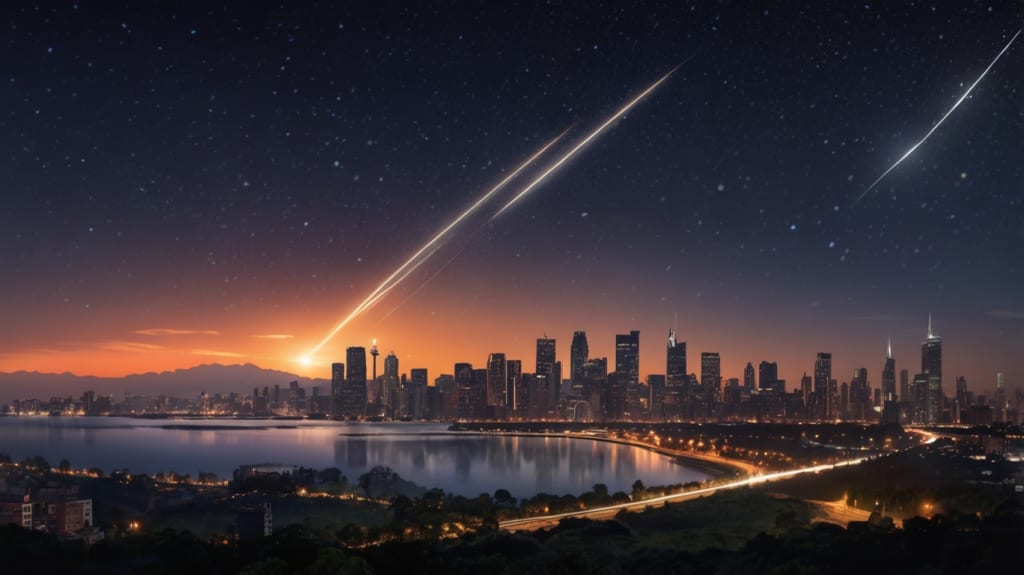
In the early hours of March 17, 2025, the skies over Karachi were illuminated by a spectacular meteor. Residents from various parts of the city, including Nazimabad, North Nazimabad, and Orangi Town, witnessed the rare celestial event as a bright, blazing meteor streaked across the night sky. Videos of the meteor quickly spread across social media, sparking widespread curiosity and amazement. This rare event has not only generated excitement among astronomers and space enthusiasts but also raised questions about its significance in religious and cultural contexts.
While science explains meteors as fragments of rock or metal from space burning up upon entering Earth's atmosphere, many religious and cultural traditions have attached spiritual or mystical meanings to such celestial events. This article explores the scientific explanation behind the meteor sighting and examines perspectives from Islam, other major religions, and cultural traditions on meteors and shooting stars.
What is a Meteor?
A meteor is a fragment of rock or metal from space that burns up upon entering the Earth's atmosphere due to intense friction with the air. This friction causes the meteor to heat up and produce a bright trail of light, commonly referred to as a "shooting star." Most meteors are small and disintegrate before reaching the ground, but larger ones may survive and hit the Earth’s surface as meteorites.
According to NASA, Earth encounters between 100 to 300 tons of space debris daily, most of which consists of tiny particles no larger than grains of sand. However, visible meteor events like the one in Karachi are rare and often associated with meteor showers or the entry of larger fragments from asteroids or comets.
The Meteor Sighting in Karachi
On March 17, 2025, at approximately 2:43 AM, Karachi residents were treated to a breathtaking sight when a bright meteor blazed across the night sky. Eyewitnesses described the meteor as a brilliant flash of light, followed by a loud sound resembling a distant explosion.
Social media platforms were soon flooded with videos and photos capturing the meteor’s path. Some residents reported feeling slight vibrations, although no structural damage was reported. The Pakistan Meteorological Department (PMD) later confirmed that the meteor was a natural occurrence and not associated with any man-made activity.
The rarity and intensity of the meteor sighting sparked a wave of interest, not only from astronomers and scientists but also from religious scholars and spiritual leaders who were asked about its significance in various belief systems.
What Does Islam Say About Meteors?
Islam recognizes the existence of celestial events like meteors, stars, and eclipses. The Quran mentions these phenomena as signs of Allah’s power and control over the universe. In Surah Al-Mulk (67:5), Allah says:
“And We have certainly beautified the nearest heaven with stars and have made [them] what is thrown at the devils and have prepared for them the punishment of the Blaze.”
This verse indicates that meteors and shooting stars serve not only as adornments of the heavens but also as a means of driving away evil spirits (shayateen). Islamic teachings suggest that meteors are a form of divine order and a reminder of Allah’s authority over creation.
Prophet Muhammad (PBUH) also referenced celestial events in his teachings. When there was an eclipse during the death of his son Ibrahim, some people speculated that the eclipse was a sign of mourning. The Prophet (PBUH) corrected this misunderstanding by saying:
“ The sun and the moon do not eclipse because of the death or life of anyone. When you see them, supplicate to Allah, and pray until the eclipse is over. ” (Bukhari)
This hadith emphasizes that celestial events are natural occurrences and not omens of good or bad fortune. Instead, they are opportunities to reflect on Allah's greatness and to turn to Him in prayer and gratitude.
Perspectives From Other Religions
While Islam offers a clear spiritual interpretation of meteors, other religions and cultures have also attached significance to these celestial events.
Christianity
In Christianity, celestial events such as meteors and comets have often been viewed as signs from God. In the Bible, stars and other celestial phenomena are mentioned as symbols of divine messages. The Star of Bethlehem, for instance, is described as a guiding light that led the Magi to the birthplace of Jesus Christ (Matthew 2:2). Some Christian scholars interpret meteors as signs of divine intervention or a call for spiritual reflection.
The Book of Revelation (6:13) mentions stars falling from the sky as part of the end-times prophecy:
“And the stars of the sky fell to the earth, as the fig tree sheds its winter fruit when shaken by a gale.”
Thus, in Christian tradition, meteors can be seen as both signs of God’s power and warnings of impending change or judgment.
Judaism
In Jewish tradition, celestial events are also considered signs from God. The Torah describes stars and heavenly bodies as part of God's creation and instruments of His will. Some Jewish interpretations suggest that meteors could symbolize divine messages or cosmic shifts. The Talmud mentions shooting stars as rare but significant events, often tied to spiritual introspection and the need for repentance.
The concept of the Shekhinah (divine presence) is also linked to celestial light. While meteors themselves are not directly referenced, the sudden appearance of light in the heavens is seen as a manifestation of God's glory.
Hinduism
In Hinduism, meteors and comets are believed to have both positive and negative meanings. A shooting star is sometimes interpreted as a soul ascending to the heavens or as a sign of a significant transition.
Hindu astrology (Jyotish) places great importance on celestial events. Meteors are seen as omens that could signal important changes in personal or societal life. Specific rituals and prayers may be performed to ward off negative effects or to harness the positive energy of such events.
Buddhism
In Buddhism, meteors are generally viewed as natural phenomena rather than spiritual signs. However, in some Buddhist traditions, meteors and comets are seen as symbols of impermanence and the transient nature of life. The sudden and fleeting appearance of a meteor reflects the Buddhist teaching that all things are temporary and constantly changing.
Meteors may also be interpreted as reminders to focus on spiritual growth and detachment from material concerns.
Pagan and Indigenous Beliefs
Many ancient pagan and indigenous cultures regarded meteors and shooting stars as messages from the gods or spirits. In Norse mythology, meteors were believed to be sparks from the weapons of the gods. Among Native American tribes, shooting stars were seen as spirits traveling across the sky or as omens of good or bad fortune.
In ancient Greek and Roman traditions, meteors were linked to the gods' activities and interpreted as signs of forthcoming events. Similarly, in Chinese culture, meteors have been viewed as symbols of destiny and cosmic order.
Scientific and Spiritual Reflection
From a scientific perspective, the meteor in Karachi was a natural phenomenon caused by a space rock entering Earth's atmosphere. However, religious and cultural traditions offer diverse interpretations that reflect humanity's fascination with the heavens.
In Surah Al-Baqarah (2:164), Allah says:]
“Indeed, in the creation of the heavens and the earth… are signs for a people who use reason.”
Islamic teachings, along with other religious and cultural interpretations, suggest that celestial events are not mere coincidences but signs that invite reflection, humility, and gratitude.
How Muslims Should Respond to Meteors?
Islam provides clear guidance on how to respond to extraordinary celestial events. When witnessing a meteor or any unusual occurrence in the sky, Muslims are encouraged to:
Praise Allah – Recognize that the event is a sign of Allah’s power and wisdom.
Seek Forgiveness – Such events should remind believers of their dependence on Allah and the importance of seeking His mercy.
Offer Prayers – Like during an eclipse, Muslims can offer voluntary prayers (Salat) and increase their supplications.
Avoid Superstition – Islam discourages attributing celestial events to bad omens or personal misfortune.
Conclusion
The meteor in Karachi was a captivating and rare celestial event that captured the attention of both scientists and religious scholars. While science explains meteors as natural phenomena caused by space debris burning up in the atmosphere, religious and cultural perspectives add deeper spiritual and symbolic meanings.
Islam teaches that meteors are signs of Allah’s greatness and control over the universe. Other religious and cultural traditions also interpret meteors as symbols of divine messages, cosmic shifts, and spiritual reminders. The meteor sighting in Karachi serves as a powerful reminder of the vastness of creation and the importance of reflection and gratitude in the face of extraordinary natural events.
About the Creator
Madi Speaks
Welcome to My blog channel where i (Madi Speaks) post daily trending content.
Discover engaging content on motivation, success, lifestyle, and trends. Stay inspired, informed, and curious as we explore stories that matter!
Keep reading
More stories from Madi Speaks and writers in The Swamp and other communities.
Deadly Train Hijacking in Balochistan Sparks Tensions
Understanding the Ongoing Conflict in Balochistan: A Deep Dive into the Latest Train Hijacking Incident Balochistan, Pakistan’s largest yet most sparsely populated province, has once again come under the global spotlight following a dramatic and deadly train hijacking incident. The hijacking of the Jaffar Express by militants from the Balochistan Liberation Army (BLA) has highlighted the long-standing tensions in the region. This article explores the details of the recent attack, the historical context of the Baloch insurgency, and the broader implications for regional stability and security.
By Madi Speaks12 months ago in The Swamp
The Saddest Thing - The Billionaires Who Rule America Aren't Even Enjoying Themselves
This single post says more about our ruling class than a thousand policy papers. The saddest thing about today's system is that the men robbing the rest of us - sabotaging our economic prospects, our pensions, our access to affordable healthcare - are not even happy.
By Scott Christenson🌴27 days ago in The Swamp
Tatt~Master
— Assembly Line Tatt Machine ~ Impressions to Impress — As I begin to understand more about the Tattoo Phenomenon. I've written silly, yet verbatim, dating site anecdotes in 'Frazzled.' So let me ask you: Would you be More attracted to someone slathered with tattoos, or Less?
By Jay Kantor5 days ago in Humor




Comments
There are no comments for this story
Be the first to respond and start the conversation.