
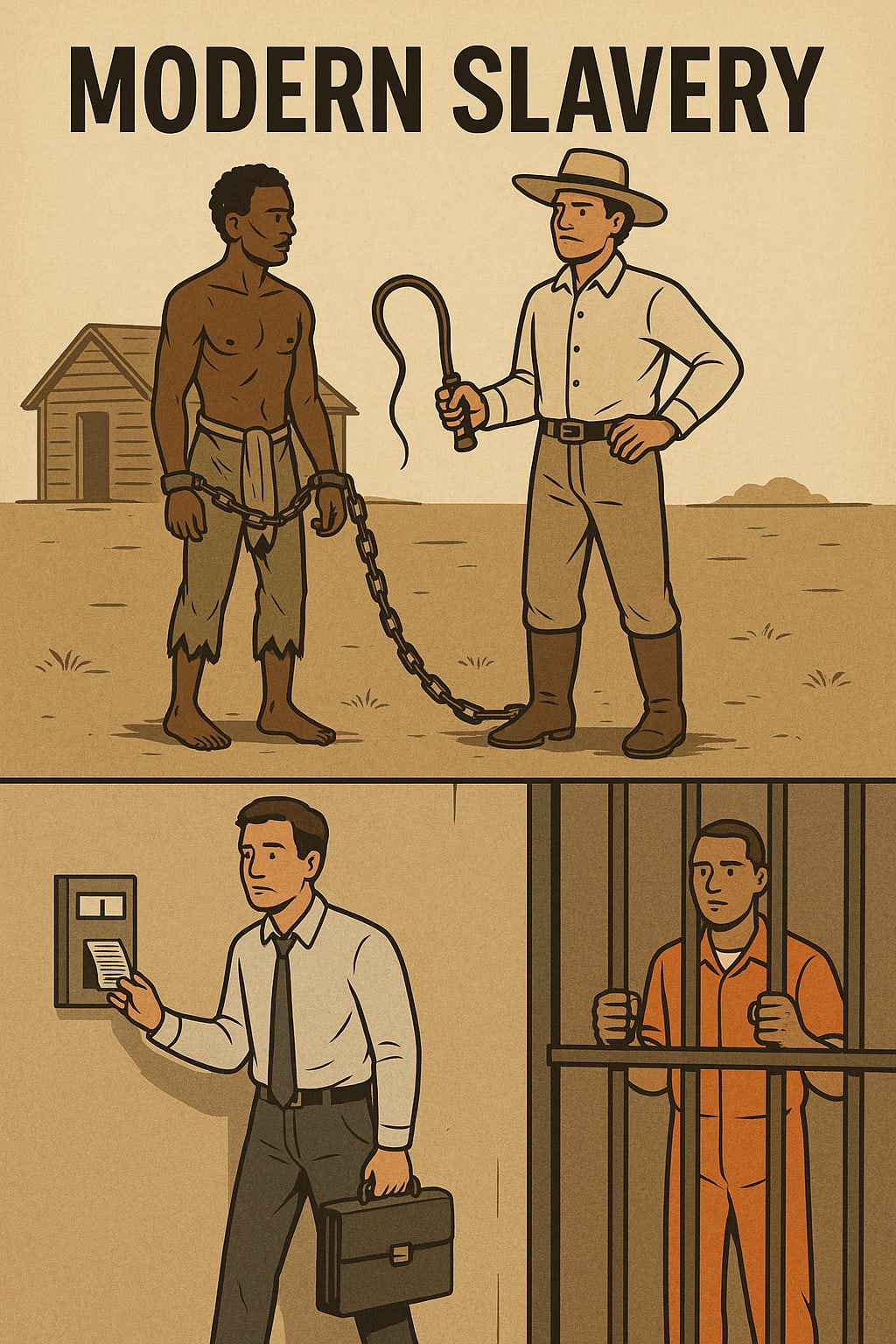
We like to believe slavery ended long ago. But if you zoom out, look past the patriotic slogans and the illusion of choice, you’ll see something chilling: the system didn’t die. It adapted. It modernized. And most people are still in chains—they just can’t see them.
From Plantations to Paychecks
Back then, slave owners provided just enough food, clothing, and shelter to keep laborers alive. They controlled their time, punished disobedience, and even gave “time off” when it served their interests.
Sound familiar?
Today, most people work just to afford the basics—housing, food, clothing. Their time is still controlled by bosses. Their freedom is still conditional. Step out of line, and you’re not whipped—you’re fired, evicted, or thrown into a prison system that literally profits off near-free labor. (Yes, slavery is still legal under the 13th Amendment if you’re incarcerated.)
It’s the same machine with shinier parts.
How the System Keeps You Compliant
Here’s how the modern version of slavery operates—and why so many accept it:
1. Economic Dependence
You're born into a system where survival requires money. Debt traps like student loans and rent hikes keep you tethered to jobs you hate.
2. The Illusion of Choice
You can choose your job, your shoes, your phone—but not whether to participate in the system itself. That’s not freedom; that’s window dressing.
3. Divide and Distract
They keep you fighting over race, gender, and party lines so you never look up and notice the real enemy: concentrated wealth and power.
4. Burnout as a Weapon
You’re too tired from 40+ hour weeks, rising prices, and side hustles to organize, resist, or even think clearly.
5. Fear of Falling
The moment you slip—lose your job, miss a payment, speak out—you’re punished. Homelessness or prison becomes a real threat. That fear is the leash.
The Prison Pipeline: Slavery Rebranded
The 13th Amendment outlawed slavery except as punishment for a crime. That loophole built the modern prison-industrial complex—and it's not colorblind.
Black Americans make up only 13% of the U.S. population but account for nearly 38% of the prison population.
That’s not justice. That’s systemic targeting. That’s profit-driven mass incarceration rooted in the same white supremacist logic that powered slavery.
Prisons are filled with disproportionately Black and Brown bodies—many working for literal pennies per hour, making products for corporations. It’s slavery. Just with paperwork.
Why People Don’t Rebel
Because the cage is invisible. Because we’re taught to blame ourselves. Because we’re promised if we just hustle hard enough, we’ll make it too. But you can’t “grind” your way out of a rigged game.
People don’t rebel because they’re weak. They don’t rebel because they’re exhausted, misinformed, and afraid.
So What Now?
Recognizing the system is the first step. Talking about it is the second. Real freedom requires real awareness—and a refusal to keep playing a game designed to keep you losing.
To move beyond awareness and talk, real change starts with action—both personal and collective. Here are some grounded ways to stop playing the rigged game:
1. Exit the Consumer Trap
Cut unnecessary spending tied to status or identity.
Barter, trade, reuse, and support local producers instead of corporations.
Own less so you owe less.
2. Reclaim Your Time
Reject hustle culture when possible. Prioritize rest and connection over productivity.
If able, shift to part-time work, start a collective, or pursue self-employment.
Build skills for autonomy: gardening, fixing, building, making.
3. Organize with Others
Join or form mutual aid networks, worker co-ops, or solidarity groups.
Push for prison abolition, labor rights, universal basic services, and economic justice.
Speak truth, even when it’s uncomfortable—especially when it’s uncomfortable.
4. Starve the System
Divest from big banks, corporations, and exploitative institutions.
Pull your data and attention from surveillance-based platforms. Support ethical tech.
Choose community over compliance and relationships over rules.
5. Educate and Agitate
Share what you know. Help others connect the dots without preaching.
Tell your story—your truth is disruptive in a system built on silence.
Don’t wait for permission. Create culture, not content.
You’re not alone—and you're not powerless. You just have to stop asking for freedom from those who profit off your captivity.
If this hits home, share it. Let’s make the invisible visible. The more we see it, the harder it is to ignore.
About the Creator
Keep reading
More stories from writers in The Swamp and other communities.
Trump Tests the Boundaries of His Power as Minnesota Pushes Back
The clash between federal authority and state autonomy has once again taken center stage in American politics, as former President Donald Trump’s latest assertions of power meet firm resistance from Minnesota’s leadership. The standoff highlights a deeper constitutional tension—one that goes beyond a single state or political personality and speaks to the evolving balance between Washington and the states in an era of intense polarization. At the heart of the dispute is Trump’s enduring political influence and his continued effort to shape national policy debates even outside the Oval Office. Through public statements, legal pressure, and mobilization of his political base, Trump has sought to assert a vision of executive power that stretches traditional norms. Minnesota, governed by leaders who emphasize states’ rights, civil liberties, and local control, has emerged as a prominent counterweight to that approach. Minnesota’s pushback is not merely symbolic. State officials have consistently defended their authority to interpret and implement policies in ways that reflect local values and legal frameworks. Whether the issue involves immigration enforcement, voting regulations, public health measures, or law enforcement cooperation, Minnesota’s stance underscores a broader resistance among Democratic-led states to what they view as federal overreach—or, in Trump’s case, an attempt to govern by pressure rather than constitutional process. Trump’s political style has long thrived on testing limits. During his presidency, he frequently challenged institutional guardrails, from the judiciary to Congress, arguing that decisive leadership required bold action. Supporters praised this approach as a rejection of bureaucratic inertia, while critics warned it eroded democratic norms. Even now, Trump’s rhetoric suggests a belief that executive power should be expansive, flexible, and closely tied to popular mandate rather than institutional restraint. Minnesota’s response reflects a contrasting philosophy. State leaders emphasize that the U.S. Constitution establishes a system of shared power, where states are not mere administrative units but sovereign entities with their own responsibilities and rights. By asserting legal challenges, issuing policy refusals, or reinforcing state laws, Minnesota is signaling that political popularity does not override constitutional boundaries. This confrontation resonates far beyond state lines. Other states are closely watching how Minnesota navigates the pressure, aware that precedents set today could shape future federal-state relations. If aggressive assertions of power go unchallenged, states fear a gradual weakening of their authority. Conversely, a strong and legally grounded resistance could reaffirm the importance of federalism in an increasingly centralized political environment. Public opinion remains sharply divided. Trump’s supporters argue that states like Minnesota obstruct policies aimed at national security, election integrity, or law and order. From their perspective, resistance is framed as defiance rather than defense of democratic principles. On the other hand, critics view Minnesota’s stance as a necessary safeguard against the concentration of power and the politicization of federal authority. Legal experts note that these conflicts often end up in court, where constitutional interpretation becomes the ultimate referee. The judiciary has historically played a crucial role in defining the limits of executive power, and future rulings may further clarify how far a president—or a former president with significant influence—can go in shaping state behavior. Minnesota’s willingness to challenge perceived overreach suggests confidence in the legal system as a counterbalance to political pressure. Beyond legal implications, the dispute also carries electoral significance. Minnesota’s resistance reinforces its identity as a state that values progressive governance and institutional checks. For Trump, confronting such states energizes his base and reinforces his image as a leader willing to confront opposition head-on. In this sense, the clash is as much about narrative as it is about policy. Ultimately, the struggle between Trump’s assertive political posture and Minnesota’s determined pushback reflects a defining question of modern American democracy: how power should be exercised, limited, and contested. As polarization deepens, these confrontations are likely to become more frequent, testing not only political alliances but the resilience of constitutional norms. Minnesota’s stand serves as a reminder that in the American system, power is not absolute. It is negotiated, challenged, and constrained through institutions designed to prevent dominance by any single figure or level of government. Whether this balance holds will shape the nation’s political trajectory long after the current disputes fade from the headlines.
By Fiaz Ahmed Brohi6 days ago in The Swamp
Physical AI: Robotics Are Poised to Revolutionize Business
The convergence of artificial intelligence (AI) and robotics is ushering in a new era of “Physical AI,” promising to transform the way businesses operate across industries. Unlike traditional software AI, Physical AI combines machine learning with autonomous machines capable of interacting with the physical world—robots that can perceive, learn, adapt, and execute tasks without human intervention.
By Aarif Lashari4 days ago in The Swamp
Five—One Grounding
Five—Locked in a perpetual battle against my failing senses and reason, I fight to survive, to get through; I am afraid of... nothingandeverythingallatonce—...—my mouth is dry, and my muscles seize up... what can I see? I can see the birdcage and birds; I can see the watercolour my beautiful wife painted many years ago and unlocked her journey into art; I can see the empty mug of tea as it sits perilously on the arm of the sofa; how many is that now? Three down, two to go; I can also see a jackdaw on the roof of our neighbour's house across the road and a bookcase of potential—Five things you can see.
By Paul Stewart7 days ago in Poets



Comments
There are no comments for this story
Be the first to respond and start the conversation.