
Malaysia Agriculture Equipment Market Size and Forecast 2025–2033
How Mechanization, Smart Farming, and Government Support Are Transforming Malaysian Agriculture

Malaysia Agriculture Equipment Market Overview
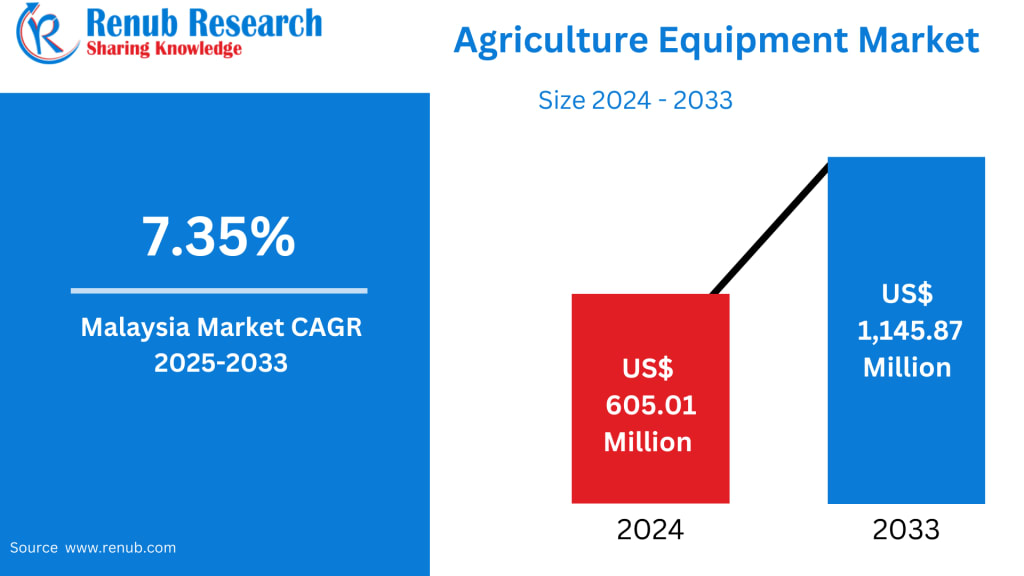
The Malaysia Agriculture Equipment Market is entering a phase of steady and meaningful transformation as the country accelerates its shift toward modern, mechanized farming. According to Renub Research, the market was valued at US$ 605.01 million in 2024 and is expected to reach US$ 1,145.87 million by 2033, growing at a CAGR of 7.35% from 2025 to 2033.
This growth reflects Malaysia’s broader agricultural modernization strategy, driven by rising farmer incomes, labor shortages, and increased emphasis on food security. Automation and mechanization are no longer optional in Malaysian agriculture—they are becoming essential. As climate uncertainty, urbanization, and aging farming populations reshape the sector, the demand for efficient, reliable, and affordable agricultural machinery continues to rise across the country.
Government-backed incentives, favorable weather conditions for crop production, and financial support programs for farmers across income groups are further strengthening market momentum. Together, these factors are positioning Malaysia as one of Southeast Asia’s steadily growing markets for agricultural equipment.
Malaysia Agriculture Equipment Industry Landscape
Malaysia’s agricultural sector has traditionally been dominated by smallholder farmers, particularly in crops such as palm oil, rice, rubber, fruits, and vegetables. While this structure has sustained rural livelihoods for decades, it has also limited productivity due to heavy dependence on manual labor and outdated farming practices.
In recent years, the industry has begun transitioning toward mechanized and semi-automated solutions. Tractors, irrigation machinery, harvesting equipment, and planting systems are increasingly replacing manual tools, especially in regions facing acute labor shortages. This shift is not only improving productivity but also making farming more attractive to younger generations.
Manufacturers and distributors are adapting their product portfolios to suit small landholdings, diverse terrain, and tropical climate conditions. Compact tractors, multi-purpose equipment, and energy-efficient irrigation systems are gaining popularity because they deliver high efficiency without requiring large-scale infrastructure.
However, despite the positive trajectory, challenges remain. High initial investment costs, limited access to financing, fragmented land ownership, and lack of technical expertise continue to restrict widespread adoption. Overcoming these barriers will be critical to unlocking the full potential of the Malaysian agriculture equipment market.
Key Growth Drivers of the Malaysia Agriculture Equipment Market
1. Strong Government Support and Policy Framework
Government intervention has played a central role in modernizing Malaysia’s agricultural sector. Initiatives such as the Agrofood Policy 2021–2030 aim to enhance food security, improve productivity, and reduce labor dependency through mechanization and digital farming.
Subsidies, grants, and soft loan schemes have made machinery more accessible to small and medium-sized farmers. Equipment-sharing programs and cooperative models are also being promoted to reduce ownership costs. These policies are accelerating mechanization, particularly in rice farming and plantation agriculture, and are expected to remain key growth enablers through 2033.
2. Technological Advancements in Farming Equipment
Technology is reshaping the agricultural equipment landscape in Malaysia. Farmers are increasingly adopting GPS-enabled tractors, smart irrigation systems, automated sprayers, and harvesting machinery that improve precision and reduce waste.
Modern irrigation systems, including micro-irrigation and sprinkler technologies, are helping farmers optimize water usage while increasing yields. Automated machinery reduces operational time, lowers labor costs, and enhances consistency across farming operations. As prices decline and financing improves, the adoption of advanced equipment is expected to accelerate rapidly.
3. Rising Demand for Productivity and Efficiency
With increasing domestic food demand and export pressure, Malaysian farmers are under constant pressure to improve yields and reduce costs. Mechanization provides a direct solution by allowing farmers to cultivate larger areas in less time with fewer workers.
Sectors such as palm oil, rubber, rice, and horticulture are witnessing growing adoption of tractors, harvesters, and planting machinery. Higher productivity not only boosts farmer incomes but also strengthens Malaysia’s competitiveness in regional and global agricultural markets.
4. Labor Shortages and Aging Farming Population
One of the most significant drivers of mechanization is the shortage of agricultural labor. Young Malaysians are increasingly moving toward urban employment, leaving farms with an aging workforce. Equipment automation helps bridge this gap by reducing the reliance on manual labor.
Machinery such as self-propelled harvesters and automated sprayers allows farms to maintain output levels even with fewer workers, making technology adoption a necessity rather than a luxury.
Challenges in the Malaysia Agriculture Equipment Market
High Initial Investment Costs
Despite government support, the upfront cost of modern equipment remains a significant barrier for many smallholder farmers. Tractors, harvesters, and irrigation systems require substantial capital, and maintenance costs further add to the burden. Limited access to affordable financing in rural areas slows adoption, particularly among low-income farmers.
Fragmented Land Holdings and Small-Scale Farming
Malaysia’s agricultural landscape is highly fragmented, with many farmers owning small plots of land. Large machinery is often unsuitable or economically unjustifiable for such holdings. This limits the adoption of high-capacity equipment and slows overall market expansion.
Manufacturers must continue to focus on compact, multi-functional, and affordable solutions tailored to small farms to overcome this challenge.
Malaysia Agriculture Equipment Market Segmentation
By Machinery Type
Irrigation Machinery
Tractors
Ploughing and Cultivation Machinery
Harvesting Machinery
Haying and Forage Machinery
Planting Machinery
Sprayers
Among these, tractors and irrigation machinery account for a major share of the market due to their widespread use across crop types.
Irrigation Machinery
Gravity Irrigation
Micro-Irrigation
Sprinkler Systems
Micro-irrigation systems are experiencing the fastest growth due to their water-saving capabilities and suitability for precision farming.
Tractors by Engine Power
Less than 40 HP
41 to 100 HP
More than 100 HP
Tractors under 40 HP dominate the market as they are ideal for small and medium-sized farms, offering affordability and versatility.
Ploughing and Cultivation Machinery
Cultivators and Tillers
Harrows
Ploughs
Others
These machines play a critical role in improving soil preparation efficiency and reducing manual labor requirements.
Harvesting Machinery
Combine Harvesters
Harvesting Robots
Self-Propelled Forage Harvesters
Automation in harvesting is gaining traction as it reduces crop losses and improves time efficiency, especially during peak seasons.
Haying and Forage Machinery
Mowers
Balers
Tedders and Rakes
Forage Harvesters
These machines are particularly important for livestock farming and are seeing rising adoption in integrated farming systems.
Competitive Landscape and Company Analysis
The Malaysia agriculture equipment market features both global giants and specialized manufacturers. Companies are increasingly focusing on localized products, after-sales service, and financing solutions to strengthen their presence.
Key Players Covered
John Deere
CNH Industrial
AGCO Corporation
KUBOTA Corporation
Titan Machinery Inc.
CLAAS
Lindsay Corporation
Alamo Group Inc.
Competitive Strategies
Leading players are adopting a mix of strategies, including:
Launching compact and fuel-efficient machinery
Expanding dealer and service networks
Offering flexible financing options
Investing in precision farming and smart technology
Partnering with government agencies and cooperatives
Kubota and John Deere continue to dominate the tractor segment, while companies like Lindsay Corporation lead in irrigation technologies. Innovation and after-sales support are becoming key differentiators in the competitive landscape.
Future Outlook: Malaysia Agriculture Equipment Market 2025–2033
The future of Malaysia’s agriculture equipment market looks strong and resilient. Rising mechanization, government backing, and technological advancements will continue to push growth across all segments. By 2033, the market is expected to nearly double in size, driven by increasing demand for efficient and sustainable farming practices.
Smart farming, automation, and climate-resilient equipment will shape the next phase of development. Manufacturers that focus on affordability, adaptability, and local customization will be best positioned to succeed.
Final Thoughts
Malaysia’s agricultural equipment market is undergoing a quiet but powerful transformation. As the nation balances food security, sustainability, and economic growth, mechanization is becoming the backbone of modern agriculture. With strong policy support, improving farmer awareness, and rising adoption of smart technologies, the market is set to grow steadily through 2033.
For investors, manufacturers, and policymakers, the message is clear: the future of Malaysian agriculture is mechanized, efficient, and technology-driven—and the agriculture equipment market will be at the center of that evolution.
About the Creator
Keep reading
More stories from Aaina Oberoi and writers in The Swamp and other communities.
Europe Electric Vehicle Market Size and Forecast 2025–2033
Introduction: Europe’s Electric Moment Has Arrived Europe is entering a defining decade for transportation. As climate goals intensify and governments tighten emission norms, the continent is rapidly transforming how people move, commute, and transport goods. Electric vehicles (EVs), once considered niche alternatives, are now at the center of Europe’s mobility strategy.
By Aaina Oberoi3 days ago in The Swamp




Comments
There are no comments for this story
Be the first to respond and start the conversation.