
Lead Acid Battery Market Size & Forecast 2026–2034
Why the World’s Oldest Battery Technology Still Powers a Multi-Billion-Dollar Energy Economy

Introduction: An Old Technology with New Relevance
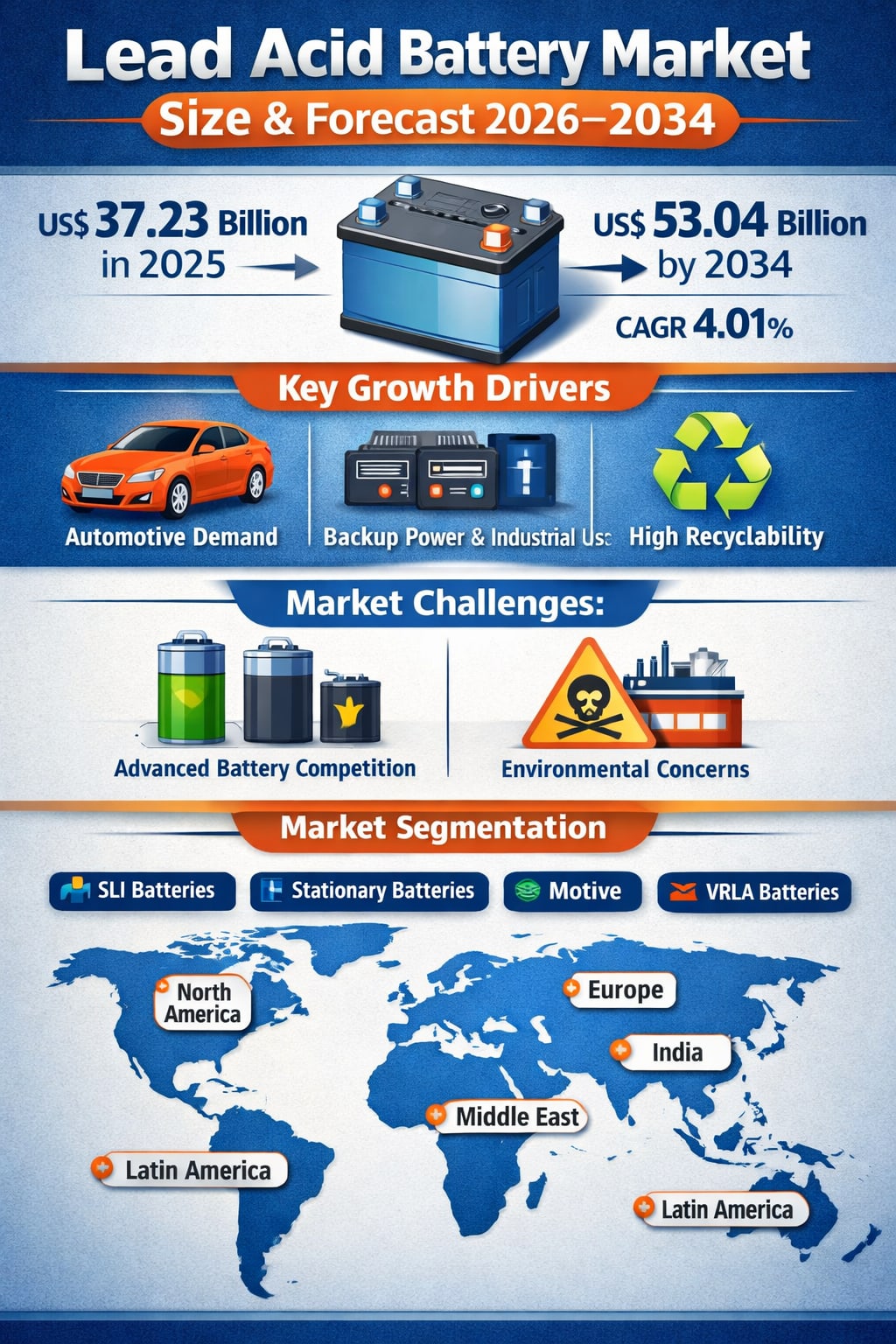
In a world racing toward electric vehicles, renewable energy storage, and next-generation battery chemistries, it would be easy to assume that lead acid batteries are fading into history. Yet, the reality is quite the opposite. The global Lead Acid Battery Market, valued at US$ 37.23 billion in 2025, is projected to reach US$ 53.04 billion by 2034, expanding at a compound annual growth rate (CAGR) of 4.01% during 2026–2034.
This steady growth is being fueled by sustained demand from the automotive sector, the telecommunications and data center industries, and the expanding need for industrial backup and renewable energy storage. At the same time, continuous improvements in battery design, recyclability, and cost efficiency are helping lead acid batteries remain commercially relevant despite intense competition from lithium-ion and other advanced chemistries.
The result is a market that is not driven by hype, but by reliability, economics, and infrastructure reality—three factors that continue to favor lead acid batteries across both developed and emerging economies.
Market Outlook: Why Lead Acid Still Matters
A lead acid battery is a secondary (rechargeable) battery that uses lead dioxide as the positive electrode, sponge lead as the negative electrode, and sulfuric acid as the electrolyte. It is one of the oldest and most widely used battery technologies in the world, known for its dependability, simplicity, and low production cost.
One of its key strengths is the ability to deliver high surge currents, making it ideal for applications such as:
Automotive starting, lighting, and ignition (SLI) systems
Uninterruptible power supplies (UPS)
Telecom backup systems
Industrial and commercial backup power
Renewable energy storage and forklifts
Despite the rapid development of newer battery technologies, lead acid batteries continue to dominate many of these applications, especially in cost-sensitive and infrastructure-heavy markets. In developing economies, their affordability and established recycling ecosystem make them particularly attractive for both residential and industrial energy storage needs.
Ongoing improvements in plate design, durability, and efficiency are further extending their usable life and performance, strengthening their position in global energy systems.
Key Growth Drivers
1. Strong Demand from Automotive and Transportation
The automotive sector remains the largest and most consistent demand source for lead acid batteries. Conventional internal combustion engine (ICE) vehicles rely heavily on lead acid batteries for SLI applications due to their low cost and high power output.
Even as electric vehicles gain market share, lead acid batteries continue to be used in:
Hybrid vehicles
Commercial fleets
Two-wheelers and off-road vehicles
Start-stop systems in modern cars
Global vehicle ownership continues to rise, particularly in emerging economies, which directly supports replacement battery demand. Batteries are consumables with a limited lifespan, ensuring recurring market demand regardless of new vehicle sales cycles.
According to the International Energy Agency, global EV sales reached 14 million units in 2023, a 35% year-on-year increase. While this trend favors advanced batteries, it also indirectly supports the broader automotive ecosystem, where auxiliary and backup battery systems still rely heavily on lead acid technology.
2. Rising Use in Backup Power and Industrial Applications
The growing dependence on digital infrastructure is driving strong demand for reliable backup power solutions. Data centers, telecom networks, hospitals, manufacturing plants, and commercial buildings all require uninterrupted power supply systems to avoid costly downtime.
Lead acid batteries remain a preferred choice in these environments because they are:
Cost-effective
Proven and reliable
Easy to scale for large installations
Supported by mature supply and service networks
With increasing investments in telecom expansion, cloud computing, and data centers, especially across Asia-Pacific, the Middle East, and Africa, demand for stationary and industrial lead acid batteries is expected to remain strong throughout the forecast period.
3. High Recyclability and Circular Economy Support
One of the strongest long-term advantages of lead acid batteries is their exceptionally high recycling rate. Among all battery technologies, lead acid batteries have one of the most efficient closed-loop recycling systems, with most of the lead and plastic components recovered and reused.
This brings multiple benefits:
Lower raw material costs
Reduced environmental impact
More stable supply chains
Strong regulatory and policy support
Governments and regulators often favor battery systems with established end-of-life management, which further strengthens the market position of lead acid batteries. Innovations in recycling technology, including low-emission and high-efficiency recovery processes, are also improving the sustainability profile of this industry.
Market Challenges
1. Competition from Advanced Battery Technologies
The biggest challenge facing the lead acid battery market is the rapid rise of lithium-ion and other advanced batteries. These alternatives offer:
Higher energy density
Longer cycle life
Lighter weight
Better performance in EVs and renewable energy storage
As costs of lithium-ion batteries continue to decline, they are increasingly replacing lead acid batteries in applications where performance and weight matter more than cost. This competitive pressure is forcing lead acid battery manufacturers to either innovate or focus on niche, cost-sensitive, and infrastructure-driven segments.
2. Environmental and Health Concerns
Lead is a toxic material, and improper manufacturing, handling, or recycling can cause serious environmental and health risks. Governments worldwide enforce strict regulations on lead mining, battery production, transportation, and recycling.
While these regulations improve safety and sustainability, they also increase compliance costs for manufacturers. In some developing regions, inadequate recycling infrastructure remains a concern, potentially leading to tighter restrictions in the future.
Key Market Segments
SLI Lead Acid Battery Segment
The SLI segment remains the backbone of the automotive battery market. These batteries are designed to deliver high burst currents required to start engines. Their low cost, reliability, and widespread compatibility ensure continued dominance, particularly in emerging markets where ICE vehicles still represent the majority of the vehicle fleet.
Flooded Lead Acid Battery Segment
Flooded batteries are widely used in automotive, industrial, and stationary applications due to their simple design and low upfront cost. They are common in forklifts, backup power systems, and renewable energy storage setups where regular maintenance is acceptable. Despite maintenance requirements, their durability and recyclability keep them economically attractive.
OEM Lead Acid Battery Segment
Original Equipment Manufacturer (OEM) demand is driven by vehicle production volumes and long-term supply contracts with automakers. Lead acid batteries remain a standard fit in most conventional vehicles and many hybrid models, ensuring stable, high-volume demand, particularly in Asia-Pacific manufacturing hubs.
Application Insights
Automotive: Still the largest application segment, driven by both OEM and replacement demand.
Telecom: Growing need for reliable backup power in towers and base stations, especially in developing regions.
UPS and Data Centers: Critical for ensuring uninterrupted operations in healthcare, IT, and commercial facilities.
Others: Includes industrial equipment, renewable energy storage, and motive power applications.
Regional Outlook
United States
The U.S. market is mature and supported by strong automotive replacement demand, industrial backup systems, and a highly developed battery recycling ecosystem. While lithium-ion adoption is growing, lead acid batteries remain widely used due to their cost advantage and regulatory-supported recycling infrastructure.
United Kingdom
The UK market is driven by automotive replacement demand, UPS installations, and renewable energy support systems. Strict recycling regulations ensure high compliance and sustainability, helping maintain the relevance of lead acid batteries even as EV adoption increases.
India
India represents one of the fastest-growing markets due to rapid urbanization, expanding automotive ownership, frequent power outages, and massive telecom infrastructure growth. Cost-effectiveness and availability make lead acid batteries a preferred choice for residential, commercial, and industrial backup power.
Saudi Arabia
Harsh climate conditions, large infrastructure projects, and expanding telecom and industrial sectors drive strong demand for lead acid batteries. Their proven reliability and lower cost keep them highly competitive despite growing interest in newer battery technologies.
Competitive Landscape
Major companies operating in the global lead acid battery market include:
EnerSys
Exide Industries Limited
GS Yuasa Corporation
HBL Power Systems Limited
Leoch International Technology Limited
Panasonic Holdings Corporation
Teledyne Technologies Incorporated
These companies compete on product reliability, distribution reach, recycling capabilities, and long-term OEM partnerships, while also investing in incremental technology improvements and sustainability initiatives.
Market Segmentation Snapshot
By Product:
SLI
Stationary
Motive
By Construction Method:
Flooded
Valve Regulated Sealed Lead Acid (VRLA)
By Sales Channel:
OEM
Aftermarket
By Application:
Automotive
UPS
Telecom
Others
By Region:
North America, Europe, Asia Pacific, Latin America, Middle East & Africa
Final Thoughts: A Market Built on Reliability, Not Hype
The global Lead Acid Battery Market may not grab headlines like lithium-ion or solid-state batteries, but its importance to the modern energy and transportation ecosystem remains undeniable. With the market expected to grow from US$ 37.23 billion in 2025 to US$ 53.04 billion by 2034, lead acid batteries will continue to play a critical supporting role in automotive systems, industrial backup power, telecom infrastructure, and energy storage.
Driven by cost efficiency, proven performance, and unmatched recyclability, this century-old technology is evolving—not disappearing. While advanced batteries will dominate high-performance applications, lead acid batteries will remain the workhorse of global power reliability well into the next decade.
About the Creator
Why Black History Matters in America?
The United States of America is celebrating their 250th anniversary in 2026. I'm proud to be an American and as someone who was born here, I wouldn't imagine myself living anywhere else. This is a country where opportunities are possible. Where anyone can be successful in anything they desire to do. Equality, community, and togetherness are the backbones of what America is and should be about. However, we have an administration who wants to erase and disregard those who have made positive, meaningful impacts in our country, specifically Black figures, such as Martin Luther King, Jr., Rosa Parks, and Maya Angelou. President Trump and his administration have been constantly complaining and fighting against what they call the "Woke agenda". They use this excuse as a distraction from other issues they refuse to address, such as the high cost of living, climate change, and inflation. That equality is dividing America, when in reality, it's bringing us together. Being woke is not tied to a specific political party. No matter where you stand on the political spectrum, you can still care about other people and their plights. Compassion and empathy for others isn't tied to a political party, either. We were taught as children to treat others the way we want to be treated and not judge others because they're different from us. Caring about others isn't a personal attack on your beliefs. It doesn't make you any less of a person. People who are easily offended over African American figures, past or present, or anything related to it, are grasping at straws. Current and future generations need to know who people like Harriet Tubman and Shirley Chisholm were, especially in the classroom. Black History is part of American History. It should be recognized, not hidden or forgotten. Besides, you can't shield children from everything, just because your feelings are easily hurt.
By Mark Wesley Pritchard 7 days ago in The Swamp
UN Human Rights Agency in ‘Survival Mode’, Chief Warns
The United Nations Human Rights Office, one of the world’s most important watchdogs for justice, dignity, and accountability, is facing an unprecedented crisis. According to its chief, the agency is now operating in what he has described as “survival mode,” a stark warning that highlights deep financial strain, political pressure, and growing global instability at a time when human rights protections are needed more than ever.
By Ayesha Lashari2 days ago in The Swamp
The Devil's Triangle
The sails ruffled in the breeze as we cruised along. The Sea Breeze was a mid-size catamaran that sailed out of Royal Naval Dockyard in Bermuda. We had booked this trip weeks in advance and were now looking at our Captain, Spike and two boat hands. Paddy and Wilson seemed like nice guys, joking around with the passengers and telling us some stories about Bermuda that only locals would know. Their island accents sounded almost British but they were pleasant to listen to.
By Barbara Gode Wiles5 days ago in Fiction


Comments
There are no comments for this story
Be the first to respond and start the conversation.