
United States Maintenance, Repair, and Operations Market Size and Forecast 2026–2034
How aging infrastructure, automation, and predictive maintenance are reshaping America’s industrial backbone

United States Maintenance, Repair, and Operations Market Outlook
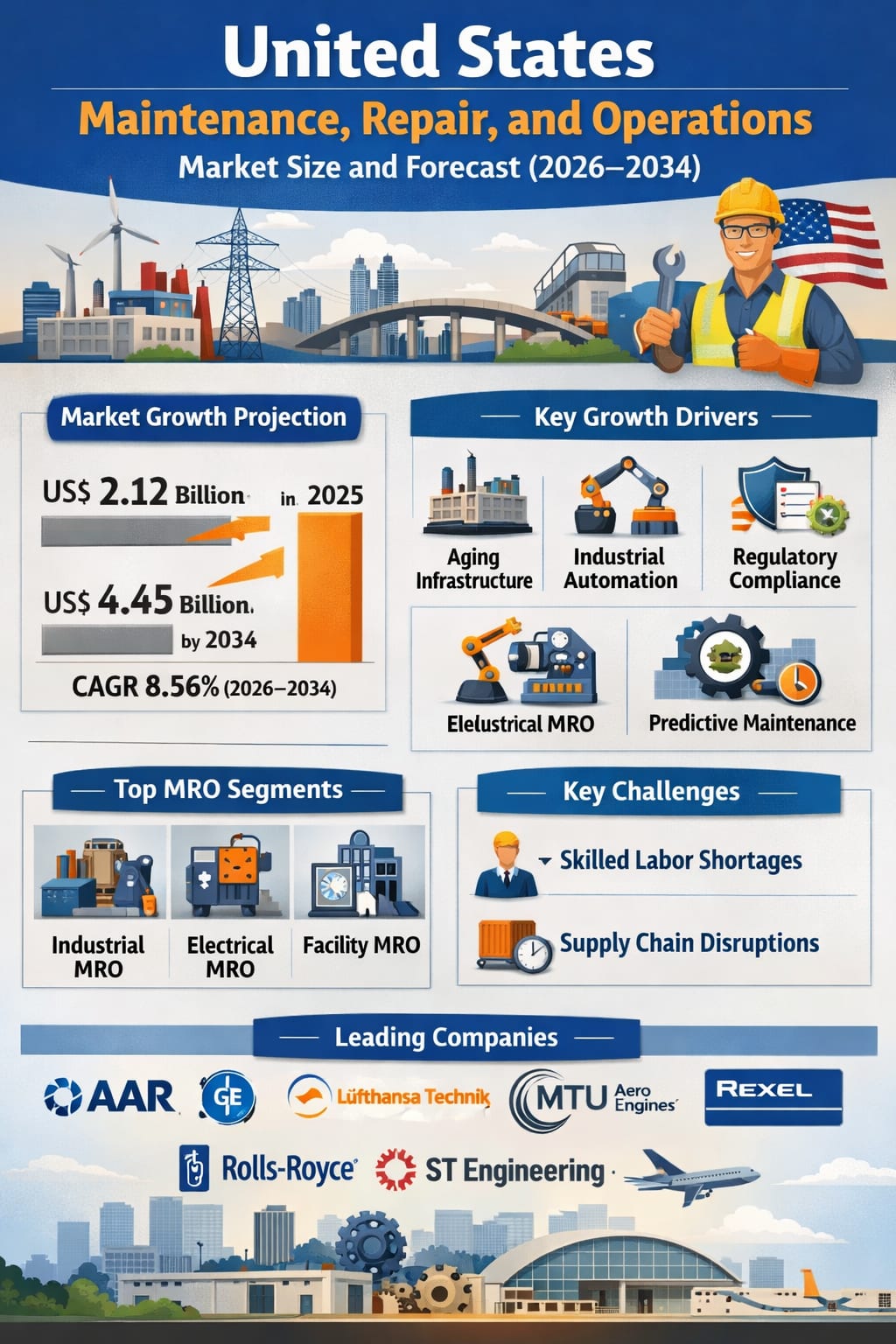
The United States Maintenance, Repair, and Operations (MRO) market is entering a decade of sustained expansion as industries prioritize reliability, efficiency, and asset longevity. According to Renub Research, the U.S. MRO market is expected to grow from US$ 2.12 Billion in 2025 to US$ 4.45 Billion by 2034, registering a CAGR of 8.56% during 2026–2034. This steady growth reflects the increasing importance of maintenance-led strategies in a nation built on complex industrial, energy, transportation, and commercial infrastructure.
Maintenance, Repair, and Operations (MRO) refers to the materials, services, tools, spare parts, and processes required to keep equipment, facilities, and production systems operating safely and efficiently. Unlike capital investments, MRO spending focuses on preserving existing assets—reducing downtime, extending asset life, ensuring regulatory compliance, and maintaining operational continuity.
In the United States, MRO has evolved from a cost center into a strategic function. With aging infrastructure, rising automation, and tighter safety regulations, organizations are shifting from reactive repairs to preventive and predictive maintenance models. Advanced technologies such as IoT sensors, artificial intelligence, and data analytics are transforming how maintenance decisions are made, strengthening the long-term outlook of the U.S. MRO market.
Market Size and Forecast: A Decade of Reliable Growth
Renub Research projects strong and consistent growth for the U.S. MRO market through 2034. The near-doubling of market value over the forecast period highlights how essential maintenance has become across sectors.
Several structural factors support this trajectory:
Aging industrial and public infrastructure requiring frequent upkeep
Expansion of domestic manufacturing and reshoring initiatives
Rapid adoption of automation and digital production systems
Rising compliance costs linked to safety and environmental regulations
Increased reliance on predictive maintenance to minimize downtime
Unlike discretionary spending, MRO investment is largely non-negotiable. Even during economic slowdowns, organizations continue to allocate budgets for maintenance to ensure business continuity, making the MRO market resilient and dependable.
Key Growth Drivers in the United States MRO Market
Aging Infrastructure and Equipment Modernization
One of the most powerful drivers of MRO demand in the U.S. is aging infrastructure. Manufacturing plants, power grids, transportation networks, and industrial facilities built decades ago remain operational today. Replacing entire systems is often cost-prohibitive, leading organizations to extend asset life through continuous maintenance and retrofitting.
Preventive maintenance programs help reduce unplanned shutdowns, while predictive maintenance—powered by sensors and analytics—identifies potential failures before they occur. Modernization efforts, including the integration of automation components and energy-efficient upgrades, further increase demand for specialized MRO services and parts.
Large-scale investments in grid modernization and industrial upgrades continue to reinforce this trend, ensuring long-term demand for electrical, mechanical, and facility MRO solutions.
Expansion of Manufacturing and Industrial Automation
The revival of U.S. manufacturing plays a central role in boosting MRO spending. Reshoring initiatives, supply chain diversification, and government incentives are driving new factory construction and capacity expansion across multiple states.
Advanced manufacturing facilities rely heavily on robotics, CNC machinery, automated assembly lines, and digitally controlled systems. These technologies require continuous calibration, software updates, electrical servicing, and mechanical maintenance. As production cycles accelerate and downtime costs rise, manufacturers are increasingly investing in preventive MRO strategies rather than reactive repairs.
Automation does not eliminate maintenance—it intensifies it. The complexity of modern equipment ensures steady demand for skilled technicians, OEM components, and specialized service providers.
Workplace Safety and Regulatory Compliance
Strict workplace safety and environmental regulations significantly influence MRO spending in the United States. Federal and state agencies mandate regular inspection and maintenance of equipment, electrical systems, ventilation, fire suppression, and protective infrastructure.
Non-compliance can result in fines, shutdowns, and reputational damage. As a result, companies proactively invest in MRO supplies such as safety equipment, compliant tools, monitoring systems, and facility upgrades. The growing emphasis on employee safety, sustainability, and ESG reporting further strengthens the role of MRO in operational planning.
Regulatory clarity and enforcement ensure consistent, recurring demand for maintenance services across industries.
Challenges Facing the U.S. MRO Market
Skilled Labor Shortages
Despite strong demand, the U.S. MRO market faces a persistent shortage of skilled labor. Many experienced technicians are nearing retirement, while fewer young workers are entering technical trades. At the same time, modern maintenance increasingly requires expertise in automation, electronics, and data-driven systems.
This skills gap leads to higher labor costs, longer maintenance cycles, and increased reliance on third-party service providers. Smaller facilities often struggle the most, as they lack the resources to attract and retain specialized talent.
Workforce development and training initiatives will be critical to sustaining long-term MRO growth.
Supply Chain Volatility and Inventory Complexity
MRO supply chains are highly complex, involving thousands of SKUs, unpredictable usage patterns, and critical lead times. Global disruptions, transportation delays, and supplier consolidation can make it difficult to source essential spare parts quickly.
Poor inventory management can either tie up capital through overstocking or increase downtime risks due to understocking. While digital inventory platforms and predictive procurement tools are gaining traction, adoption remains uneven across industries.
Supply chain resilience remains a key operational challenge for MRO buyers and providers alike.
United States OEM Maintenance, Repair, and Operations Market
OEM MRO services play a vital role in industries where precision, safety, and reliability are non-negotiable. Original equipment manufacturers provide certified parts, specialized tools, software updates, and technical expertise tailored to specific machinery.
Industries such as aerospace, automotive, pharmaceuticals, and heavy equipment strongly favor OEM maintenance to protect warranties and ensure optimal performance. As equipment becomes more software-driven and interconnected, OEM involvement in maintenance continues to grow.
Long-term service contracts and lifecycle management solutions make OEM MRO a stable and expanding segment of the U.S. market.
United States Industrial MRO Market
Industrial MRO represents the largest share of U.S. MRO spending. Manufacturing, energy, chemicals, mining, and processing facilities depend on reliable maintenance of mechanical systems, pumps, compressors, conveyors, and production equipment.
Preventive and predictive maintenance strategies are increasingly standard, supported by digital platforms and condition monitoring technologies. Even during economic uncertainty, industrial MRO remains resilient, as maintenance is essential to sustain operations and protect capital assets.
United States Electrical MRO Market
The electrical MRO segment is expanding rapidly due to electrification, automation, data center growth, and renewable energy deployment. This segment includes wiring systems, motors, transformers, control panels, and power distribution equipment.
Regular inspection and maintenance are critical to preventing outages, equipment damage, and safety incidents. As facilities integrate IoT devices and advanced control systems, electrical maintenance becomes more specialized and essential.
Long-term electrification trends strongly support continued growth in this segment.
United States Facility MRO Market
Facility MRO supports commercial buildings, industrial plants, healthcare facilities, and public infrastructure. HVAC systems, plumbing, lighting, cleaning supplies, structural repairs, and safety equipment all fall within this category.
Aging buildings, energy efficiency requirements, and indoor air quality standards drive consistent facility maintenance demand. Many organizations outsource facility MRO to specialized providers to improve cost efficiency and service reliability.
Smart building technologies are further transforming facility maintenance through real-time monitoring and predictive repairs.
State-Level Market Insights
California leads in electrical and industrial MRO due to advanced manufacturing, clean energy, and strict environmental regulations.
New York is dominated by facility MRO, driven by dense urban infrastructure and aging commercial buildings.
Washington benefits from aerospace, technology, and renewable energy maintenance needs.
Across the U.S., regional industrial profiles shape localized MRO demand while maintaining a consistent national growth pattern.
Competitive Landscape
Key companies operating in the U.S. MRO ecosystem include:
AAR Corp.
AFI KLM E&M
General Electric Company
Hong Kong Aircraft Engineering Company Limited
Lufthansa Technik
MTU Aero Engines AG
Rexel Group Company
Rolls-Royce plc.
SIA Engineering Company
ST Engineering
Each company is analyzed across five viewpoints: overview, key personnel, recent developments, SWOT analysis, and revenue performance.
Final Thoughts
The United States Maintenance, Repair, and Operations market stands at the intersection of aging infrastructure, advanced automation, and operational resilience. As industries increasingly recognize maintenance as a strategic investment rather than a reactive expense, MRO is becoming central to long-term competitiveness.
With the market projected by Renub Research to grow from US$ 2.12 Billion in 2025 to US$ 4.45 Billion by 2034, the outlook remains robust. Organizations that embrace predictive maintenance, digital inventory management, and workforce upskilling will be best positioned to capitalize on this growth.
In a rapidly evolving industrial landscape, MRO is no longer just about fixing what’s broken—it’s about building reliability into the future of American industry.
About the Creator
We Must Not Ban the Guga Hunt
The guga hunt, a centuries-old tradition carried out in the remote regions of Scotland’s Shetland Islands, has become a focal point of debate in recent years. Environmental groups, animal rights activists, and policymakers have called for stricter regulations—or even a total ban—citing concerns about wildlife conservation and ethical treatment. Yet supporters argue that banning the hunt would not only destroy a cultural cornerstone but also undermine sustainable practices that have been refined over generations.
By Aarif Lashari6 days ago in The Swamp




Comments
There are no comments for this story
Be the first to respond and start the conversation.