Latest Stories
Most recently published stories in The Swamp.
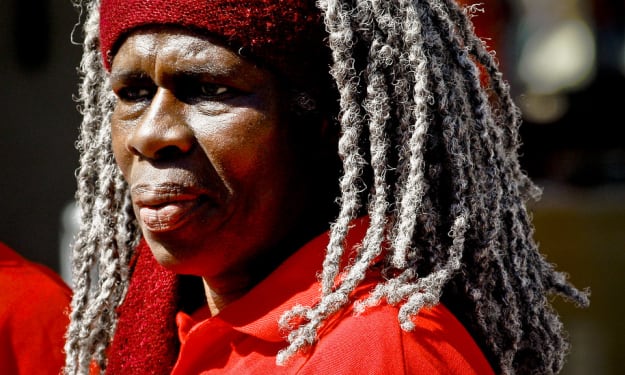
Reason First: Should the Government Be Involved in Cornrows and Afros?
Nonessentials, like hair texture and skin color, should have no bearing on whether an employer hires a candidate or not. And there definitely should be no laws for or against natural hair. In reality, in a fully free laissez-faire capitalist society, there would and ought to be discrimination against race, color, sex, sexual preference and anything else that really doesn’t matter among private citizens. All that should be considered is the competence of a given potential employee.
By Skyler Saunders7 years ago in The Swamp
The 27th Amendment
Gregory Watson was an undergrad at the University of Texas, Austin, who rediscovered a forgotten amendment, the 27th Amendment to be accurate. This Amendment had come about on September 25, 1789, including eleven other proposed amendments. The first Congress had wanted to address the issue of salaries for Congress. In 1982, Watson had dredged up this amendment by writing a paper about it. This amendment had not been fully ratified in the 18th century, as it had become constitutional on May 5, 1992, because this was a ratification period of 202 years, 7 months and 10 days when this amendment was finally ratified.
By Iria Vasquez-Paez7 years ago in The Swamp
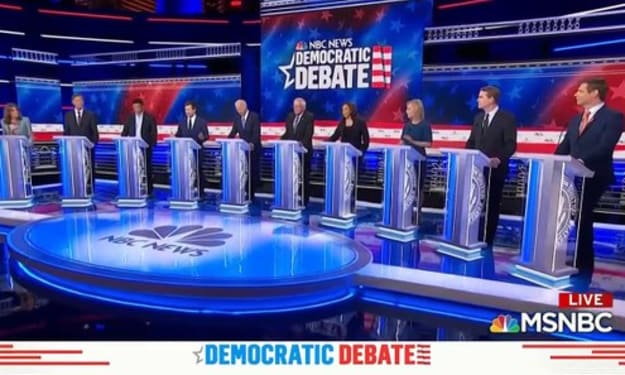
First Democratic Presidential Debate, Part 2 of 2
I thought the second part of the first 2020 Democratic Presidential debate was better than the first part, in that more of the ten on stage had standout moments. My assessment follows, in descending order of what I thought were the best performances:
By Paul Levinson7 years ago in The Swamp
Bryan Watch: Commerce/Justice
On June 20 and 21, the House debated more amendments to the Commerce-Justice-Science Appropriations bill (HR 3055). There were 31 votes, 23 party line and 8 non-party line. Steil sided with the Republicans 21 out of 23 times on HR 3055 amendment votes, for a support score of 91 percent.
By John Heckenlively7 years ago in The Swamp
Why Transitioning to a Vegan Economy Wouldn't Reduce Greenhouse Gas Emissions
Pretty much every activity humans undertake has an emissions footprint of some description, and animal agriculture is no different. However, when the suggestion arises that since animal agriculture is responsible for quite a large proportion of manmade greenhouse gas emissions and that we can eliminate these emissions immediately through simply getting rid of it, there are major issues that the vegan activist community has failed to address, and which could spell disaster if such a system were to be implemented. What they've as yet failed to establish is what the current system of agriculture is to be replaced with, the timescales involved and whether or not this new paradigm will actually emit less methane and CO2; additionally, they've failed to answer the most important question in all this: whether or not vegan agriculture can actually feed the population. In addition to this, I suspect that animal agriculture isn't the progenitor of the rising levels of atmospheric methane, which started in the 19th century, since this rise followed the Industrial Revolution and the burning of fossil fuels, not the Agricultural Revolution of the 17th century.
By Sam Cottle7 years ago in The Swamp
4 Years of Marriage Equality. Top Story - June 2019.
On June 26, 2015, the Supreme Court ruled 5-4 that marriage equality was the law of the land in all 50 states, almost 46 years to the day that the uprising of the Stonewall Inn occurred in New York. The United States was the 21st country to legalize same-sex marriage nationwide. It was a victory for gay rights activists, same-sex couples, and the LGBT community. Two days ago, I wrote an article about why Pride Month matters and is important. In case you missed it, you can click the link below:
By Mark Wesley Pritchard 7 years ago in The Swamp