
Iran and Israel on the Brink of All-Out War: Global Tensions Escalate Amid Missile Strikes and Civilian Tragedy
As drone strikes, missile barrages, and leadership assassinations mount, the Israel-Iran conflict plunges the Middle East—and the world—into uncertainty.

The Conflict Erupts Into a New Phase
On June 13, 2025, what had been a long-simmering tension between Israel and Iran exploded into a full-scale military confrontation. Israel launched a wave of coordinated airstrikes, targeting more than 100 key military and nuclear locations across Iran, marking the start of what is now being called Operation Rising Lion.
The offensive, executed with surgical precision, reportedly struck deep into Iran’s military heartland, including strategic facilities in Tehran, Natanz, Isfahan, and missile command sites across the country. Israeli intelligence services, particularly the Mossad, are believed to have played a critical role in infiltrating and sabotaging Iranian defenses from within—utilizing covert drone operations and cyberwarfare tactics previously unseen on this scale.
Top Iranian Military Figures Assassinated
One of the most shocking outcomes of this sudden escalation was the targeted assassination of top Iranian military leaders. Among the dead is General Gholam Ali Rashid, one of the most influential figures in Iran's armed forces. Within days, another high-ranking figure—Ali Shadmani, Iran's wartime chief of staff—was also confirmed killed in a separate Israeli strike.
These assassinations have sent shockwaves through Iran's political and military leadership, raising fears of a broader retaliation and plunging the nation into an atmosphere of anger, grief, and instability.
Iran Strikes Back: Missiles Rain Down on Israeli Cities
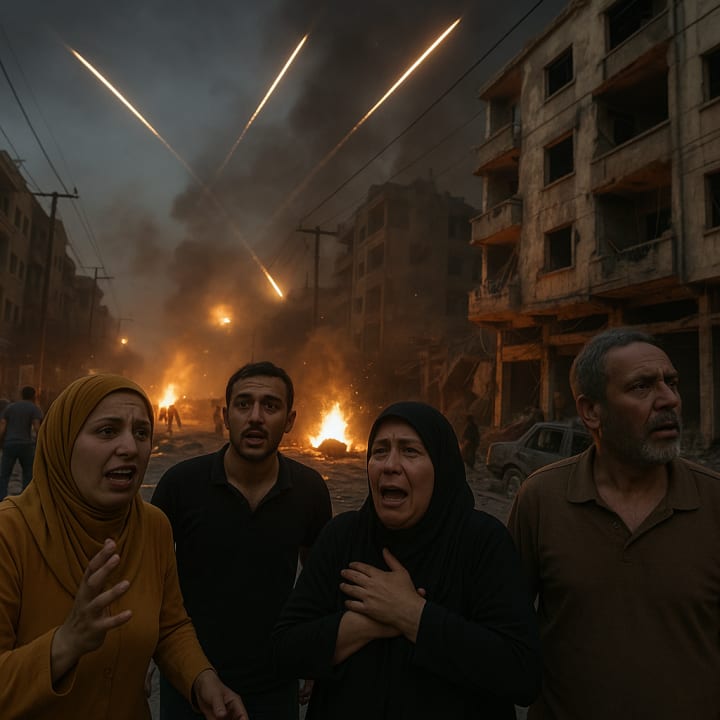
In response, Iran unleashed a massive counter-offensive, launching over 400 drones and missiles at Israeli territory over a 72-hour span. Among these were more than 100 ballistic missiles, making this one of the largest missile attacks in Middle Eastern history.
Israeli cities including Tel Aviv, Haifa, Herzliya, and Bat Yam came under direct attack, with air raid sirens blaring through the night. Despite Israel's advanced Iron Dome and David's Sling air defense systems, many missiles broke through, resulting in dozens of civilian deaths and hundreds of injuries.
Hospitals across Israel have been overwhelmed, and images of destroyed residential buildings and fire-engulfed vehicles have flooded international media.
Gaza Caught in the Crossfire
As if the direct conflict between Israel and Iran wasn’t catastrophic enough, violence has also flared in Gaza, where Israeli tanks shelled a crowded food distribution site in Khan Younis, killing at least 47 Palestinians and injuring more than 200. Humanitarian organizations are calling the situation in Gaza a full-blown crisis, with aid deliveries halted and civilians caught in the crossfire.
This event has prompted worldwide condemnation, including calls for immediate ceasefires and humanitarian corridors to be opened.
Tehran in Chaos: Civilian Exodus Underway
In Iran, the impact of Israeli strikes has gone beyond military targets. The Natanz nuclear facility was hit, with inspectors from the International Atomic Energy Agency confirming that underground infrastructure sustained damage. Meanwhile, Iran’s state television headquarters (IRIB) in Tehran was partially destroyed, disrupting communications nationwide.
Panic has gripped the Iranian capital. Gasoline shortages, blackouts, and food rationing have led to mass evacuations. According to local estimates, more than 100,000 civilians have fled Tehran in the last three days. Schools and markets are closed, the Grand Bazaar has shut down, and highways out of the city are jammed with vehicles.
Trump’s Intervention and G7 Diplomacy
In a surprise move, Donald Trump, attending the G7 summit in Italy, cut his visit short to return to Washington. In a press statement, he said, “Iran must surrender unconditionally,” adding that “the skies over Iran are now under our control.”
While he stopped short of declaring war, the deployment of U.S. naval forces, including destroyers and a carrier strike group to the Persian Gulf and Eastern Mediterranean, signals that America is positioning itself militarily—if not directly entering the war, then preparing for broader regional consequences.
The G7 leaders, while expressing support for Israel’s right to self-defense, have urged all parties to de-escalate. Germany and France have emphasized the need for diplomatic channels and are working through Qatar and Oman to reopen backdoor negotiations between Iran and Western powers.
Cyberwarfare: A New Front in the Conflict
In addition to kinetic warfare, cyberattacks have become a central tool in this conflict. Israeli forces reportedly launched a sophisticated cyber operation targeting Iran’s financial sector, including Bank Sepah, and multiple electricity grids. Iran, in return, is suspected of trying to disable Israeli emergency response systems, although with limited success so far.
This cyber-conflict introduces a chilling new dimension to modern warfare—one where digital infrastructure becomes as vulnerable as physical cities.
The World Watches in Fear
The ripple effects of the Israel-Iran war are already being felt globally. Oil prices have surged, and maritime traffic through the Strait of Hormuz—a vital corridor for global oil shipments—is under threat. Countries like India, China, and Thailand are working urgently to evacuate their citizens from the region.
Organizations such as the Red Cross, WHO, and the United Nations have issued urgent warnings about a humanitarian catastrophe if the conflict continues.
What’s Next? A Tenuous Path Forward
Israel has hinted it may target Iran’s deeply buried Fordow nuclear facility next—a move that could cross a dangerous red line. Meanwhile, back-channel diplomacy is being tested as Iran reportedly explores ceasefire terms with the help of Qatar and Oman.
At the same time, with both sides suffering civilian and military losses, and with global powers engaged either diplomatically or militarily, the Middle East now teeters on the edge of a wider regional war.
Conclusion
The Israel-Iran conflict of June 2025 is unlike anything the world has seen in recent years. With advanced drones, cyberattacks, and high-level assassinations, this war is as modern as it is deadly. And with civilians paying the heaviest price, the calls for peace have never been more urgent.
rael Iran conflict
Middle East war 2025
missile strikes
Operation Rising Lion
Tehran evacuation
Gaza civilian crisis
Trump Iran war
Iran nuclear site
-
About the Creator
NextGen Mobile Tech
- I review the latest smartphones, mobile accessories, and tech essentials to help you make smart buying decisions. Explore my curated kits for phones and gear here: [Kit.co link].
Keep reading
More stories from NextGen Mobile Tech and writers in The Swamp and other communities.
India and Pakistan Face Off Over Kashmir Terror Attack: Is South Asia Headed for a Major Conflict?
rorist attack in Indian-administered Kashmir. The April 22 attack in the scenic town of Pahalgam, a popular destination for Hindu pilgrims, killed at least 26 people and injured dozens more. Claimed by a militant group called *The Resistance Front*, the incident has triggered a wave of retaliation from the Indian government and a strong counter-response from Pakistan, bringing the nuclear-armed neighbors to the brink of confrontation once again.
By NextGen Mobile Tech9 months ago in The Swamp
Wild Card Weekend Recap: What Happens Now?
I think I figured out why I love Wild Card Weekend so much. It's because it's the first playoff anything of the calendar year. The NFL season starts in the fall, and once upon a time, the champion was crowned either on or slightly before New Year's. The evolution of the NFL schedule has resulted in the playoffs starting just into the New Year, and currently, the final week of the season falls on the first weekend of the New Year, with Wild Card Weekend coming a week after that. So yes, chronologically, the NFL's Wild Card Weekend serves as the first playoff anything of the calendar year.
By Clyde E. Dawkins7 days ago in Unbalanced



Comments (1)
This conflict is getting intense. Israel's strikes on Iran are bold, and Iran's counter with 400+ drones and missiles is no joke.