
India Telecom Market Size and Forecast 2025–2033
5G Momentum, Digital India Push, and Data-Driven Consumption Reshape the Industry

India Telecom Market Outlook (2025–2033)
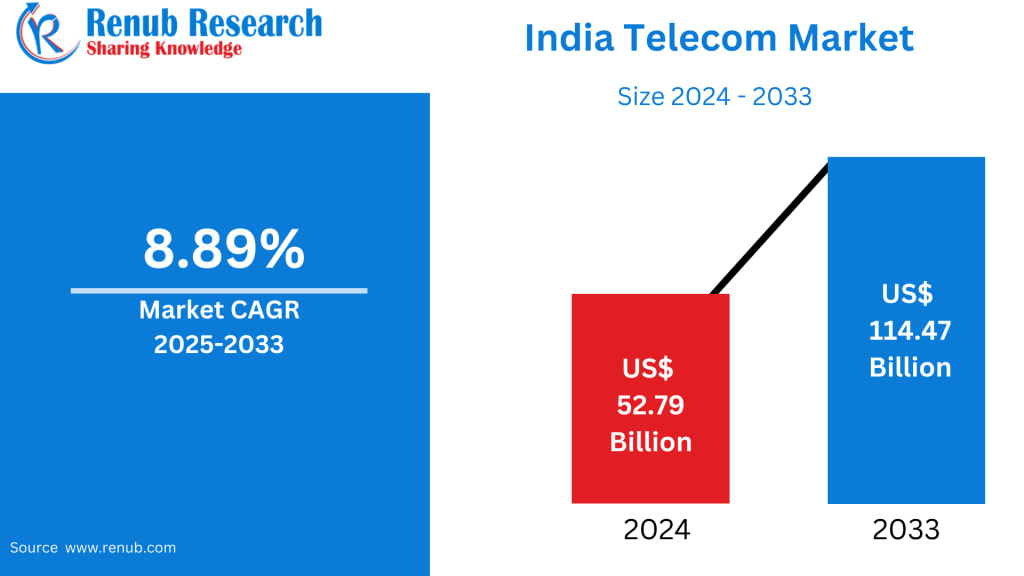
The India Telecom Market is on a high-growth trajectory, underpinned by surging data consumption, rapid smartphone penetration, supportive government policies, and the nationwide rollout of next-generation technologies. According to Renub Research, the market is expected to expand from US$ 52.79 billion in 2024 to US$ 114.47 billion by 2033, registering a robust CAGR of 8.89% during 2025–2033.
India’s telecom ecosystem has evolved from being voice-centric to data-driven, with mobile broadband becoming the backbone of digital services across banking, education, healthcare, entertainment, and e-commerce. The aggressive launch of 5G services, combined with competitive pricing strategies and rising foreign direct investment (FDI), is accelerating digital inclusion across urban and rural India alike.
India Telecom Industry Overview
India hosts one of the world’s largest and most dynamic telecom markets, serving over a billion subscribers. The sector has witnessed significant restructuring over the past decade, marked by consolidation, spectrum reforms, and massive investments in network modernization.
In 2024, competitive dynamics shifted when Reliance Jio Infocomm overtook Bharti Airtel in active subscriber additions after trailing for three consecutive months. While Jio recorded strong growth in wireless broadband users, Airtel’s improving Average Revenue Per User (ARPU) signaled healthier monetization trends. Growth momentum was strongest in B- and C-circles, highlighting rising digital adoption beyond metropolitan regions.
From a regulatory standpoint, the sector is governed by legacy and modern frameworks, including the Indian Telegraph Act, 1885, the Indian Wireless Telegraphy Act, 1933, and oversight by the Telecom Regulatory Authority of India (TRAI). The repeal of outdated provisions under the Repealing and Amending Act, 2023, reflects the government’s intent to modernize telecom governance and improve ease of doing business.
Key Factors Driving India Telecom Market Growth
1. Rapid Rise in Internet and Smartphone Penetration
India’s telecom expansion is fundamentally driven by explosive growth in mobile internet usage. Affordable smartphones, low-cost data plans, and expanding digital literacy have turned mobile connectivity into a basic utility. Telecom operators continue to strengthen 4G networks while accelerating 5G rollouts to meet rising data traffic.
Mobile internet now underpins everyday activities—from digital payments and online education to OTT streaming and e-commerce—creating sustained demand across both consumer and enterprise segments. As connectivity becomes central to daily life, telecom services are witnessing consistent volume and revenue growth.
2. Government Policies and Digital India Initiatives
Policy support remains a cornerstone of telecom sector development. Programs such as Digital India, BharatNet, and the National Digital Communications Policy aim to expand broadband access, enhance rural connectivity, and attract private investment.
Spectrum rationalization, production-linked incentive (PLI) schemes, simplified compliance norms, and encouragement of public-private partnerships have improved the sector’s long-term outlook. These initiatives enable operators to modernize infrastructure, deploy next-generation technologies, and extend services to underserved regions.
3. Growing Demand for Enterprise and Digital Services
India’s accelerating digital transformation across industries has significantly boosted demand for enterprise-grade telecom solutions. Businesses increasingly rely on cloud connectivity, IoT platforms, unified communications, and secure data networks.
Telecom operators are diversifying beyond traditional voice and data offerings into managed services, edge computing, and digital platforms. Meanwhile, growth in digital banking, telemedicine, online education, and content streaming continues to drive higher network usage, positioning telecom as a critical enabler of India’s digital economy.
Challenges in the India Telecom Market
Financial Stress and Intense Competition
Despite strong demand, the sector faces persistent financial pressure due to intense price competition, high spectrum costs, and regulatory liabilities. Aggressive tariff wars have compressed margins, leading to consolidation and elevated debt levels.
Operators must strike a delicate balance between affordability for consumers and long-term profitability. Sustained financial health is essential to support ongoing investments in 5G, rural expansion, and advanced digital services.
Infrastructure Gaps and Rural Connectivity Issues
While urban India enjoys high-speed connectivity, rural and remote regions still face infrastructure challenges. Sparse populations, difficult terrain, and power constraints limit return on investment for network expansion.
Bridging this digital divide requires targeted subsidies, innovative technologies, and stronger collaboration between government and private players. Inclusive connectivity is vital not only for telecom growth but also for broader socioeconomic development.
India Telecom Market Overview by Top States
Maharashtra Telecom Market
Maharashtra stands as a cornerstone of India’s telecom industry, driven by its large urban population and strong industrial base. Mumbai, the financial capital, is a hub for enterprise connectivity, data centers, and digital services. Telecom operators continue investing in 4G densification and 5G deployment to meet rising urban data demand. Smart city initiatives and a thriving startup ecosystem further reinforce Maharashtra’s leadership role.
Tamil Nadu Telecom Market
Tamil Nadu’s high literacy rates, advanced urban infrastructure, and strong IT and manufacturing sectors fuel robust telecom demand. Chennai serves as a major IT and BPO hub, driving enterprise solutions, cloud connectivity, and broadband adoption. With strong 4G penetration and expanding 5G coverage, the state remains a key innovation center in India’s telecom landscape.
Gujarat Telecom Market
Gujarat’s pro-business environment, industrial growth, and logistics infrastructure make it one of the fastest-growing telecom markets. Cities like Ahmedabad and Surat generate strong demand for mobile and enterprise services. Government-backed digitalization programs and smart infrastructure projects further accelerate telecom adoption across sectors such as healthcare, agriculture, and education.
West Bengal Telecom Market
West Bengal’s telecom growth is supported by expanding digital infrastructure and increasing urbanization. Kolkata acts as a regional telecom hub for eastern India, with rising demand for mobile broadband and enterprise solutions. Ongoing 4G upgrades and planned 5G deployments are expected to further enhance connectivity across urban and semi-urban areas.
Recent Developments in the India Telecom Industry
April 2024: Vodafone Idea Limited announced preparations for its 5G launch, targeting 40% of revenue from 5G services within the next 24–30 months.
October 2023: Reliance Jio Infocomm Limited showcased JioSpaceFiber, India’s first satellite-based mega fiber service, at the India Mobile Congress—aimed at delivering high-speed broadband to remote and previously unreachable regions.
These developments highlight the industry’s focus on innovation, inclusivity, and next-generation connectivity.
Market Segmentation Overview
By Service Type
Voice Services
Wired
Wireless
Data and Messaging Services
OTT and Pay-TV Services
By Top States
Maharashtra
Tamil Nadu
Karnataka
Gujarat
Uttar Pradesh
West Bengal
Rajasthan
Telangana
Andhra Pradesh
Madhya Pradesh
Competitive Landscape and Company Analysis
The Indian telecom market is moderately consolidated, with a few large players dominating subscriber share and revenue. Renub Research’s coverage includes comprehensive profiles of key operators, featuring business overviews, leadership insights, recent developments, SWOT analysis, and revenue performance.
Key Players Covered
Reliance Jio Infocomm
Bharti Airtel
Vodafone Idea Limited
Bharat Sanchar Nigam Limited
Mahanagar Telephone Nigam Ltd.
Each of these players is actively adapting strategies around 5G monetization, enterprise services, and digital platforms to sustain competitiveness in a rapidly evolving market.
Final Thoughts
The India Telecom Market is entering a transformative phase defined by 5G expansion, digital service proliferation, and deeper rural penetration. With strong policy backing, rising enterprise demand, and a digitally engaged population, the sector is poised for sustained growth through 2033.
However, addressing financial stress, infrastructure gaps, and profitability challenges will be crucial to ensuring long-term stability. Operators that successfully balance affordability with innovation—and leverage advanced technologies to unlock new revenue streams—will shape the future of India’s telecom ecosystem.
As India continues its journey toward becoming a digitally empowered economy, telecom will remain at the heart of connectivity, inclusion, and innovation.
About the Creator
Janine Root
Janine Root is a skilled content writer with a passion for creating engaging, informative, and SEO-optimized content. She excels in crafting compelling narratives that resonate with audiences and drive results.
Keep reading
More stories from Janine Root and writers in The Swamp and other communities.
Global Tires Market Size & Forecast 2025–2033
Global Tires Market Overview The Global Tires Market is on a steady growth trajectory as the world’s transportation ecosystem continues to expand and modernize. According to Renub Research, the global tire market is expected to reach US$ 194.95 billion by 2033, up from US$ 140.33 billion in 2024, registering a compound annual growth rate (CAGR) of 3.72% during 2025–2033.
By Janine Root 17 days ago in The Swamp



Comments
There are no comments for this story
Be the first to respond and start the conversation.