
How China Got Benefit from Pakistan and India Conflict
China’s Strategic and Economic Gains Amid Rising Tensions Between Pakistan and India

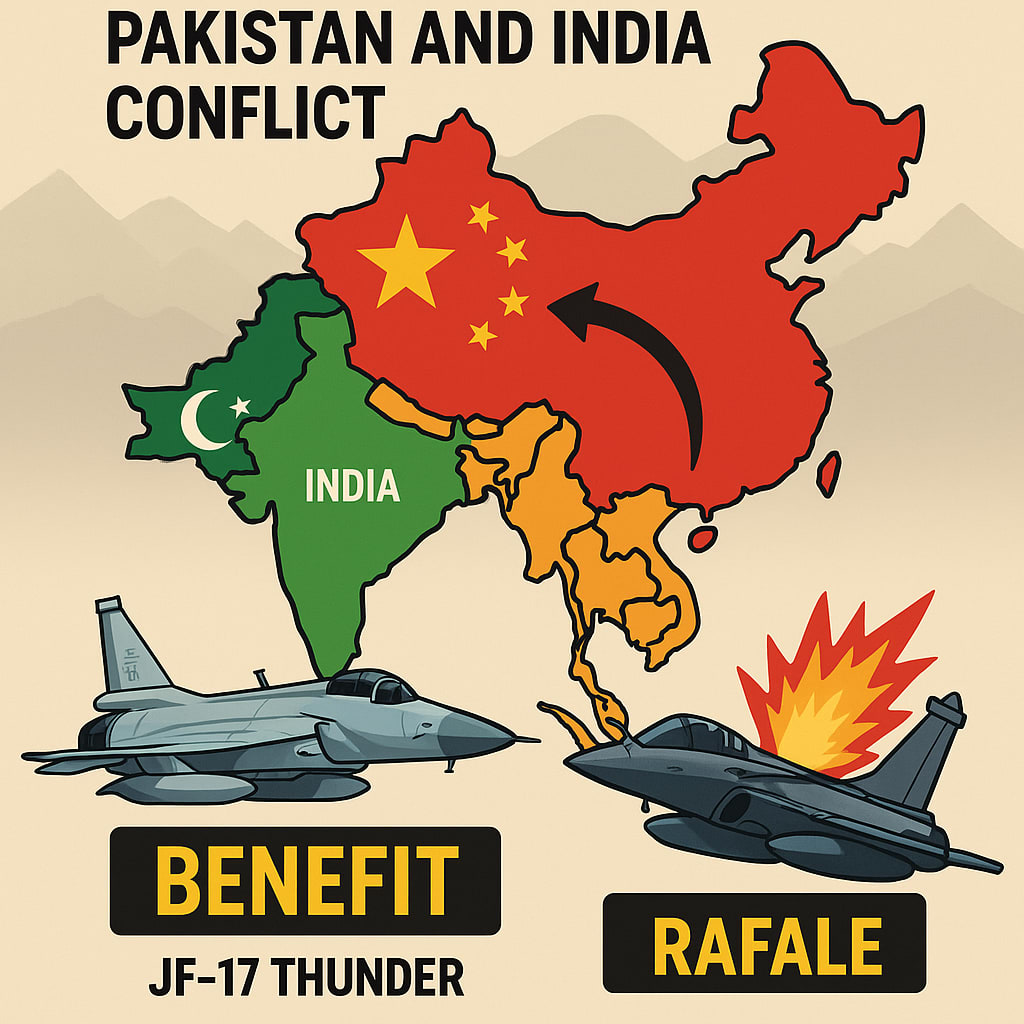
In a dramatic turn of events during a recent India-Pakistan conflict, the Pakistan Air Force (PAF) reportedly downed a French-made Rafale fighter jet using the JF-17 Thunder, a multi-role combat aircraft developed jointly by China and Pakistan. Though official confirmation is still pending, the symbolic value of this event is already resonating across global defense and strategic communities.
This high-profile engagement is more than just a military success for Pakistan — it is a major geopolitical and commercial win for China, which now stands to benefit immensely in the global arms market and regional power dynamics.
The Rafale Setback: France’s Prestige Under Fire:-
India purchased 36 Rafale fighter jets from France in a $8.7 billion deal to strengthen its air capabilities against regional threats. The Rafale, known for its advanced avionics, stealth profile, and air superiority features, was expected to give India an edge in any future conflict.
However, the reported destruction of this high-end jet by a much cheaper JF-17 Thunder has dealt a blow to France’s image as a reliable defense exporter. Nations that were once considering Rafale acquisitions may now think twice. The perception that a significantly cheaper Chinese-designed fighter can defeat one of France’s premier jets casts doubt on the cost-to-performance ratio of Western weaponry.
As a result, France’s arms exports may decline, particularly in developing nations seeking value for money and battlefield reliability. This shift in perception directly benefits China, which is positioning itself as a global alternative to expensive Western arms.
The Rise of the JF-17 Thunder:-
The JF-17 Thunder has emerged as a success story of Sino-Pakistani military cooperation. Designed to be a cost-effective, combat-ready alternative to expensive Western jets, the JF-17 has steadily improved through new upgrades, such as the Block III variant which includes AESA radar, electronic warfare systems, and advanced Chinese missiles.
Priced between $25–35 million per unit, the JF-17 is one-third the cost of the Rafale, yet it now carries the badge of combat credibility. The aircraft is already in service in Pakistan, Nigeria, and Myanmar — and following the recent conflict, several countries in Africa, the Middle East, and Southeast Asia are reportedly reconsidering their aircraft procurement strategies, giving the JF-17 new momentum.
China’s Strategic Gains: More Than Just a Sale:-
For China, the growing popularity of the JF-17 means much more than financial profit. It is part of a broader strategy to expand its global influence through military-industrial partnerships. The recent conflict has given Beijing an opportunity to showcase:
The effectiveness of Chinese military technology in real-world combat.
Its ability to support allies, like Pakistan, in challenging Western-equipped militaries.
The reliability of its weapons platforms, especially for countries with limited budgets or those under Western sanctions.
This success boosts China’s arms exports, strengthens its diplomatic ties with developing nations, and weakens the monopoly once held by Western arms manufacturers.
Moreover, with Pakistan increasingly dependent on Chinese equipment, China gains not only a loyal defense customer but also a strategic ally in South Asia, further pressuring India and indirectly challenging U.S. interests in the Indo-Pacific.
The Broader Shift in Global Arms Dynamics:-
The symbolic downing of a Rafale by a JF-17 reflects a larger global transformation in defense procurement patterns. Developing nations are no longer prioritizing expensive, elite Western systems. Instead, they are looking for affordable, effective, and politically flexible alternatives — and China is filling that role.
The fact that the JF-17, a platform mocked by some in its early years, is now being credited with defeating one of the most advanced fighter jets from Europe marks a turning point in perception. China is no longer just a buyer or copier of foreign technology; it is now an innovator and exporter in its own right.
Meanwhile, the West — particularly France — must deal with the fallout. Its defense industry risks losing not just sales, but also the reputation of superiority that has long justified its high prices.
Geopolitical Implications for India, Pakistan, and China:-
For Pakistan, this moment is a military and diplomatic triumph. It shows that indigenous and Chinese-supported technology can hold its own against Western platforms. It strengthens national pride and supports the PAF’s strategy of air parity through affordability.
For India, the loss is both material and symbolic. It raises questions about the value of its costly defense imports and could lead to political pressure to review its military procurement strategies.
But the biggest winner is China.
Through this conflict, China gains:
A stronger defense industry reputation
Increased arms sales
Tighter control over Pakistan’s defense structure
Greater leverage in South Asian geopolitics
China’s long-term strategy to become a global military supplier and superpower is clearly benefiting from the India-Pakistan rivalry. The recent incident with the JF-17 is just one of many steps in its global rise.
Conclusion:-
The reported destruction of a Rafale jet by a JF-17 Thunder may be debated in terms of battlefield details, but its impact on global defense politics is undeniable. China emerges as the ultimate beneficiary, gaining economically, militarily, and diplomatically. As nations look for more practical, cost-effective defense solutions, the JF-17 is proving that the future of air combat may no longer belong solely to the West.
About the Creator
Zakir Ullah
I am so glad that you are here.
Reader insights
Outstanding
Excellent work. Looking forward to reading more!
Top insights
Compelling and original writing
Creative use of language & vocab
Easy to read and follow
Well-structured & engaging content
Excellent storytelling
Original narrative & well developed characters
Expert insights and opinions
Arguments were carefully researched and presented
Eye opening
Niche topic & fresh perspectives
Heartfelt and relatable
The story invoked strong personal emotions
Masterful proofreading
Zero grammar & spelling mistakes
On-point and relevant
Writing reflected the title & theme
Keep reading
More stories from Zakir Ullah and writers in The Swamp and other communities.
War Between Brothers: A Call for Peace in South Asia
The world watched in horror as tensions between Pakistan and India erupted once again into a full-blown conflict in these recent days. What began as a border skirmish soon escalated into one of the most destructive confrontations in recent South Asian history. While the international media flooded timelines with statistics and breaking updates, the real cost of this war—human lives, fractured communities, economic collapse, and regional instability—remains far more than what any headline can convey.
By Zakir Ullah10 months ago in The Swamp
The Forsyth House Fire
Since 1851, Forsyth House has stood on the corner of Union Street and Gordon Street in the heart of Glasgow. Its iconic, or was... because on Sunday 8th of March, 2026, a fire broke out in a small, seemingly un-named shop in the building and tore all that history down. As I write, the rubble is still unsettled and the street is still blocked off. Central Station is quiet on the upper level, and around 30 small businesses have quite literally gone up in smoke.
By S. A. Crawford2 days ago in The Swamp


Comments (1)
Great! You are also invited to read my writing.