
Hitler’s Downfall
Inside Hitler’s Final Hours in the Berlin Bunker
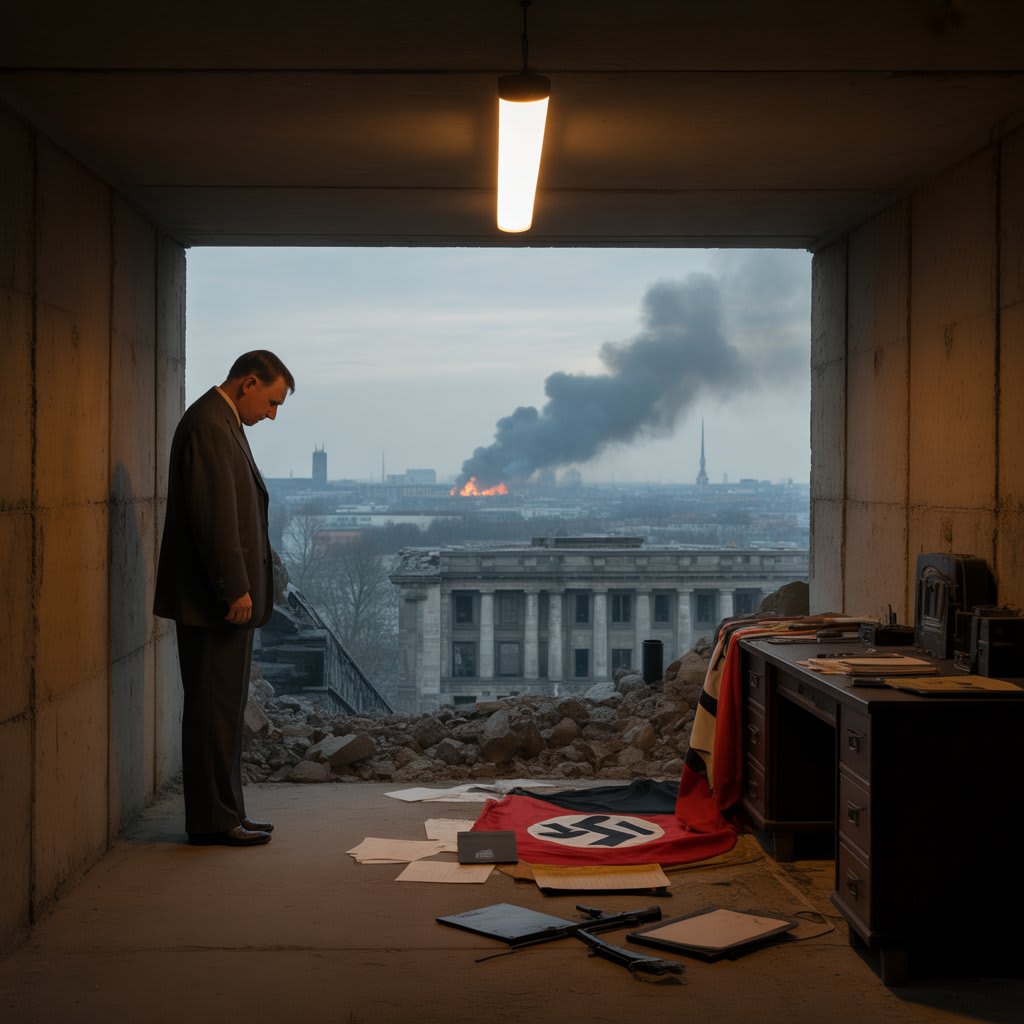
By April 1945, Adolf Hitler’s empire, which he once envisioned as lasting a thousand years, was crumbling into dust. The Soviet Red Army had surrounded Berlin, and the Allies were closing in from the west. Bombs fell daily on the capital, and the once-proud streets of the Reich lay in ruins. Hitler, refusing to leave, retreated into the underground Führerbunker beneath the Reich Chancellery, determined to spend his final days in the heart of the collapsing Third Reich.
Life Inside the Bunker
The Führerbunker was a dim, airless complex of concrete rooms buried deep underground. It smelled of damp cement, stale air, and cigarette smoke. The mood inside was a strange mixture of denial and despair. Loyal aides, secretaries, and military officers tried to carry on routine duties, but the thunder of artillery grew louder each day. Food supplies were dwindling, communications were breaking down, and morale was almost gone.
Hitler appeared physically and mentally broken. His left hand trembled uncontrollably, his posture was stooped, and his speech sometimes slurred. Years of war, illness, and crushing defeat had taken their toll. Yet, he still clung to delusions of hope—expecting German armies that no longer existed to rescue Berlin, or secret weapons to turn the tide. His generals knew the truth: the war was lost.
Eva Braun and the Final Wedding
In the midst of the chaos, Hitler’s long-time companion, Eva Braun, joined him in the bunker. She had opportunities to flee, but she chose to stay, declaring she would rather die with him than live without him. In the early hours of April 29, 1945, as Soviet troops fought just a few streets away, Hitler and Eva were married in a small civil ceremony inside the bunker. Witnesses said Hitler appeared unusually calm, almost relieved, as if accepting his fate.
The wedding was followed by a modest breakfast with champagne, a rare moment of celebration in the shadow of destruction. But there was no illusion about what lay ahead—Hitler and Eva both knew they would not live to see another day.
The Decision to Die
On April 29, Hitler dictated his last will and political testament. In it, he blamed the Jews for starting the war, denounced his military commanders for betrayal, and appointed Admiral Karl Dönitz as his successor. It was a bitter, defiant document that showed he had learned nothing from the devastation he had caused.
The following day, April 30, 1945, Soviet forces were only a few hundred meters from the Reich Chancellery. Hitler ordered that his body must never fall into enemy hands. He feared being captured and displayed like Mussolini, whose corpse had been hung in public in Italy just days earlier.
Shortly after 3:00 p.m., Hitler and Eva retired to his private study. Witnesses reported hearing a single gunshot. When aides entered, they found Hitler slumped on the sofa, a pistol in his hand, and Eva dead beside him from cyanide poisoning. His faithful staff quickly wrapped the bodies, carried them into the garden, and doused them in petrol. As Soviet shells exploded nearby, the bodies were set alight—fulfilling Hitler’s last request.
The Fall of Berlin
The news spread quickly through the bunker. Some felt relief; others were stunned. For those still loyal to Hitler, his death meant the symbolic end of the Third Reich. For many ordinary Germans above ground, it hardly mattered—the war had already destroyed their lives.
Within days, Berlin surrendered. The Soviet flag was raised over the Reichstag, marking the final defeat of Nazi Germany. In the chaos, Hitler’s remains were hastily buried by his staff, only to be later found and secretly disposed of by Soviet forces.
Legacy of a Dictator’s End
The death of Adolf Hitler on April 30, 1945, marked more than just the end of a man—it was the end of a brutal regime responsible for the deaths of millions. His suicide avoided the humiliation of trial, but it did not erase his crimes.
Historians continue to debate whether Hitler’s final days reveal a man trapped by his own ideology, or simply a coward unwilling to face the consequences of his actions. What is clear is that, even in his last hours, he showed no remorse. The bunker, now long gone, remains a powerful symbol of both the physical and moral collapse of Nazi Germany.
For survivors of the war, the moment was bittersweet. The tyrant was gone, but Europe lay in ruins, and the scars of the conflict would last for generations. The world was left to rebuild from the ashes, and to ensure that such darkness would never rise again.
About the Creator
Reader insights
Nice work
Very well written. Keep up the good work!
Top insights
Compelling and original writing
Creative use of language & vocab
Excellent storytelling
Original narrative & well developed characters
Eye opening
Niche topic & fresh perspectives
Masterful proofreading
Zero grammar & spelling mistakes
On-point and relevant
Writing reflected the title & theme
Keep reading
More stories from Salman Bin and writers in The Swamp and other communities.
"When Beauty Broke His Heart"
The night was quiet, except for the faint hum of streetlights and the soft patter of rain against the cobblestones. Daniel stood there, his coat damp, clutching a single red rose that had already begun to lose its petals. He didn’t know why he had come back to this place. Maybe it was habit. Maybe it was hope. Or maybe it was the cruel need to stand where it had all begun—and ended.
By Salman Bin5 months ago in Fiction
Trump Calls on Congress to Pass Legislation Ending Sanctuary Policies
Former President Donald Trump has intensified his long-standing push against sanctuary city policies, calling on Congress to pass legislation that would end such policies nationwide. Speaking at a rally in Phoenix, Arizona, Trump framed sanctuary cities as a threat to public safety and a challenge to federal law enforcement, reigniting a heated national debate over immigration policy, state versus federal authority, and the future of local enforcement discretion.
By Salaar Jamaliabout 2 hours ago in The Swamp
US Set to Quit World Health Organization: What It Means for Global Health
The United States has officially announced its intention to withdraw from the World Health Organization (WHO), a decision that has sent shockwaves through the global health community. The move, announced by government officials, is framed as a response to concerns over organizational efficiency, governance, and accountability. However, experts warn that the decision could have far-reaching consequences for global health initiatives, pandemic preparedness, and international cooperation.
By Aarif Lashari4 days ago in The Swamp


Comments (1)
Oh amazing history of hitler hear by first time