
History of Roman Slavery in Eastern Europe.
A roma woman with a child.

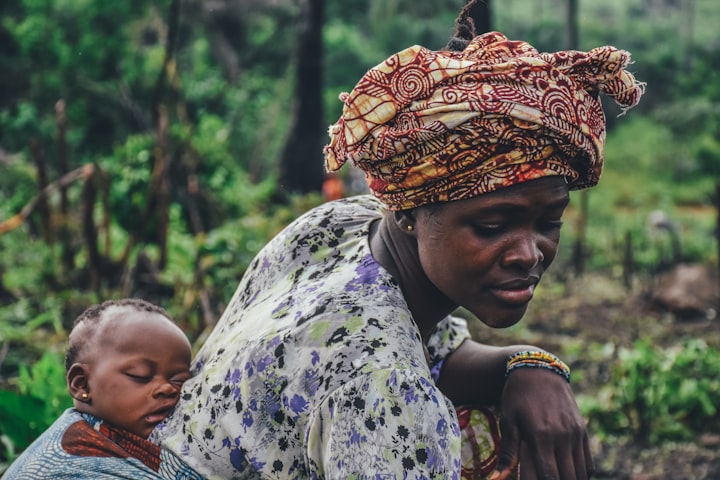
To understand why the history of Porrajmos, or slavery in eastern Europe has been forgotten or erased from memory, it lies in two main aspects of the problem of memory construction: the intra-cultural aspect of the Roman community and the socio-cultural dimension and the relationship between them.
One of the main features of Roman culture which has influenced the construction of memory in general and Porrajmos in particular is the lack of the collective historical memory of society.
This is partly due to the fact that the Romans were steeped in oral and not written culture. This is also related to the absence of hierarchical organization among the Romans and their spread throughout the world without them ever having a defined territory. The traumatic nature of Porrajmos' memories has caused further difficulty in telling stories.
According to Halbwachs, community in building collective memory and memory is by reflecting community construction; The fragmentation of Rome does not allow narrative continuity. In the absence of a narrative, there is no structured memory or collective or communicative meta-narrative with other communities.
However, the main reason for the fragmented memories of the Romans is the history of their continuing persecution in Europe. For 500 years the Romans were slaves in Eastern Europe, while in Western Europe they were driven wherever they went and even persecuted to death. This situation continued until the end of the 19th century when their persecution took on a more modern look, but it didn't stop there. Living in the shadow of persecution and in a position of slavery destroys the continuity of collective memory; this is what happened to Africans who were taken to America as slaves.
Forgetting Porrajmos was compatible with Rome's position in society at large. "The postmodern state," notes Loytard, associates knowledge with power through narrative means. Knowledge combined with power also builds hegemonic memory formulated by central authorities. Various narratives accept 'status', namely expression and legitimacy, based on social status. The ruling social power gives legitimacy to the narrative it supports.
The Romans, as an isolated group in society, have yet to gain the legitimacy to add their unique story to the memory of the Holocaust hegemony, which is largely seen as the story of the Jews as victims, and of the Germans as persecutors. Rome, as a community is considered as 'the other,' which strives for cultural recognition and its rights in European society. The issue of power, which participates in the reciprocal formation of memory and community, is illustrated by postcolonial theory.
Romans in Europe are the eternal 'other', whose exile was in their own homeland and their homeland who alienated them in their absence by their own territory. Hence, their efforts to remember their genocide and their demands to include Porrajmos as part of the history of the Holocaust had little effect.
The struggle is complex and plagued by contradictions and internal ambivalence, arising from both the central authority and from the peripheral communities. Society in general sends ambiguous messages to marginalized groups, requiring them to assimilate and give up their cultural identity, while at the same time rejecting their integration efforts and insisting that they maintain their alienation and 'oddity'. This dynamic is also characteristic of memory position and mode of construction. The marginalized and rejected position of the Romans in society pushed the Porrajmos story to the fringes of history far from the center because of their status as the eternal 'other' in the European social context.
Consequently, the traditional culture of Rome, together with Rome's marginal social position, has caused Porrajmos' memory to remain an intra-community memory. Community builds memory; In doing so, fragments of memory from a devastated community like Rome can revive and strengthen it. To some extent, the Porrajmos story was structured into a common narrative among the Roman community, but it was not until the late 1980s and 1990s that attempts were made to convey this narrative to the outside world as well. However, most of these attempts have met an indifference or demand to distinguish between the memory of the Jewish Shoah and the memory of Rome. The time that has passed since the war and the sparse documentation on the subject have hindered public awareness. The testimonies of the few survivors that remain are difficult to obtain, although their significance in the documentation process is excellent.
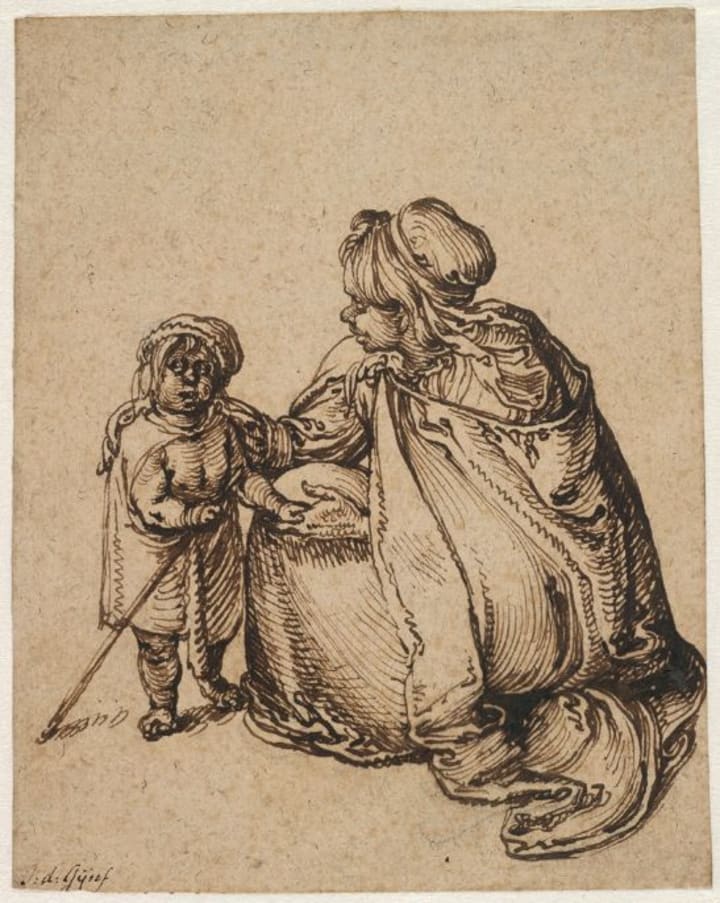
This touching image belongs to De Gheyn's closely related group of four studies, executed in the same media and on the same paper, of Roman women and children. De Gheyn worked on rough, fibrous paper in gall-nut ink over an initial sketch in black chalk, from which pen work took off in places. With its many zigzagging, rhythmic movements and long curved strokes that evoke the swelling of women's skirts and robes, this study exemplifies its mature technique, drawn from a pen drawing from the 1590s by Hendrick Goltzius.
Romans migrated from India and arrived in northern Europe during the Middle Ages. In the Netherlands they are known as "infidels" and, due to their supposed country of origin, "Egyptians", a misunderstanding of where the word "gypsies" in English originated. Because of their unconventional dress, language, and customs, as well as their disregard for local regulations, they were driven from the cities and sentenced to marginal life by wandering and camping in the countryside. During the 1590s, scholars at Leiden University studied the language and customs of the Romans, an interest De Gheyn seemed to share, with distance connections to the university.
De Gheyn's studies culminated in two prints that he had designed, but not engraved,. Her pictures objectively record Roman clothing and physiognomy, and the gentle care of a mother on a Harvard university sheet of paper, dressed in a robe and headdress typical of Roman costumes, attests to the drawer's empathy for her exotic subjects. However, prints such as those of Hendrick Avercamp, Jan Miense Molenaer, Georges de la Tour, and other artists of the early seventeenth century place them in their conventional roles as social outcasts who endure deception, beggars and petty crimes. In one carving after De Gheyn, four Roman women and two children stop on a road near the farmhouse to prepare a meal. The farmer and his wife watched them suspiciously from their property, while their dog approached the stranger, growling aggressively. Another print depicts a Dutch woman dressed dearly, paying a ruffled old Roman grandmother to tell her fortune. It is one of the many earliest seventeenth-century Dutch works featuring Roman fortune tellers.
The image does not address the social stigma of the Roman people, but rather deplores the gullible young woman: instead of consulting a surgeon about her illness, she uses fortune-telling to "hear things from the future that she wants to hear." De Gheyn bases the figure of a child man on the right edge of the sculptures on the young man he had sketched in the Chicago drawing, the only detail among the four extant studies which he translated directly into print. The carving, attributed to Andries Jacobsz. Stock, dating from around 1608, but De Gheyn probably executed four studies of Roman women and children a few years earlier.
Van Regteren Altena noted that Hendrick Goudt drew exactly like the boy in Chicago's picture. If Goudt copied the figures before he left, perhaps in 1604, for a longer stay in Rome, the Chicago sheet and three other studies of Roman women and children would have to be dated later that year.
-
Images are available to download for personal, noncommercial use, including for publication on personal websites and blogs. As a courtesy, please include the credit line “Harvard Art Museums”.
About the Creator
Viona Aminda
Not a fiction story telling
Keep reading
More stories from Viona Aminda and writers in The Swamp and other communities.
A sustainable recovery for people and planet.
Sustainability is not an add on but absolutely fundamental for business and economic growth, Many Pacific island nations face infrastructure and housing emergencies due to massive deficits, high urbanization, and increasing populations. Many communities also lack systems and do not know how to properly maintain infrastructure and homes.
By Viona Aminda5 years ago in The Swamp




Comments
There are no comments for this story
Be the first to respond and start the conversation.