
“He Is Finished”: Why Serbia’s Protests Have Reached the Boiling Point
Serbia faces massive protests against President Vučić as citizens demand justice, free elections, and an end to corruption.

Introduction: A Country in Crisis
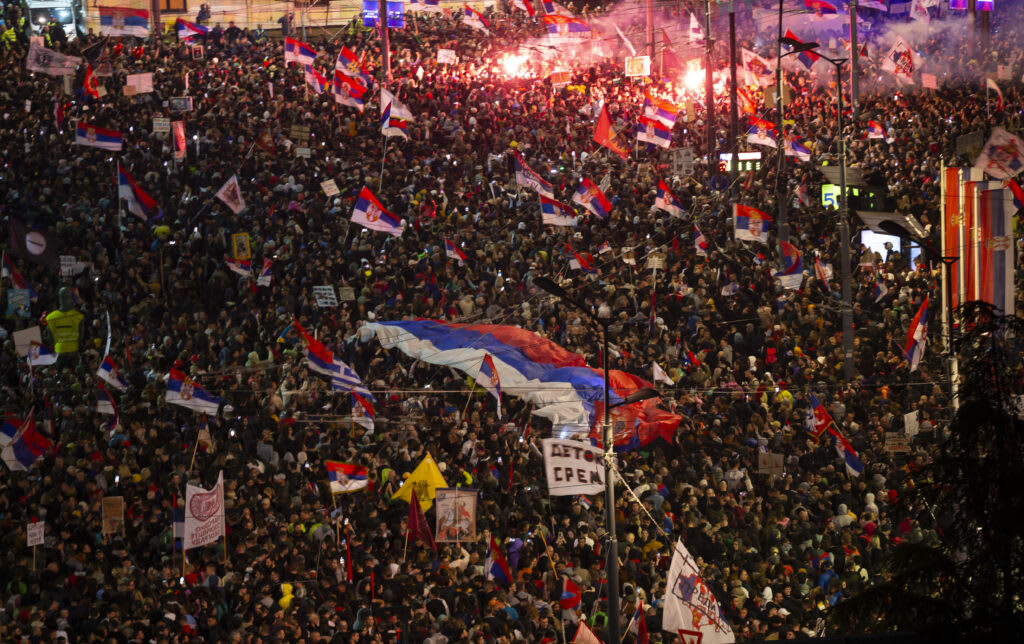
Serbia has witnessed some of the largest demonstrations in recent times. For months, people have marched in the streets of cities, chanting against President Aleksandar Vučić and his government. A grassroots movement that began among students has grown to a national rage. Protesters hold the government responsible for corruption, poor governance, and lack of accountability.
The most frequently shouted slogan on the streets is: "He is finished." People are shouting these slogans in the face of Vučić, meaning that they believe his time as president is over. But even so, even with all this pressure, the president does not want to resign, and this has created a volatile situation in the country.
How It All Began
The Station Collapse Tragedy
The proximal trigger of the protests was a canopy collapse at one of Novi Sad's train stations. Sixteen people died in the accident, and dozens were injured. To citizens, it was not just a tragedy—it was proof of deep corruption and substandard construction work involving government allies.
Citizens believed that the government had been dismissive of safety measures and allowed shoddy work on construction sites. Instead of blaming contractors, critics attributed the fault to the country's leadership that tolerated corruption in any shape or form.
Students Organize the First Protests
Students conducted peaceful protests following the tragedy. They organized vigils for the victims and demanded answers. Silent marches were conducted every 15th of the month to commemorate the victims. These became a tradition, with tens of thousands attending.
At first, the government dismissed the students as "misled youth." But when the protests grew, it was clear that this was a movement more than the students—it was turning into a national clamor for justice.
The Growth of the Movement
From Students to Citizens
Later, teachers, workers, peasants, and families joined the demonstrations. The protests stretched from Novi Sad to Belgrade, Niš, and over 300 towns. Over 60% of Serbians supported the protests, according to opinion polls.
By March, Belgrade saw one of the largest rallies in decades, with around 100,000 people packing the streets. It was a turning point. Serbia hadn't seen such a unified display of anger since Slobodan Milošević toppled in 2000.
Demands Arise
As the movement gained momentum, so did its list of demands. Protesters called for:
- Early parliamentary elections
- A full investigation of the Novi Sad tragedy
- Publication of all construction project documents
- Accountability of politicians and construction companies
- Resignation of President Vučić, the prime minister, and the mayor of Novi Sad
- Combating corruption and a return to genuine democracy
All these demands reflected frustration built up over years. Serbians feel trapped in a system in which the same political elite hold power without accountability.
When the Protests Turned Violent
Street Battles
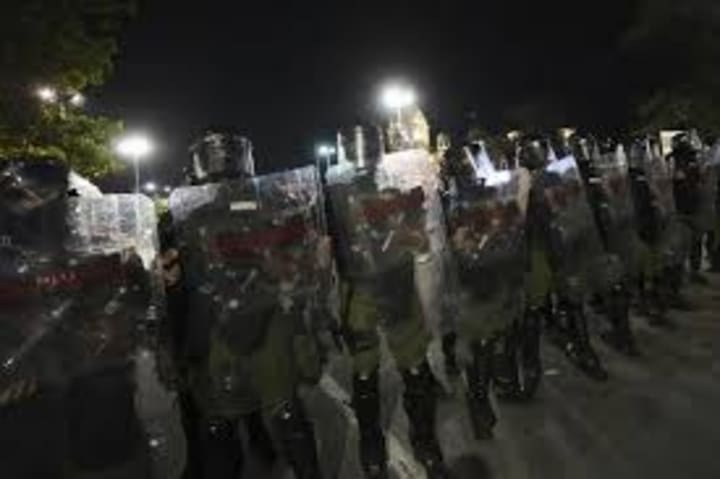
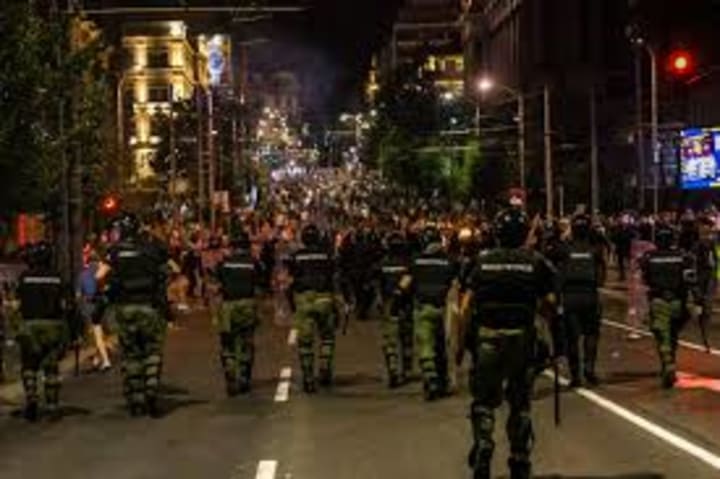
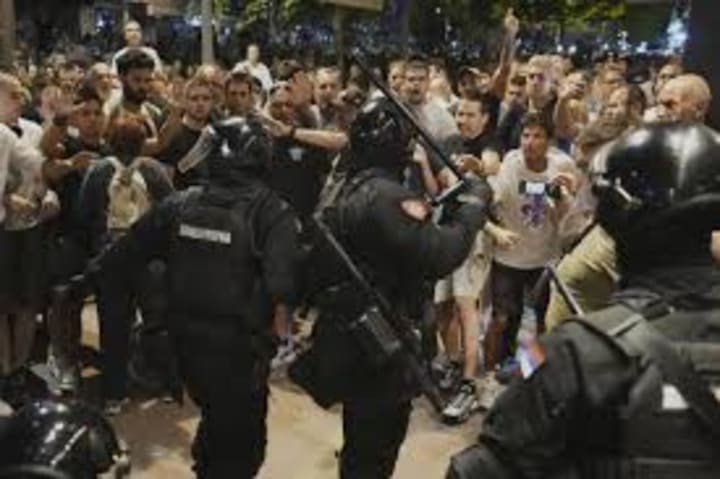
There had been peaceful protests for months. But when the government refused to budge, that rage overflowed. Protesters vandalized the headquarters of the governing Serbian Progressive Party in Novi Sad. Riot police clashed with protesters in Belgrade, employing tear gas and batons.
In some cases, pro-government demonstrators joined the violence, pelting protesters with stones and flares. Protesters accused the police of doing nothing and allowing these attacks to happen. Dozens were arrested, and some were injured in the violence.
Chaos in Parliament
The crisis even spilled into the parliament of Serbia. In March, opposition lawmakers set off smoke bombs and flares during a tense session. Fistfights broke out, furniture was destroyed, and at least three MPs were hurt.
An MP even suffered a stroke in the midst of the chaos, sending him into critical condition. This shocking sight showed how polarized the politics of the country had become.
Government's Response
Denial and Accusations
President Vučić and ruling party supporters tried to label the protests as foreign-orchestrated. They accused Western countries of bribing students to riot. They also referred to protesters as "terrorists" and "thugs."
Instead of defusing the crisis, accusations only infuriated protesters. Many felt insulted that their real sorrow and anger were dismissed as foreign manipulation.
Resignations and Small Changes
To assuage nerves, Prime Minister Miloš Vučević stepped down in January. In May, a new cabinet was formed, but it seemed like more of the same to protesters. They were calling for systemic reform, not cosmetic touch-ups.
The government also threatened snap elections, but no date was given. People began to believe Vučić was simply stalling, hoping the protests would dissipate.
Use of Force
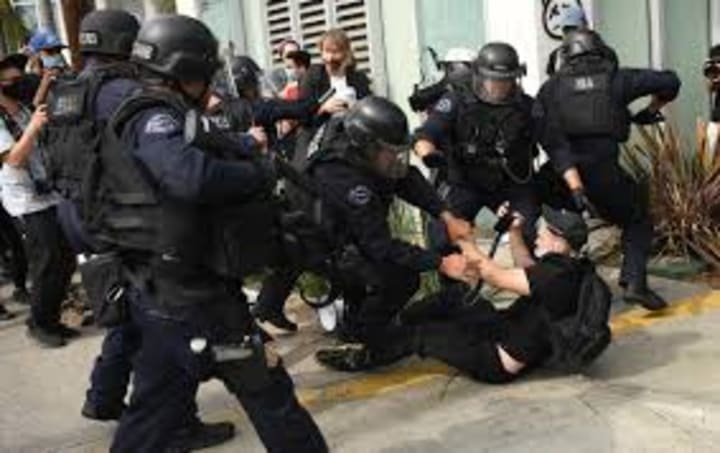
Police were used in mass numbers at demonstrations. Videos recorded police beating protesters and dragging them into vans. Tear gas was used in crowded areas, even where there were children and families.
There were also some reports of unexplained "sonic attacks" at rallies—loud noises that made people dizzy. A Russian investigation later claimed no sonic weapons had been used, but suspicion lingers.
The Role of the European Union
Serbia had long been interested in joining the European Union. But EU leaders indicated that membership entails respect for democracy, rule of law, and freedom of the media.
As demonstrations grew, the EU and Council of Europe called on Serbia to uphold the right to peaceful assembly. European politicians also put pressure on Vučić to organize free and fair elections.
The crisis is now challenging Serbia's European path to the test. If Serbia's government keeps repressing the opposition, it can hurt its ambition to join the EU in the coming years.
Voices from the Streets
Protesters' Resolve
The majority of protesters claim that they are tired of living in a corrupt state. "We don't want to leave Serbia. We want to live here, but in a country where the government takes responsibility.".
Yet another marcher explained: "We are no longer frightened. They can't arrest us all. If ten of us get beaten, ten more will replace them."
Such testimonials point to the fact that the movement has moved beyond politics—it's about dignity and equality in daily life.
Government Supporters
At the same time, Vučić also has a loyal base. Some of the Serbians perceive him as offering stability and protecting national interests. They fear that if he is ousted, there will be chaos.
This polarization in public opinion makes the country extremely polarized, making compromise difficult.
Why the Crisis Matters
For Serbia's Future
The protests are not about one disastrous accident alone. They are about how Serbia functions, how corruption eats into institutions, and about citizens feeling locked out of decisions that count in their world.
If the government refuses genuine change, more violence could follow. Or, early elections and accountability could trigger a stabilisation process.
For the Region
Serbia is the central nation of the Balkans. Instability in the government can spread to other countries, especially in a region that is still under conflict. The world is keeping an eye on the situation with hopes that the crisis does not widen.
For Europe
The EU must decide how much to push Serbia toward reform. If Brussels ignores democratic backsliding, it will lose its legitimacy. But if it pressures too much, Serbia may seek to look elsewhere for influence, maybe Russia or China.
What Happens Next?
The future of the protests is uncertain. Some believe the movement will keep growing until the government makes a proposal to hold elections. Others fear the authorities may turn to harder methods of dispersing protests.
For now, citizens and students keep protesting. They claim that they will not stop until their conditions are met. The longer the protests drag on, the harder the pressure grows for Vučić.
Whether this results in reform, resignation, or further repression will decide Serbia's future for many decades to come.
Conclusion: A Turning Point for Serbia
The wails shouted out in the streets of Serbia—"He is finished"—signal a country at the breaking point. What began as national mourning for a sad accident escalated into a call for justice, democracy, and accountability across the country.
President Vučić is facing the largest challenge of his presidency. His response will decide not just his political future but the future of Serbia's path.
Will the government listen to its people and allow change, or will it cling to power at all costs? The answer will tell us if Serbia is stepping closer to democracy—or gradually further away.
About the Creator
Finallen
Passionate about sharing the latest news and real-world stories. I publish high-quality, fact-checked content to keep readers informed and engaged. Follow for timely updates, insights, and trusted coverage on current events.
A Gathering of Evil Bosses
“I’m the queen of chin jutting while I smooth my hair, attacking, insulting, and deflecting to protect my appointer.” “Oh, please, Blondi, my hair is curled, highlighted, and longer than yours. I feature television commercials telling immigrants that we will give them a free plane ride home, and if they voluntarily turn themselves in, they will be allowed to legally apply for re-entry. It runs everywhere, and I look good in it! You can’t compete because of your blond hair. Mine is nicer, and my lips are prettier than yours.”
By Andrea Corwin 22 days ago in The Swamp
Sons Were Suspects in Nearly One in Five Cases of Women Killed by Men in UK in Past Year
New data from the UK’s Femicide Census shows that in the past year nearly one in five women killed by men in the United Kingdom were allegedly murdered by their sons, highlighting a disturbing trend in what researchers call a largely under‑recognised form of matricide. The findings were released on International Women’s Day and have prompted renewed calls from campaigners and lawmakers for a stronger focus on family‑based violence prevention and mental health support. The Femicide Census is the most comprehensive ongoing database in the UK tracking women killed by men; it records every case where a man has been charged with the homicide of a woman. In the most recent year covered, the group identified 108 women killed by male suspects, and among those cases, 19 involved sons as the principal suspects. This figure—nearly 18 per cent—represents the highest recorded level of matricide in the 16‑year history of the project. Campaigners and researchers say the figures underline how domestic violence can take many forms. While much public attention rightly focuses on intimate partner violence, the Femicide Census data suggests that mother–child homicide—though rarer—must also be part of the conversation about violence against women and girls in the UK. “These are women who have given life to their children, and to see them killed by their own sons is deeply tragic and often preventable,” said Clarrie O’Callaghan, co‑founder of the Census. Understanding the Scale and Context Across the UK, official homicide statistics show that women are disproportionately likely to be killed by male relatives or partners. According to government data, in recent years over two‑thirds of female homicide victims were killed in domestic settings, and most of these killings were committed by men known to the victim. Common relationships for suspects include partners, ex‑partners, and other family members such as sons, fathers, or brothers. Domestic homicide statistics from the Office for National Statistics (ONS) show that among female victims, significant proportions were killed by family members, which include parents and children, reflecting the broader domestic violence issue in households. � ons.gov.uk Although matricide represents a small fraction of all homicides of women, its rise within the Femicide Census data has prompted questions about underlying causes. Researchers point to a range of complex factors that can contribute to these tragic outcomes, including poor mental health support, substance misuse, economic instability, and the absence of adequate crisis intervention resources for families in distress. Drivers Behind the Trend Experts on family violence and crime say that cases of matricide—particularly where sons kill their mothers—often involve a mix of social and personal stressors. A 2021 analysis of similar cases found that mental illness was implicated in more than half of documented matricides, including conditions such as depression, psychosis, and untreated psychiatric disorders. Campaigners argue that many individuals who go on to commit violence against their mothers or other relatives are living with untreated or poorly supported mental health issues. “The intersection of domestic stress, untreated mental health needs, and isolation can create explosive circumstances,” says a psychologist working with survivors of family violence. Without early intervention and sufficient community resources, warning signs can be missed. Other contributing factors cited by researchers include housing instability, economic pressure, and substance dependency—all of which can exacerbate tensions in family relationships and increase the risk of violent confrontations. These socio‑economic stressors are often overlapping and cyclical, making it difficult for families to break free without support. Government Response and Campaigner Demands In response to growing concern about violence against women and girls, the UK government unveiled a new strategy last year that includes £1bn in funding for prevention and victim support programs. However, women’s organisations and advocacy groups say the strategy, while a step forward, does not go far enough to address the full scale of femicide and domestic murder, including cases perpetrated by sons. MP Jess Phillips, a long‑standing campaigner on domestic violence issues, used International Women’s Day to read aloud the names of all 108 women killed by men in the past year—a symbolic gesture designed to highlight the human cost of these crimes. Phillips has called for more targeted funding for mental health services, community support schemes, and early intervention programs aimed at families at risk of extreme conflict. Women’s rights groups also argue that the existing data on domestic violence, homicide, and family violence is too limited and must be expanded to better capture nuanced patterns such as matricide. “We cannot meaningfully address violence against women if our understanding of it only focuses on partners and ex‑partners,” says a spokesperson for a leading advocacy organisation. A Broader Debate on Prevention The debate over how best to prevent femicide and family violence extends beyond criminal justice responses. Researchers and social workers emphasise the importance of early social support, accessible mental health care, and community programmes that strengthen family resilience and provide safe spaces for those in conflict. Without such systems in place, the risk of tragic outcomes remain unacceptably high. As discussions unfold in parliament and among advocacy groups, the focus on cases where sons are suspects in murders of women has highlighted not only the tragic loss of life but also the complex web of social factors that can lead to family violence. For policymakers, community leaders, and families alike, the challenge remains how to translate data into effective action that prevents future deaths and supports those at risk.
By Fiaz Ahmed about 10 hours ago in The Swamp



Comments (1)
Nice