
GLSDB On The Way To Ukraine
But what are these ground-launched small diameter bombs and should Russian forces be worried?


Reuters reported in late November 2022 that the Pentagon was considering sending Ukraine the GLSDB weapon.
Then on 20 January 2023 the Telegram channel Ukraine War — Intel News included GLSDB on the extensive list of weapons Ukraine was expecting over the coming weeks.

If correct, GLSDB could well be a game changer in much the same way as HIMARS was.
Ground Launched Small Diameter Bombs (GLSDB) are relatively cheap and capable of being used in existing Ukraine rocket launch platforms such as HIMARS.
GLSDB would allow Zelensky’s troops “to strike far behind Russian lines as the West struggles to meet demand for more arms,” Reuters wrote.
SAAB developed GLSDB in partnership with Boeing. SAAB describes the GPS-guided GLSDB as highly effective with the capability of being engaged from any angle and usable in all weather conditions.
What is the GLSDB?
The Ground Launched Small Diameter Bomb is a precision-guided munition that is designed to be launched from ground-based platforms, such as the M270 Multiple Launch Rocket System and HIMARS.
The missile made by Boeing and the Saab Group, who modified Boeing’s GBU-39 Small Diameter Bomb (SDB) with the addition of a rocket motor.
The weapon is intended to provide a highly accurate and reliable means of engaging a wide range of targets, including stationary and moving vehicles, buildings, and other fortified structures. Even ships.
One of the key features of the GLSDB is its small diameter offering a small radar cross section. This allows the weapon to evade enemy radar and other detection systems, making it difficult for the enemy to detect and intercept.
After the rocket motor launches it to a high enough altitude and speed, the wings deploy and glide the bomb to its target. While typical rockets from multiple launch rocket systems (MLRS) follow a ballistic trajectory, the rocket-launched SDB can be launched to altitude and glide on a selected trajectory. The SDB and rocket motor separate at altitude.
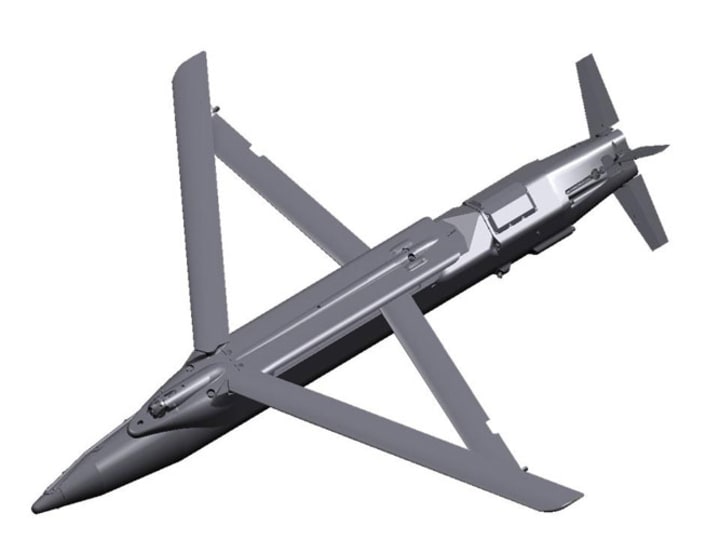
I could find no information on glide speed — this would be important in establishing the likelihood of the SDB being successfully intercepted with high probability by Russian air defences. The HIMARS standard MLRS rockets have a maximum flight speed of Mach 2.4. Bear in mind that these bombs were designed for unassisted air launch, so my guess is that they fly subsonic in glide mode.
The GLSDB is guided by a combination of inertial navigation and GPS, which allows it to fly to its target with a high degree of accuracy. The weapon is also equipped with a semi-active laser seeker, which allows it to home in on its target even in the presence of countermeasures such as flares or smoke. This makes the GLSDB highly effective against moving targets, such as vehicles or boats.
There are several warhead payloads. The smallest is in the SDB1 bomb (GBU-39B) with a 16 kg high-explosive enhanced blast warhead. The warhead is also equipped with a delay fuse, which allows it to penetrate a target before detonating, increasing the effectiveness of the weapon against hardened structures. Warhead penetration is 3 ft (1 m) of steel reinforced concrete under 3 ft of earth.
In a 2017 demonstration, the GLSDB engaged a moving target at a distance of 62 mi (100 km). The [small diameter bomb] SDB and rocket motor separated at altitude and the bomb used a semi-active laser (SAL) seeker to track and engage the target. A 2019 test extended this range to 81 mi (130 km) against a target at sea.
It is being considered for use in Ukraine with the HIMARS system. Ukraine has long wanted the ATACMS missiles for their long range. The GLSDB would be a compromise giving them a range of some 150 kilometres (94 miles) using a M26 rocket engine and an SDB. Both the SDB and the M26 are common in the US arsenal. It could be delivered by early 2023 using surplus bombs from the conflict in Afghanistan. Each would cost US$40,000. — Wikipedia
To the cost of the bomb must be added that of the relatively cheap solid fuel rocket motor. Compare that with the price per unit for ATACMS which is estimated to be well over $1M. The US has many SDBs in its arsenal and the rocket motors are said to be plentiful.
I checked into costings and $40,000 seemed a bit on the low side for the GBU-39, with costs ~$100,000 per unit for the perhaps being more realistic:
April 2016 — FMS request by Australia for 2,950 units and support equipment valued at US$386 million (Wikipedia ibid.).
However Air Force quotes $40,000.
Whichever way, they offer many more bangs per buck than the ATACMS, albeit with shorter range.
Why could GLSDB be a game changer?
The GLSDB offers high-lethality, increased range and high-manoeuvrability. It has the ability to defeat soft and hard skin threats, targets behind the launcher, as well as hard-to-reach targets. That includes terrain avoidance, cave breaching and reverse-slope engagement.
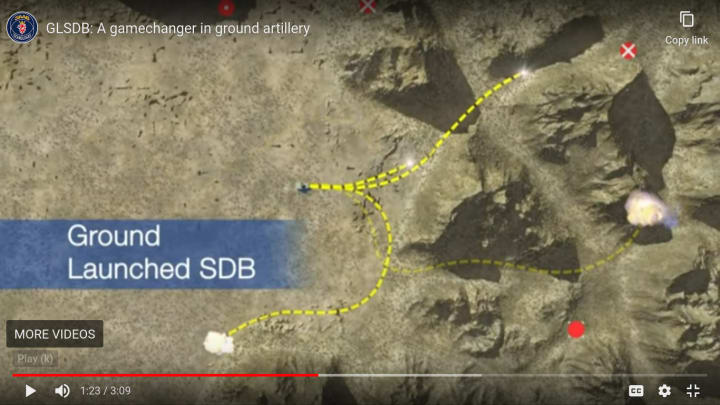
The GLSDB can reach a range of up to 130km (81 nm) although some reports claim 150 km. It has the ability to hit moving targets under all weather conditions both during the day and at night, with low collateral damage due to its high precision guidance. The CEP is 5–8 metres (SDB1)
According to Telegram Channel United24Media:
OSINT analyst Def Mon calculated the effective range of GLSDB missiles [see map below]
If Ukraine gets these missiles, the situation at the front will change very well.
Thus, the Armed Forces of Ukraine will be able to reach targets on the territory of the entire mainland of occupied Ukraine, and will also be able to hit the north of Crimea and the border territory of Russia itself.

In the above image the red line is the front — the Russian line of control as of the day of calculation. The blue dashed line is 140 km from the front.
Here’s an expert view (Former Commanding General US Army Europe):

The decision
In late 2022 the US rejected Ukraine’s request for the ATACMS missile which can be fired from the HIMARS platform. There was concern that the 300 km range of ATACMS would enable Ukraine to hit targets deep within Russian territory and that would cause escalation. The current M31 GMLRS missile that Ukraine uses in its HIMARS launchers has a range of up to 70 km.
So, the range of the GLSDB falls neatly in between that of the M31 and the ATACMS.
It brings targets in Crimea into range, although not Sevastopol, based on the current front line (and there would be some safety margin allowed for the launchers).
Should Russian forces be worried?
I think that the answer to this depends on how effective Russian air defences would be against the weapon in glide mode. Having a longer range than the standard HIMARS MLRS rockets, there is more time for acquisition and interception, especially if the glide mode is subsonic.
From a morale point of view, this is certain to have a negative effect on Russian forces. There is ample evidence to deomonstrate that HIMARS had a huge negative effect on Russian force morale.
Logistically it could pose additional problems. The standard HIMARS MLRS rocket has had a serious impact on Russian arms dumps dispositions and structure.
HIMARS attacks by Ukraine have been credited with “destroy[ing] Russian command nodes, tens of thousands of howitzer artillery rounds and a staggering 20 million small-arms rounds.” — Wikipedia (ibid.)
With Russia already suffering big problems in supplying sufficient ammunition for their traditional artillery-driven battle tactics, things can only get worse for them.
Should the West be worried?
Politically, Putin has said that weapons which threaten Russian territory would lead to escalation. He considers Crimea, Lukhansk and Donetsk to be Russian territory.
Here’s the latest pot-stirring as the first full year of the war draws near:
Continued deliveries of arms to Ukraine by its allies in the West will lead to retaliation with “more powerful weapons,” a top official in Russian President Vladimir Putin’s regime said on Sunday.
Vyacheslav Volodin, chairman of Russia’s lower house, the State Duma, threatened Europe and the U.S. with “global catastrophe” over their continued military support to the government in Kyiv, which is trying to continue retaking territory it lost in the Russian invasion.
Volodin directly invoked the use of nuclear weapons in his statement over messaging app Telegram. — politico.eu
There's plenty of food for thought in that, since reiterated by Russian ex-President Medvedev, one of Putin's running dogs:
***

Canonical link: This story was first published in Medium on 24 January 2023 [edited]
About the Creator
James Marinero
I live on a boat and write as I sail slowly around the world. Follow me for a story diet of Tech, AI, Geopolitics and more as the world is rapidly changing. I also write techno thrillers, with six to my name. More of my stories on Medium
Keep reading
More stories from James Marinero and writers in The Swamp and other communities.
The Saddest Thing - The Billionaires Who Rule America Aren't Even Enjoying Themselves
This single post says more about our ruling class than a thousand policy papers. The saddest thing about today's system is that the men robbing the rest of us - sabotaging our economic prospects, our pensions, our access to affordable healthcare - are not even happy.
By Scott Christenson🌴27 days ago in The Swamp
Sirens Expected Across Central Israel Amid New Iranian Missile Attack
Central Israel braced for potential air-raid sirens and heightened alert after Tehran launched a fresh missile attack targeting Israeli territory, in what Israeli officials called a “significant escalation” in a conflict that has drawn the two adversaries into direct confrontation. The incident underscores the increasing risk of a wider regional war and has prompted intensified military readiness, emergency preparations, and diplomatic alarm from capitals around the world. The reported missile barrage late Tuesday was confirmed by both Israeli and Iranian sources, with the Iranian government claiming the strikes were retaliation for recent attacks on Iranian territory and “acts of aggression” attributed to Israel. According to state media in Iran, multiple ballistic missiles and long-range cruise systems were fired toward targets inside central Israel, including near urban population centres. Israeli defence officials, while remaining cautious about public disclosures, acknowledged that air-defence systems had detected incoming threats and that civil defence sirens could be expected across central districts, including in and around Tel Aviv and Jerusalem. The Israeli military stressed that interception efforts were underway and urged civilians to follow protective instructions from authorities. Details of the Attack Iranian state television released video footage purportedly showing ballistic missiles being launched from bases in central Iran, accompanied by statements from Iranian military officials claiming the operation was precise and intended to strike military infrastructure. Tehran asserted that its forces had successfully launched multiple projectiles that crossed neighbouring airspace and entered Israeli defensive zones. Israeli air-defence batteries, including the Iron Dome and longer-range anti-missile systems, were reported to have engaged the incoming missiles to protect population centres and critical infrastructure. Early reports suggested that several intercepts had occurred, though assessments of resulting damage were still being compiled as of early Wednesday. Casualty and Damage Assessments At the time of the report, Israeli authorities had not confirmed civilian casualties but described some structural impacts in outlying areas near military installations. Hospitals in central districts were placed on emergency standby, and authorities mobilised additional medical and civil-defence personnel to prepare for potential civilian injuries. Local news outlets broadcast footage of residents taking shelter in protected areas, while official civil-defence channels advised families to remain indoors, stay near reinforced areas, and avoid unnecessary travel until the alert was lifted. Escalatory Context The missile exchange comes amid months of intensifying hostilities between Iran and Israel. The two countries, which have long engaged indirectly through proxies and covert operations, have escalated to overt strikes in recent weeks. Israel has targeted Iranian missile and nuclear facilities, claiming that Tehran’s efforts to expand its nuclear programme and long-range strike capabilities pose an existential threat. Iran, in turn, has justified its actions as defensive, framing them as retaliation for apparent aggression by Israeli forces. The attacks mark a significant shift from earlier phases of tension, which were primarily conducted through proxy forces in Syria, Lebanon (via **Hezbollah), and Palestinian territories. Analysts say direct missile exchanges between Tehran and Jerusalem increase the risk of miscalculation and could draw in other regional actors. Military and Civil Responses In Israel, the military — known as the Israel Defense Forces — placed key units on heightened alert and prepared fighter squadrons, air defence batteries, and reserve forces. Defence Minister Yoav Gallant emphasised that Israel would defend its citizens and sovereignty “with full force and resolve,” vowing that any attacks on Israeli civilians or territory would be met with decisive response. Prime Minister Benjamin Netanyahu addressed the nation, urging calm and unity. “Our enemies seek to sow fear, but we will protect our people and our land,” he said in a televised statement. “We call on all residents to remain vigilant and heed instructions from civil-defence authorities.” Global Diplomatic Reactions International reaction to the escalation was swift. Western capitals, including the United States Department of State, called for restraint, urging both sides to step back from further military confrontation. The United Nations Security Council convened an emergency session to address the crisis, with diplomats warning that unchecked escalation could destabilise the Middle East and disrupt global economic and security interests. European leaders expressed concern about the safety of civilians and called for an immediate de-escalation. Several countries emphasised support for Israel’s right to self-defence while also criticising the use of long-range missile strikes against population centres. Economic and Regional Impacts Markets reacted to the news of the missile strikes, with energy prices rising amid fears of wider disruption in the region, which contains some of the world’s most critical oil-export infrastructure. Shipping corridors, including access to the Strait of Hormuz, were closely monitored amid concerns about disruptions. Regional neighbours, including Jordan, Egypt, and Gulf Cooperation Council members, heightened their own security postures and appealed for de-escalation. Looking Ahead With sirens and alerts expected across central Israel, the immediate focus remains on civilian protection and intercepting any further missile threats. The broader geopolitical implications — from defence postures to diplomatic negotiations — continue to evolve rapidly. As both Tehran and Jerusalem stand firm, analysts warn that without diplomatic intervention, the exchange of strikes risks drawing the region into a broader conflict that could have far-reaching consequences for security and economic stability across the Middle East and beyond.
By Fiaz Ahmed 5 days ago in The Swamp



Comments
There are no comments for this story
Be the first to respond and start the conversation.