
German bend on the Ukrainian bend
The echo of the Ukrainian war and its effects will reverberate for many years, but there is another turning point that seems to have suddenly arisen from it,

The echo of the Ukrainian war and its effects will reverberate for many years, but there is another turning point that seems to have suddenly arisen from it, which may have the greatest repercussions, in itself and with its far-reaching effects as well, which is the unexpected change that occurred in general in German defense and foreign policy, which is unique in its kind. Since the last global war.
After that war, pacifism prevailed in German politics, which became a well-established tradition, motivated by the level of violence it practiced at the time and the resultant international and local results. The government of the new chancellor, Schulz, initially strongly resisted all American, Polish and Ukrainian pressures to budge this policy, or even to change the position refusing to stop the Nord Stream-2 project, without result. Until the time came when the Ukrainian torrent reached an extent beyond what the Kremlin circles dreamed of, and the Chancellor delivered a historic speech before the Bundestag, in which he announced that Germany had abandoned decades of restrictions on its trademark that prevented its military industry from contributing to military actions, and raised the German contribution to military support. for the Ukrainians. The most important was the announcement of allocating one hundred billion euros to support and modernize the capabilities of the German army, and the pledge to raise the proportion of military budgets to 2%, like the other partners in NATO.
For the Europeans at least, this was an astonishing transformation, and in other circumstances it could have been a nightmare, as a result of which the European Union recently issued a document on qualitatively adjusting its defense and military policy, last week.. However, in fact German foreign policy was preparing Before the Ukrainian event, the ingredients for an important change, its introductions began in advance, and before the formation of the new (red-yellow-green) traffic light coalition government. This appeared in a major detailed report last fall. It was organized by the Institute for International Relations and Security in Berlin, one of the most important decision-making centers, which until two years ago was headed by the strategic figure whom we have known in the Arab world and Syria for a long time - and the Sudanese know him well now as the representative of the Secretary-General of the United Nations there, Professor Volker Peretz; He was then succeeded by another prominent academic and strategist, Nicholas von Baumhardt. This report starts from a vision of the reality of the current international system, to draw a new scheme for it that takes into account the new coalitions, and Germany has a greater role in it as well. In it, he revives awareness of shifts in international power, the loss of influence of Western powers, growing authoritarian models, weakening multilateral institutions, and pressing global problems such as climate change—all of which require a realignment of German foreign policy. In doing so, it is important to make an adequate and objective assessment of its capabilities, as well as the current room for maneuver, all of which should guide and define its goals and priorities. Accordingly, German foreign relations must be guided by reliable partnerships and new forms of responsibility-sharing in various fields, in addition to, of course, adopting dialogue as a basis for negotiating conflicting goals.
The first is adaptation, as there are new conditions in foreign policy that have been underestimated. This relates to the rise of China, as well as the geopolitical ambitions of other countries to control strategic resources.
The second is the change related to identity, by linking the change in the national self-image, and the impact of local political interests, on the one hand; And that change in the concepts of foreign policy roles at the present time; There is a repositioning of the state in international politics, different from the previous prevailing conditions.
The third is structural change, internationally synthetic. There is an urgent interest in being on the international stage, an anticipation of opportunities to exert influence, and a desire to gain prestige or avoid losing it - these factors can inspire a more active participation in the formation of international politics, as in the cases of South Korea and Turkey - for example. their regional and global ambitions.
Finally, there is partner change, because the scope and impact of foreign policy change will be highly dependent on the choice of partners and support groups. This could begin with a deepening of the processes of convergence in official behavior internationally. For example, if China appears to Germany simultaneously as partner, competitor, and adversary, joint coalitions will constitute a normative and pragmatic expression of interests and an arrangement of preferences in the exercise of foreign policy.
The partnerships necessary for German foreign policy bring with it opportunities, but also consequences, so managing overall expectations, both internally and externally, is essential and of central importance, particularly in NATO, as well as in the European context. Orientation - for example - towards the important Franco-German partnership should not lead to a feeling of exclusion among other members of the European Union. Thus, “neighborhood” will no longer be a regional concept; “Germany needs “global” neighbors in different regions of the world, if it is to contribute to solving the problems of the future, as not only will burden-sharing arrangements be achieved, but it will also be important to develop a new set of tools to share responsibility and shape the future. together.
In this scenario, the international system is no longer based on Paxa Americana. The latter is moving away to make way for a multipolar system with a bipolar at its core, of the two biggest rivals, the United States and China. These two - along with the European Union, India, Japan and Russia - would constitute the new union, the orchestra of the world's movement, relatively speaking. These six powers account for about 70 percent of global GDP and military spending, and 65 percent of carbon dioxide emissions. In this union model, a commitment to maintain close and flexible cooperation in order to ensure stability in terms of the current regional emergency here and there. The "six" mutually avoid interfering in internal affairs. The Union sees itself as the center of control in international politics, and it is superior in its practical capabilities to the United Nations and groups such as the Big Seven. That authority and legitimacy derives from the ability of the Six to find common answers and solutions to global challenges. These include the proliferation of weapons of mass destruction, the threat of terrorist networks, concerns about global health, and the effects of climate change. Senior diplomats do the essential work; They have a secure headquarters, possibly in Geneva or Singapore, where the secretariat is. Close contact between them is aimed at compatibility, and at preventing one member from surprising the others with isolated actions. However, when no agreement can be reached, even the sum of those powers will remain impotent, and their members can act unilaterally if they see their vital national interests under threat, and a member is expelled only if it repeatedly violates the interests of another party in an aggressive manner.
Of course, there will be an important change in the scenarios and facts after the violence in Ukraine, which is not over yet. This brutal event developed new conditions that will have consequences for the position on Russia and the future of the relationship with it, and perhaps on its position that Putin wanted to develop, to return to the level of the days of the Cold War, when there was a world with two heads. That distinguished position at the time, with distinguished military capabilities, a decent economy, and great international influence, was no longer possible with an economy that ranked twelfth internationally, and a military force that the Ukrainian resistance had proven to be backward until now, with nuclear capabilities that only benefit in the event of suicide.
Zelensky said last week that the missiles were descending on Ukraine with the words “To Berlin” written on it, to cause panic in it, so that it hastened to meet his demands and European support, instead of submitting to the pressure of Russian gas. He is aware of Germany's pivotal role in Europe, and in its future and that of Ukraine as well; The upheaval of Germany's defense and foreign strategy has revived and revived his hopes.. But German change and change carry larger and broader meanings, even than Putin's expected catastrophe in Ukraine. Often, China, in turn, was also waiting for the results of the Russian adventure, to begin its adventure in Taiwan. That possibility is diminishing... until now!
About the Creator
Keep reading
More stories from Zernouh abderrahman and writers in The Swamp and other communities.
Will NATO borders extend to Ceuta and Melilla?
It is not new for the idea to be raised, but at a time when Putin is still determined to prevent NATO from expanding further east of Europe, who do you think can stand in the way of the alliance if it wants to expand from the other side, that is, to the southern borders of the continent? This may not seem possible or expected right now. The Ukrainian fire has not yet been extinguished, and no one can say for sure where it will spread, or whether its fire will recede quickly, or not?
By Zernouh abderrahman4 years ago in The Swamp
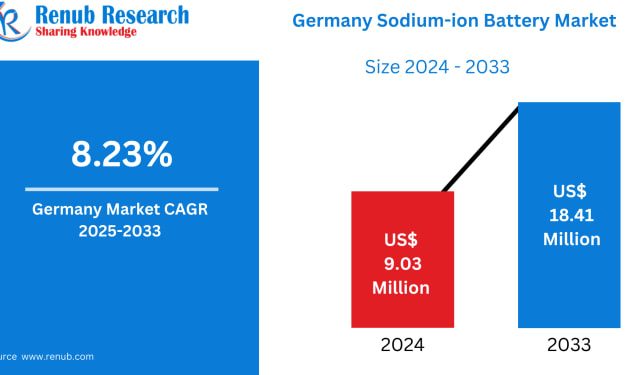
Germany Sodium-ion Battery Market Size & Forecast 2025–2033
Market Overview Germany’s Sodium-ion Battery Market is poised for steady expansion as the country accelerates its transition toward clean energy and material-secure battery technologies. According to Renub Research, the market is projected to grow from US$ 9.03 million in 2024 to US$ 18.41 million by 2033, registering a Compound Annual Growth Rate (CAGR) of 8.23% during 2025–2033.
By jaiklin Fanandish8 days ago in The Swamp
Wild Card Weekend Recap: What Happens Now?
I think I figured out why I love Wild Card Weekend so much. It's because it's the first playoff anything of the calendar year. The NFL season starts in the fall, and once upon a time, the champion was crowned either on or slightly before New Year's. The evolution of the NFL schedule has resulted in the playoffs starting just into the New Year, and currently, the final week of the season falls on the first weekend of the New Year, with Wild Card Weekend coming a week after that. So yes, chronologically, the NFL's Wild Card Weekend serves as the first playoff anything of the calendar year.
By Clyde E. Dawkins2 days ago in Unbalanced



Comments
There are no comments for this story
Be the first to respond and start the conversation.