
"France defends decision to grant George Clooney and his family French citizenship amid criticism"
Paris pushes back against backlash, saying citizenship is a sovereign choice as celebrity, culture, and politics collide


Conclusion: More Than a Celebrity Story
Ultimately, the controversy surrounding George Clooney’s French citizenship is less about one actor and more about how nations balance law, values, and public perception. France’s defense of its decision underscores its commitment to republican principles, even in the face of criticism.
Whether the debate fades or reshapes future discussions on citizenship, one thing is clear: in a globalized world, the intersection of fame, law, and national identity will continue to provoke strong opinions—and France is not backing down from its interpretation of what it means to belong.France has found itself at the center of an unusual but revealing debate after defending its decision to grant French citizenship to Hollywood star George Clooney and his family. What might have been a quiet administrative move instead sparked criticism, social media backlash, and political commentary, forcing French officials to publicly justify the decision. The controversy highlights deeper questions about national identity, celebrity privilege, and how modern nations balance openness with public sentiment.
According to French authorities, the decision to grant citizenship to George Clooney, his wife Amal Clooney, and their family followed existing legal frameworks. Officials emphasized that French citizenship can be awarded through residency, contribution to national culture, or special consideration by the state. In Clooney’s case, France pointed to the family’s long-standing ties to the country, including property ownership, extended residence, and engagement with French society.
Critics, however, were quick to accuse the government of double standards. On social media and in opinion columns, some questioned why a wealthy Hollywood actor could seemingly fast-track citizenship while ordinary migrants and long-term residents often face years of bureaucratic hurdles. Others argued that the move sends the wrong message at a time when immigration and national identity remain sensitive political issues in France.
The French government firmly rejected these claims. Officials stated that Clooney did not receive “special treatment” and that his case met legal criteria available to any applicant. They also stressed that celebrity status alone is not enough to secure citizenship, countering the narrative that fame overrides the law. “France is a nation governed by rules, not star power,” one official remarked, underlining the state’s position.
Beyond legality, supporters of the decision highlighted George Clooney’s global influence and his wife Amal Clooney’s work as a prominent human rights lawyer. Amal’s involvement in international justice, advocacy for press freedom, and legal defense of persecuted journalists has earned widespread respect in Europe. Many argue that such contributions align closely with French values of liberty, equality, and human rights.
The debate also exposes a broader tension in modern democracies: how public perception shapes policy legitimacy. While citizenship laws may be clear, symbolic cases involving celebrities often trigger emotional reactions. For some French citizens struggling with economic pressures or frustrated by immigration policies, the Clooney case became a lightning rod for deeper anxieties about fairness and belonging.
France, however, has a long history of welcoming artists, intellectuals, and public figures from around the world. From writers and philosophers to filmmakers and musicians, the country has often used cultural influence as a form of soft power. Defenders argue that granting citizenship to globally respected figures enhances France’s international image and reinforces its role as a cultural and humanitarian leader.
At the same time, the controversy reflects changing attitudes toward celebrity itself. In an era of rising inequality, public trust in elites has eroded. Decisions involving wealthy, famous individuals are increasingly scrutinized, regardless of legality. What once might have been celebrated as a prestigious association is now viewed through a more critical lens.
George Clooney himself has remained largely silent on the backlash, avoiding public statements that could escalate the situation. Observers note that his low-key response may be intentional, allowing French institutions to speak for themselves. This approach contrasts with the media frenzy surrounding the issue, which has extended far beyond France’s borders.
About the Creator
Fiaz Ahmed Brohi
I am a passionate writer with a love for exploring and creating content on trending topics. Always curious, always sharing stories that engage and inspire.
Keep reading
More stories from Fiaz Ahmed Brohi and writers in The Swamp and other communities.
Finnish Police Seize Ship Suspected of Sabotaging Undersea Cable: A Growing Threat Beneath the Seas
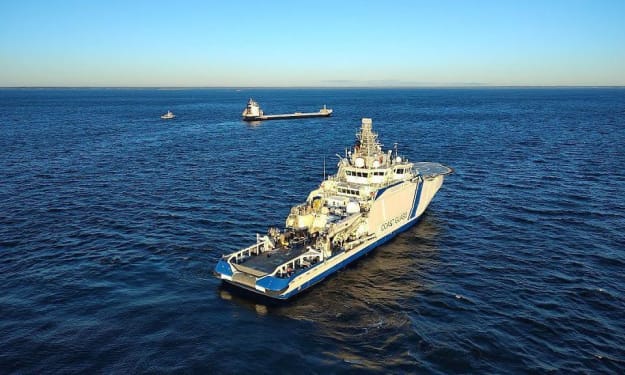
Finnish police have seized a ship suspected of sabotaging an undersea cable, raising fresh alarms across Europe about the vulnerability of critical underwater infrastructure. The incident, unfolding in the strategically sensitive Baltic Sea region, has once again highlighted how modern conflicts are increasingly moving beyond land, air, and cyberspace—into the depths of the ocean. Undersea cables are essential to global connectivity. They carry internet traffic, financial transactions, military communications, and energy flows between nations. Despite their enormous importance, these cables remain largely invisible and difficult to monitor, making them an attractive target for covert operations. The Finnish case underscores just how exposed these systems are in an era of rising geopolitical tension. What Happened? According to Finnish authorities, the vessel was operating near a vital undersea cable when damage was detected. While officials have stopped short of publicly confirming deliberate sabotage, the ship’s movements reportedly raised serious suspicions. As a result, Finnish police seized the vessel to secure evidence and question the crew as part of an ongoing criminal investigation. Maritime and technical experts are now examining whether the damage was caused accidentally—such as by an anchor or fishing equipment—or whether it was intentional. Investigators are focusing on navigation data, onboard equipment, and the timeline of the ship’s presence in the area to determine responsibility. Why Undersea Cables Matter More than 95 percent of the world’s data travels through undersea cables. These cables form the backbone of modern economies, enabling everything from online banking and emergency services to cloud computing and international trade. A single damaged cable can disrupt communications across multiple countries, causing financial losses and public inconvenience within hours. In regions like the Baltic Sea, the stakes are even higher. The area contains a dense network of data cables, power links, and energy pipelines connecting Northern and Eastern Europe. Any interference with this infrastructure can have cascading effects far beyond national borders. A Security Issue, Not Just an Accident Finnish officials have emphasized that potential sabotage of undersea infrastructure is treated as a national security issue. Finland, which recently joined NATO, has taken a particularly firm stance on protecting its territorial waters and strategic assets. The seizure of the ship signals that authorities are willing to act decisively when suspicious activity is detected. Security analysts note that undersea cable sabotage fits into a broader pattern of “hybrid warfare,” where states or non-state actors use covert, deniable actions to pressure rivals without triggering open conflict. Because cable damage can often be blamed on accidents, attribution becomes difficult, allowing perpetrators to operate in a legal and diplomatic gray zone. Rising Tensions in the Baltic Sea The Baltic Sea has become a hotspot for security concerns since the Russia-Ukraine war began. Several unexplained incidents involving pipelines and cables in recent years have increased anxiety among European governments. While no direct link has been established between this case and any specific country, the timing has heightened regional alertness. NATO and European Union members are closely watching Finland’s investigation. Any evidence suggesting deliberate sabotage could have far-reaching diplomatic consequences and prompt stronger collective security measures. Calls for Better Protection The incident has renewed calls for enhanced monitoring of undersea infrastructure. Experts argue that governments have long underestimated the risks because these assets are hidden from public view and costly to patrol. Proposed solutions include increased naval surveillance, underwater drones, satellite tracking of vessel movements, and closer intelligence sharing among allied nations. There is also growing debate about international law. Existing maritime conventions provide limited protection for undersea cables, but enforcement remains weak—especially in international waters. Cases like this may push policymakers to strengthen legal frameworks and penalties for interference with critical seabed infrastructure. A Wake-Up Call for the Digital Age For most people, undersea cables are out of sight and out of mind—until something goes wrong. Internet outages, disrupted payments, or communication failures quickly reveal how dependent modern life is on fragile systems lying on the ocean floor. Whether the Finnish investigation ultimately confirms sabotage or not, the message is clear: undersea infrastructure can no longer be treated as a low-risk asset. As geopolitical rivalries intensify, the battle for security is increasingly being fought in places the public rarely sees. The seizure of the suspected ship marks more than just a police action—it is a warning that the next front line of global security may lie deep beneath the waves.
By Fiaz Ahmed Brohi2 months ago in The Swamp
The Forsyth House Fire
Since 1851, Forsyth House has stood on the corner of Union Street and Gordon Street in the heart of Glasgow. Its iconic, or was... because on Sunday 8th of March, 2026, a fire broke out in a small, seemingly un-named shop in the building and tore all that history down. As I write, the rubble is still unsettled and the street is still blocked off. Central Station is quiet on the upper level, and around 30 small businesses have quite literally gone up in smoke.
By S. A. Crawford3 days ago in The Swamp
Hottest in the Office
Dear Rafi, You’re very distracting to work around. For the first second I saw you the other day, I thought you were some type of executive. It took a moment to realize no, you were just the new guy, dressed up for the job he wants. Be still, my heart.
By Gabriel Shames6 days ago in Pride


Comments
There are no comments for this story
Be the first to respond and start the conversation.