
Flipping Democracy: KP Assembly Seat Decided by Coin Toss Sparks National Outrage
As PTI loses reserved seats despite public mandate, a coin toss decides who enters parliament—raising serious questions about justice and democracy in Pakistan.

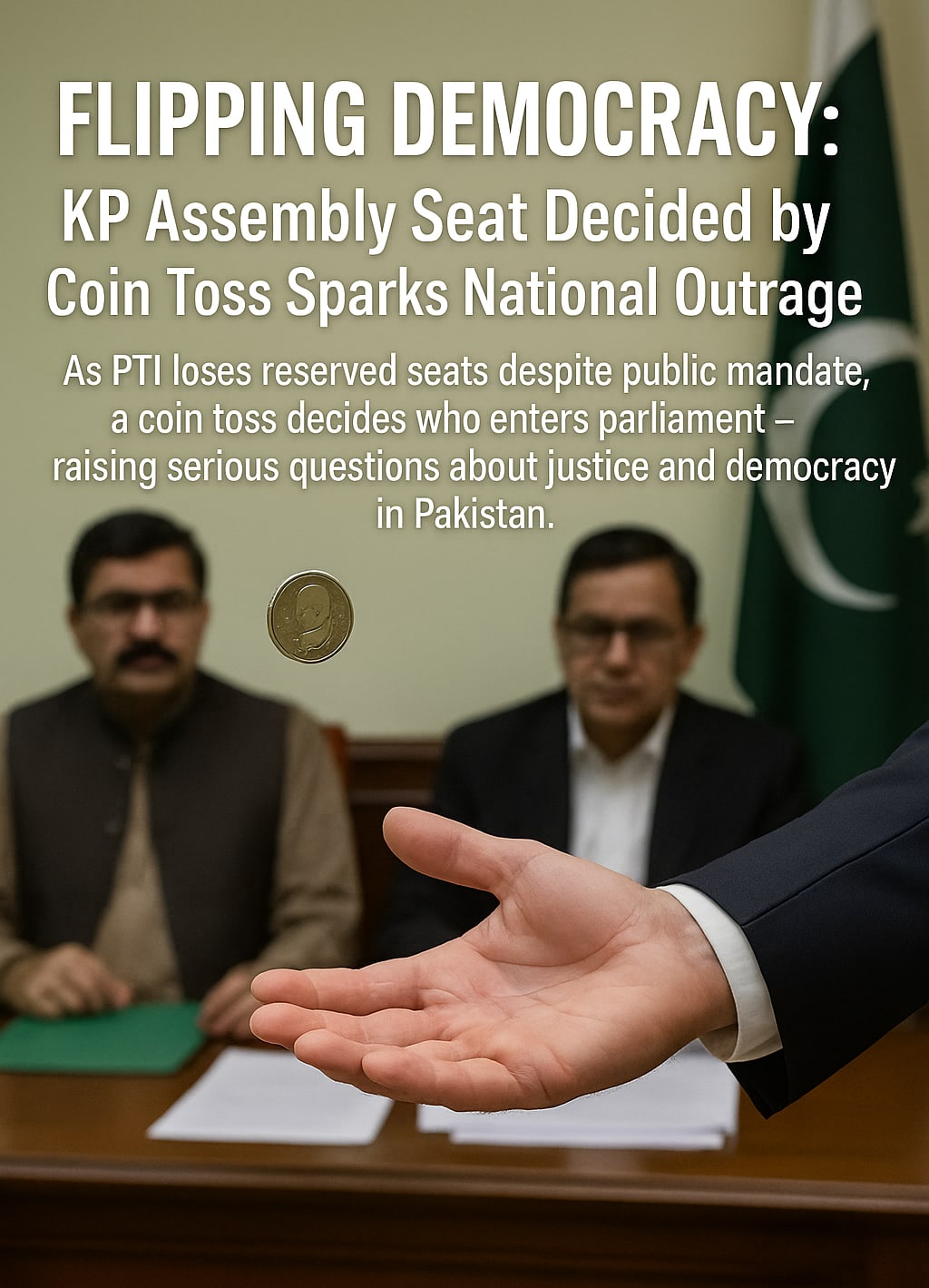
In a strange and symbolic moment in Pakistan’s political history, a coin toss decided a reserved women’s seat in the Khyber Pakhtunkhwa (KP) Assembly. This shocking event took place during the reallocation of reserved seats, after the Supreme Court declared that Pakistan Tehreek-e-Insaf (PTI) and its allied Sunni Ittehad Council (SIC) were not eligible to receive them.
Reserved seats for women and minorities were reallocated in all provincial and national assemblies across Pakistan as a result of this court ruling. However, the most surprising development occurred in Khyber Pakhtunkhwa, where the Election Commission of Pakistan (ECP) was forced to flip a coin to resolve a deadlock between two political parties. This act has stirred serious concerns about the fairness of the democratic process and the denial of the people’s will.
What Happened in KP: Coin Toss for Reserved Seat
In KP, a women’s reserved seat was tied between Awami National Party (ANP) and PTI-Parliamentarians. As both parties had equal numerical strength in the assembly and the law did not offer a clear solution, a coin toss was conducted by the ECP at its office in Peshawar. Senior representatives from both parties were present to witness the process. ANP’s Shahida Waheed won the toss and secured the seat.
This was not a joke. It was a real, legally recognized decision—made not through voting, not through negotiation, but by sheer chance.
In contrast, another close call over a minority reserved seat between PML-N and JUI-F was resolved through mutual agreement, with PML-N withdrawing its claim in favor of JUI-F.
According to Dunya News and Daily Times, the coin toss was only used for the women’s seat in KP, making this incident both rare and controversial.
Public Mandate vs Legal Technicalities
Many citizens and political analysts believe this entire situation reflects a deeper injustice. In the February 2024 general elections, PTI-backed candidates received a massive public mandate, especially in Khyber Pakhtunkhwa. Due to the party’s disqualification from using its electoral symbol, PTI candidates contested as independents and later joined the Sunni Ittehad Council.
Despite this move, the Supreme Court ruled that SIC had failed to submit the proper list of candidates for reserved seats in time. As a result, PTI and SIC were declared ineligible for any reserved seats in the National Assembly and all four provincial assemblies.
This legal interpretation effectively nullified a significant portion of the public’s vote. Political observers and PTI supporters argue that this was not just a legal matter but a denial of democracy itself. The very seats that were meant to ensure fair representation for women and minorities were taken from the largest vote-winning party and distributed among others who had won far fewer seats.
Coin Toss Adds Insult to Injury
While the reallocation of reserved seats was a serious blow to PTI and its supporters, the use of a coin toss to decide parliamentary representation has added insult to injury. Many see this act as symbolic of how undemocratic and uncertain the political process has become.
“How can a decision that affects the people of an entire province be left to chance?” asked one frustrated voter in Peshawar. “People stood in long queues and risked their safety to vote—and now a coin decides the outcome?”
A Question of Fairness
There is no doubt that the courts and the ECP followed legal procedures. But the larger question remains: Is this justice? Was it fair to strip PTI of its reserved seats, despite clear support from the public? And if legal technicalities override the people’s will, what does that say about the health of democracy in Pakistan?
The KP coin toss has become more than just a quirky headline—it is a powerful symbol of a broken system that failed to represent the people who voted in good faith. It raises a deeper concern: If elections do not lead to representation, what purpose do they serve?
Sources:
Dunya News – Toss decides tie as ANP’s Shahida Waheed wins reserved seat
Daily Times – ANP wins toss for reserved women’s seat in KP Assembly
The Nation – Opposition gains ground in KP after reserved seat reallocation
The Standard – Supreme Court rules PTI ineligible for reserved seats
About the Creator
Muhammad Adil
Master’s graduate with a curious mind and a passion for storytelling. I write on a wide range of topics—with a keen eye on current affairs, society, and everyday experiences. Always exploring, always questioning.
Keep reading
More stories from Muhammad Adil and writers in The Swamp and other communities.
“If Anything Happens to Me, Hold Him Responsible”: Imran Khan’s Explosive Jail Message Shakes Pakistan
On July 15, 2025, former Prime Minister Imran Khan issued a strong and emotional message from Adiala Jail, which was conveyed to the public via his official Twitter (X) account through his family and legal team. In this message, Khan addressed his supporters, party members, and the general public of Pakistan. His words have sparked fresh waves of political debate and renewed attention on the conditions of political prisoners in the country.
By Muhammad Adil6 months ago in The Swamp
Global Blow Torch Market Size and Forecast 2025–2033
Introduction: A Tool with Firepower and Finesse The global blow torch market is poised for steady and promising growth, projected to expand from US$ 348.42 million in 2024 to US$ 527.23 million by 2033, registering a CAGR of 4.71% during 2025–2033, according to Renub Research. Once regarded primarily as an industrial heating device, the blow torch has evolved into a versatile tool used across manufacturing, construction, automotive repair, jewelry making, and even culinary arts.
By Janine Root 7 days ago in The Swamp


Comments
There are no comments for this story
Be the first to respond and start the conversation.