
FBR Updates Customs Values for 62 Used Phone Models — What It Means for Pakistan’s Tech Market
Why the FBR Updated Customs Values

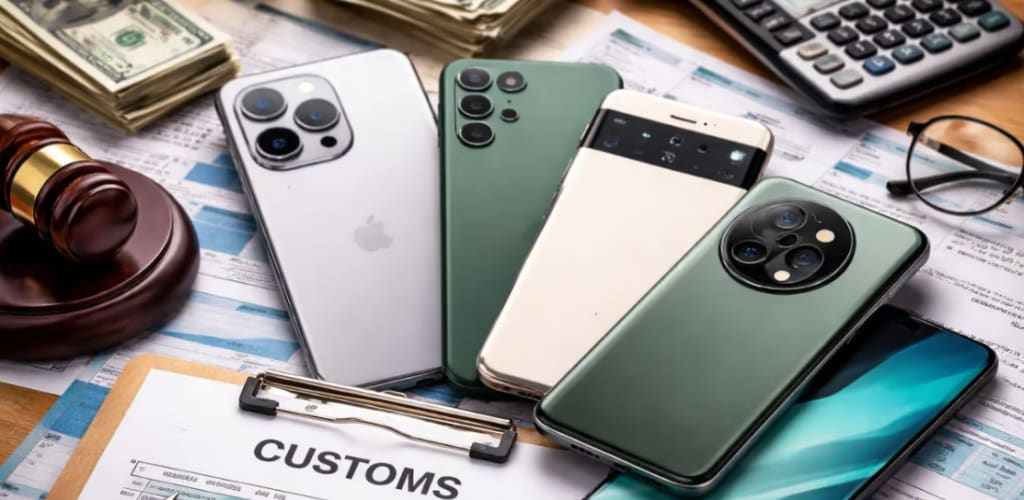
The Federal Board of Revenue (FBR) recently shook up Pakistan’s mobile phone import landscape by updating customs values for 62 used phone models. Announced through Valuation Ruling No. 2035 of 2026 by the Directorate General of Customs Valuation, Karachi, this move is the most comprehensive revision in recent years. For a country where smartphones are not just devices but lifelines to work, education, and social life, this update is far from just numbers—it affects businesses, consumers, and the overall tech market.
Why the FBR Revised Customs Values
The last official list for used phone customs values came out in 2024, and in tech terms, 18 months is a long time. Many older flagship devices have fallen in price, while new models have entered the market, changing the landscape entirely.
Before this revision, traders were declaring low import values, often below real-world resale prices. This mismatch created under-invoicing issues, leading to revenue loss for the government and unfair advantages for certain importers. By aligning declared values with actual market rates, the FBR aims to streamline trade, increase revenue, and reduce disputes at customs.
Which Devices Are Affected?
The update covers 62 popular models of used mobile phones from major brands, including:
Apple iPhones
Samsung Galaxy Series
Google Pixel Devices
OnePlus Phones
The FBR has established fixed C&F values (Cost & Freight) for each model. These act as a baseline for calculating import duties and taxes. Importantly, these values apply regardless of the phone’s physical condition, simplifying customs procedures.
Here’s a snapshot of the updated values in US dollars:
Apple iPhones
iPhone 15 Pro Max – $460
iPhone 15 Pro – $390
iPhone 15 Plus – $320
iPhone 14 Pro Max – $360
iPhone 13 Pro Max – $295
iPhone SE (various generations) – ~$24-$25
Samsung Galaxy
Galaxy S23 Ultra – $255
Galaxy S23+ – $160
Galaxy S22 Ultra – $160
Galaxy Note 20 Ultra – $115
Galaxy Note 9 – $25
Google Pixels
Pixel 9 Pro XL – $260
Pixel 8 Pro – $188
Pixel 6a – $28
Pixel 5 – $18
OnePlus
OnePlus 12 – $184
OnePlus 11 – $92
OnePlus 10T – $60
This list shows a clear pattern: newer flagship devices have higher valuations, while older models have been adjusted downward, yet still higher than some pre-revision declared values.
Important Conditions for Importers
The FBR didn’t just revise numbers—they also issued rules for compliance:
Commercial Import Only – The update applies to bulk imports meant for sale, not small personal imports.
Handset Only – Customs values apply to the phone alone; accessories like chargers or boxes are taxed separately.
Condition Doesn’t Matter – Phones are valued the same whether they are pristine or slightly used.
Six-Month Activation Rule – Only phones that have been activated for at least six months qualify as “used.” Customs may verify activation periods to prevent near-new phones from being misclassified to avoid duties.
These rules aim to standardize the used phone market, reduce disputes, and prevent loopholes in import taxation.
If Your Model Isn’t Listed
Not all phones are covered. For unlisted models, customs officials will determine the value using Sections 25(5) and 25(6) of the Customs Act, 1969, often by comparing similar models. If the importer declares a higher invoice value, that value will typically override the fixed customs rate.
What This Means for the Market
While customs values may seem like dry bureaucracy, their impact is tangible:
More Transparent Trade – Standardized values reduce subjective assessments and improve trust between traders and authorities.
Revenue Boost – Closer alignment of customs values with real market prices reduces under-invoicing, increasing government revenue.
Potential Savings for Consumers – Since duties and PTA taxes are calculated on customs values, adjustments may lower taxes on certain older phones, making them more affordable.
Market Regulation – The six-month activation rule ensures the market for “used” phones remains legitimate and protects small retailers from unfair competition by misclassified devices.
In essence, this policy attempts to balance consumer affordability with trade fairness and revenue collection, showing the interconnectedness of technology, economics, and governance in Pakistan.
Looking Ahead
Pakistan’s used phone market has often been volatile, influenced by fluctuating taxes, currency changes, and customs valuation practices. The FBR’s latest update signals a push toward modernization and standardization, benefiting traders, consumers, and regulators alike.
For consumers, this is a reminder that used phones remain a viable and often more affordable option, especially as new models continue to arrive at high prices. For importers, the message is clear: compliance with updated values and rules is crucial to avoid penalties.
Finally, for policymakers and industry watchers, the revision highlights how data-driven policy can streamline trade, reduce revenue leakages, and make markets fairer. What may seem like a technical adjustment actually shapes buying patterns, business strategies, and the day-to-day choices of millions of smartphone users in Pakistan.
Final Thoughts
The FBR’s update on customs values for 62 used phone models is more than just numbers—it is an effort to balance the needs of consumers, traders, and the government. By bringing valuations in line with real-world prices, introducing clear rules, and tightening compliance standards, Pakistan is taking a step toward a more transparent and sustainable used mobile phone market.
As smartphone usage continues to grow and digital connectivity becomes ever more critical, these policies remind us that technology, trade, and governance are inseparable. Consumers and traders alike should stay informed, and adapt to the new rules—because in the world of tech imports, knowledge is power.
About the Creator
Muhammad Hassan
Muhammad Hassan | Content writer with 2 years of experience crafting engaging articles on world news, current affairs, and trending topics. I simplify complex stories to keep readers informed and connected.
Keep reading
More stories from Muhammad Hassan and writers in The Swamp and other communities.
British Business Bank Makes Its Biggest Direct Bet Yet on Energy Tech
When you think about government-backed banks, “taking big risks” isn’t usually the first thing that comes to mind. But the British Business Bank (BBB) is changing that perception. Recently, it announced its largest direct equity investment ever — a whopping £25 million in Kraken Technologies, the AI-driven energy software company spun out of Octopus Energy.
By Muhammad Hassanabout 10 hours ago in The Swamp


Comments
There are no comments for this story
Be the first to respond and start the conversation.