
EV Charging Infrastructure Market Size and Forecast 2025–2033
From US$31.91 Billion to US$258.53 Billion: How Policy, Technology, and Consumer Adoption Are Reshaping the Global Charging Ecosystem

Introduction: The Backbone of the Electric Mobility Revolution
The electric vehicle (EV) transition is no longer a future promise—it is an unfolding reality reshaping transportation systems worldwide. At the heart of this transformation lies one indispensable element: charging infrastructure. Without a dense, reliable, and intelligent network of charging points, even the most advanced electric vehicles would remain limited in reach and appeal.
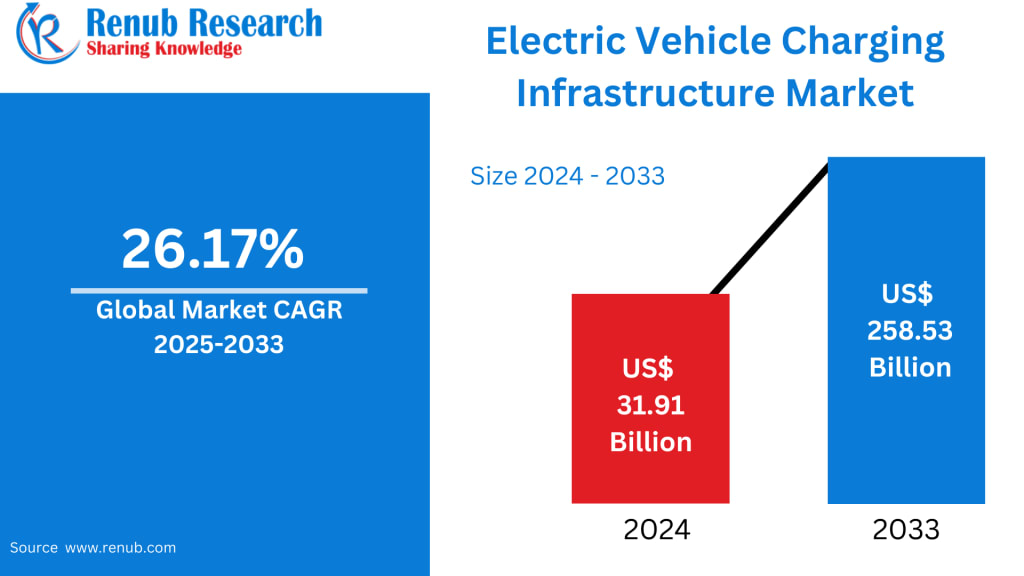
According to Renub Research, the global electric vehicle charging infrastructure market was valued at US$ 31.91 billion in 2024. Between 2025 and 2033, the market is projected to expand at a robust CAGR of 26.17%, reaching approximately US$ 258.53 billion by 2033. This remarkable growth reflects not only accelerating EV adoption but also sustained government support, private sector investment, and rapid technological innovation.
What was once perceived as a niche utility has become a strategic pillar of modern transportation, energy transition, and urban development. The following analysis explores how the EV charging ecosystem is evolving, who is shaping it, and why the next decade will be decisive.
Understanding the EV Charging Infrastructure Market
EV charging infrastructure refers to the network of equipment, systems, and digital platforms that enable electric vehicles to recharge. This ecosystem includes:
Hardware: Charging stations, power converters, connectors, and cables
Software: Network management platforms, payment systems, load balancing, and remote monitoring
Energy Systems: Grid integration, renewable energy links, and storage solutions
Charging solutions are typically classified into three levels:
Level 1 (Slow Charging): Uses standard household outlets; best for overnight residential use.
Level 2 (AC Fast Charging): Widely installed in homes, workplaces, and commercial areas.
DC Fast Charging (Rapid/Ultra-Fast): High-power stations along highways, transit hubs, and fleet depots for quick top-ups.
Modern charging stations increasingly integrate smart features such as mobile app access, real-time availability, digital payments, predictive maintenance, and renewable energy compatibility. These capabilities transform charging from a basic utility into a digitally managed service.
Market Drivers: What Is Fueling Explosive Growth?
1. Rapid EV Adoption
Global EV sales continue to rise as automakers electrify portfolios and consumers seek cleaner mobility. Every new EV sold strengthens the demand for accessible and fast charging points across residential, commercial, and public spaces.
2. Government Policies and Incentives
Governments in Europe, North America, and Asia-Pacific are aggressively promoting EV adoption through:
Subsidies for charging station installation
Mandates for EV-ready buildings
Investments in highway fast-charging corridors
Net-zero and emission-reduction targets
These initiatives reduce entry barriers for infrastructure developers and accelerate deployment.
3. Corporate and Fleet Electrification
Logistics providers, ride-hailing companies, delivery services, and municipal fleets are transitioning to electric vehicles. This shift drives demand for high-capacity depot charging, load-managed networks, and energy-optimized fleet solutions.
4. Technological Advancements
Innovations in power electronics, ultra-fast charging, modular station design, wireless charging, and vehicle-to-grid (V2G) technologies are making charging faster, safer, and more energy-efficient.
5. Consumer Expectations
The modern EV user expects charging to be as convenient as refueling—available “anywhere, anytime.” This demand is pushing charging networks into parking facilities, shopping malls, workplaces, residential complexes, and highways.
Regional Outlook: Where Growth Is Accelerating
Europe: Strong regulatory frameworks, ambitious carbon goals, and mandates for EV-ready infrastructure in new buildings.
North America: Expansion of highway fast chargers, state-level incentives, and increasing fleet electrification.
Asia-Pacific: Rapid urbanization, government-backed EV adoption in China, India, Japan, and South Korea, and rising investments in public infrastructure.
Emerging Markets: Gradual expansion supported by renewable energy integration and public–private partnerships.
Competitive Landscape: Leading Companies Shaping the Market
The EV charging infrastructure market is highly competitive, featuring global technology leaders, energy companies, and specialized charging providers.
ABB Ltd.
Established: 1988 | Headquarters: Switzerland
ABB is a global leader in electrification and automation, offering advanced AC and DC charging solutions integrated with smart grids and renewable energy. With deep engineering expertise and large-scale infrastructure capabilities, ABB plays a crucial role in public and commercial charging networks.
ChargePoint, Inc.
Established: 2007 | Headquarters: United States
ChargePoint operates one of the world’s largest networked EV charging platforms. Its business model integrates hardware, cloud software, and support services, serving residential, commercial, and fleet customers across multiple continents.
Blink Charging Co.
Established: 2009 | Headquarters: United States
Blink provides both hardware and network services, offering cloud-based management through the Blink Network. Its strategic partnerships across retail, hospitality, healthcare, education, and municipal sectors support rapid market penetration.
Eaton Corporation
Established: 1911 | Headquarters: Ireland
Eaton delivers intelligent power management solutions for utilities, data centers, and transportation. Its eMobility portfolio includes electrical systems, charging hardware, and energy optimization services tailored for large-scale infrastructure.
Tesla Inc.
Established: 2003 | Headquarters: United States
Tesla operates one of the most extensive fast-charging networks globally through its Supercharger stations. Integrated with Tesla’s vehicle ecosystem, the network sets benchmarks in reliability, speed, and user experience.
Product Launches Driving Market Momentum
Webasto Group (Nov 2023)
Webasto announced the broader rollout of its TurboConnect™ charger in early 2024, following high-volume customer adoption. It also unveiled upcoming products—the Turbo DX™ 2 Charging Station and Webasto Go™ Gen 2 High-Power Cordset—designed to improve safety, efficiency, and accessibility.
Schneider Electric (Jan 2025)
Schneider Electric launched Schneider Charge Pro, an energy-efficient solution aimed at commercial fleets and multi-family residential properties. With European regulations mandating EV charging readiness in new and renovated buildings by 2027, this solution addresses key adoption barriers in fragmented markets.
Strategic Insights: SWOT Highlights
Siemens – Strengths
Siemens benefits from deep electrification expertise, a broad portfolio of AC and DC chargers, and integration with smart grids and renewable systems. Its reputation for engineering excellence, strong partnerships with utilities and governments, and sustained R&D investment position Siemens as a trusted provider for large-scale charging infrastructure.
Delta Electronics – Strengths
Delta is recognized for its power electronics expertise, high-efficiency charging technologies, and vertically integrated manufacturing. Its modular AC, DC, and ultra-fast chargers support solar integration, battery storage, and smart-grid applications. Global manufacturing capabilities enable competitive pricing and rapid deployment.
Recent Market Developments
Robert Bosch GmbH (August 2022)
Bosch installed advanced manufacturing systems in Nuremberg to support powertrain and electric drive components. This reflects broader industry investment in next-generation EV technologies that indirectly strengthen charging ecosystem demand.
EVBox (ENGIE) (Nov 2023)
EVBox began production of its Troniq Modular charging station in Illinois. The system’s modular architecture allows scalable output from 90 kW to 240 kW and compliance with “Build America, Buy America” standards. Its ability to charge multiple vehicles simultaneously makes it ideal for high-traffic applications.
Sustainability as a Core Strategy
ClipperCreek Inc.
ClipperCreek embeds sustainability into product design through energy-efficient operation, durable construction, and recyclable materials. By supporting solar-integrated charging, reducing standby power, and promoting long product lifecycles, the company aligns charging infrastructure with global clean-energy objectives.
Exicom Tele-Systems Ltd.
Exicom integrates sustainability at the core of its EV infrastructure strategy, emphasizing renewable integration—particularly solar—energy-efficient charging, and low-impact manufacturing. With a strong focus on India’s EV transition, Exicom contributes to carbon reduction through smart diagnostics, predictive maintenance, and responsible sourcing.
Market Segmentation Overview
The EV charging infrastructure market can be segmented by:
Charging Level: Level 1, Level 2, DC Fast Charging
Application: Residential, Commercial, Public, Fleet Depots
Connectivity: Smart vs. Conventional Charging
Power Output: Low, Medium, High, Ultra-Fast
Geography: North America, Europe, Asia-Pacific, Rest of the World
This segmentation reflects the diversity of use cases—from home charging convenience to high-speed highway corridors and large-scale fleet operations.
Company Analysis Framework
For leading players such as ABB, ChargePoint, Blink, Eaton, Tesla, Webasto, Schneider Electric, Siemens, Delta Electronics, Bosch, EVBox, ClipperCreek, Exicom, Star Charge, Wallbox, Fortum, Pod Point, Efacec, Leviton, and Heliox, comprehensive evaluation includes:
Company Overview and History
Business Model and Operations
Leadership and Workforce
Recent Strategies and Partnerships
Sustainability Initiatives
Product Portfolios and Benchmarking
SWOT Analysis
Revenue and Market Share Insights
Such structured analysis highlights how each organization contributes to innovation, deployment, and long-term market growth.
Challenges and Restraints
Despite rapid expansion, the industry faces notable challenges:
High Installation Costs: Grid upgrades, land acquisition, and permitting increase capital requirements.
Grid Capacity Limitations: High-power charging strains existing infrastructure without proper energy management.
Interoperability Issues: Fragmented standards can affect user experience.
Utilization Imbalance: Some regions experience underused stations while others face congestion.
However, advancements in energy storage, smart load management, and V2G systems are steadily addressing these constraints.
The Road Ahead: Future Outlook
The next decade will define the maturity of electric mobility. As EV adoption accelerates, charging infrastructure will evolve into a fully integrated component of smart cities, renewable grids, and digital mobility ecosystems. Key trends likely to shape the future include:
Ultra-fast and wireless charging technologies
Vehicle-to-grid (V2G) integration for grid stability
AI-driven energy management and predictive maintenance
Expansion of charging-as-a-service business models
Greater emphasis on renewable-powered charging networks
By 2033, the global EV charging infrastructure market—projected by Renub Research to reach US$ 258.53 billion—will not only support electric mobility but also redefine how energy is produced, distributed, and consumed.
Final Thoughts
The EV charging infrastructure market is no longer merely an auxiliary service to electric vehicles; it is a foundational pillar of the global energy transition. With strong policy support, technological innovation, and increasing consumer demand, the industry is on a trajectory of unprecedented growth.
From US$ 31.91 billion in 2024 to an estimated US$ 258.53 billion by 2033, the numbers tell a compelling story. But beyond the figures lies a deeper transformation—one where charging stations become nodes in a smart, sustainable, and resilient energy ecosystem.
For governments, corporations, and consumers alike, investing in robust EV charging infrastructure is not just about enabling transportation—it is about building the backbone of a cleaner, smarter future.
About the Creator
Keep reading
More stories from Aaina Oberoi and writers in The Swamp and other communities.
UPS Market Size and Forecast 2025–2033
Introduction: Why UPS Systems Matter More Than Ever In a world increasingly driven by digital platforms, automation, and always-on connectivity, even a momentary power interruption can translate into lost data, disrupted operations, and significant financial damage. From hyperscale data centers and hospitals to manufacturing plants and smart homes, uninterrupted electricity has become a critical necessity rather than a convenience. At the center of this reliability ecosystem stands the Uninterruptible Power Supply (UPS) system.
By Aaina Oberoiabout 16 hours ago in The Swamp




Comments
There are no comments for this story
Be the first to respond and start the conversation.