
UPS Market Size and Forecast 2025–2033
Powering Continuity in a Digitally Dependent World

Introduction: Why UPS Systems Matter More Than Ever
In a world increasingly driven by digital platforms, automation, and always-on connectivity, even a momentary power interruption can translate into lost data, disrupted operations, and significant financial damage. From hyperscale data centers and hospitals to manufacturing plants and smart homes, uninterrupted electricity has become a critical necessity rather than a convenience. At the center of this reliability ecosystem stands the Uninterruptible Power Supply (UPS) system.
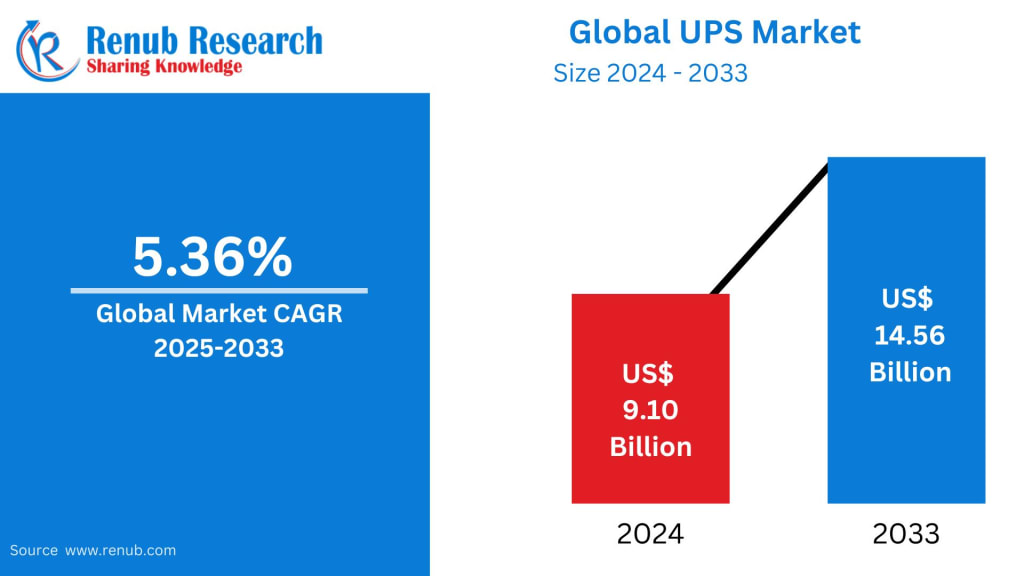
The global uninterruptible power supply market is projected at a value of USD 9.10 billion in 2024, with an expected valuation of USD 14.56 billion by 2033, representing a CAGR of 5.36% during the forecast period. This steady growth reflects the expanding demand for reliable backup power solutions across commercial, industrial, and residential sectors worldwide. Technological advancements—particularly high-efficiency UPS architectures, lithium-ion batteries, and intelligent energy management—are further reshaping the competitive landscape.
As power grids face increasing stress from renewable integration, climate-related disruptions, and surging electricity demand, UPS systems have become indispensable infrastructure for continuity, safety, and productivity.
UPS Market Overview
A UPS (Uninterruptible Power Supply) is an electrical device designed to provide immediate backup power when the primary power source fails or experiences voltage instability. It protects sensitive equipment such as servers, computers, medical devices, telecom systems, and industrial machinery by delivering clean, stable power and preventing sudden shutdowns, data loss, or equipment damage.
Modern UPS systems typically comprise batteries, inverters, and control electronics that instantly switch to backup mode during outages. Depending on application requirements, they are available in three major configurations:
Offline/Standby UPS: Cost-effective protection for basic electronics.
Line-Interactive UPS: Enhanced voltage regulation for office and commercial environments.
Online/Double-Conversion UPS: Mission-critical protection for data centers, healthcare, and industrial operations.
Global demand is rising in tandem with the expansion of cloud computing, digital infrastructure, automation, and smart devices. Developing regions with unstable grids increasingly rely on UPS systems to maintain business continuity, while advanced economies integrate them into data centers, renewable energy systems, and smart buildings.
Key Growth Drivers in the Global UPS Market
1. Data Center Proliferation
The rapid growth of hyperscale and edge data centers is among the strongest catalysts for UPS adoption. These facilities require zero-downtime operations, making high-capacity, modular, and energy-efficient UPS systems indispensable.
2. Industrial Automation and Smart Manufacturing
Industries are automating production lines, robotics, and process controls, all of which demand continuous power. UPS solutions protect machinery, prevent costly downtime, and maintain operational safety.
3. Healthcare and Mission-Critical Infrastructure
Hospitals, laboratories, and pharmaceutical facilities rely on uninterrupted power for life-saving equipment and digital health records. Regulatory standards further reinforce the need for reliable backup power.
4. Smart Homes and IoT Penetration
Residential consumers are increasingly adopting smart devices, security systems, and home networks that require stable electricity. Compact and affordable UPS units are finding growing acceptance in home environments.
5. Renewable Energy Integration
With solar and wind energy introducing variability into power grids, UPS systems help stabilize power flow and store energy, particularly when paired with lithium-ion batteries and advanced power electronics.
Top Manufacturers Shaping the UPS Landscape
Hitachi Ltd. (Japan)
Established in 1910, Hitachi operates across power systems, industrial automation, IT, and infrastructure. Its UPS offerings integrate seamlessly with smart grids, data centers, and industrial power systems. Hitachi’s global presence across Asia-Pacific, Europe, and the Americas strengthens its market reach.
ABB Ltd (Switzerland)
Founded in 1988, ABB is a global leader in electrification and automation. The company provides industrial-grade UPS systems designed for utilities, transport, and manufacturing. ABB’s strong channel network and focus on energy efficiency make it a key competitor.
General Electric Company (USA)
GE has diversified operations spanning aerospace, power systems, and industrial technologies. While best known for heavy-industry solutions, its power electronics expertise contributes to high-reliability UPS systems for infrastructure and industrial environments.
Emerson Electric Co. (USA)
Emerson offers advanced automation and power management solutions for energy, life sciences, semiconductors, and industrial markets. Its UPS portfolio is widely deployed in mission-critical facilities requiring reliability, monitoring, and predictive maintenance.
Mitsubishi Electric Corporation (Japan)
Established in 1921, Mitsubishi Electric develops advanced UPS systems for industrial plants, transportation, and building management systems. Known for durability and efficiency, the company plays a major role in high-capacity UPS deployments worldwide.
Product Launches in the UPS Market
Toshiba Corporation
Toshiba Electronic Devices & Storage Corporation recently launched a new series of silicon carbide (SiC) MOSFETs—the TWxxxZxxxC series—designed to reduce switching losses in industrial power equipment. Utilizing advanced packaging and third-generation SiC chips, the products significantly enhance efficiency and reduce power losses, directly benefiting high-performance UPS systems.
Delta Electronics Inc. (June 2024)
Delta introduced the UZR Gen3 Series UPS Li-ion Battery System, purpose-built for data centers. Designed for safety, reliability, and reduced total cost of ownership, this system integrates seamlessly with Delta’s power and cooling infrastructure. It establishes a new benchmark for lithium-ion UPS deployments in mission-critical environments.
Company SWOT Snapshots
KSTAR Science & Technology Co., Ltd.
Strengths: Advanced R&D, diverse product portfolio, and leadership in renewable-energy integration.
KSTAR serves multiple market segments, from small offices to industrial and data-center applications. Known for high-efficiency designs, intelligent monitoring, and lithium-ion technologies, the company benefits from global distribution networks and competitive pricing.
Riello UPS
Strengths: Premium European engineering, high reliability, and specialization in mission-critical applications.
Riello excels in modular and double-conversion UPS systems for healthcare, telecom, and industrial plants. Its sustainability-focused designs and worldwide service network enhance long-term customer trust.
Recent Market Developments
Schneider Electric SE (March 2024)
Schneider Electric launched the Back-UPS BE Series – 900 & 1050 VA, offering higher power capacity and enhanced protection for home networks and smart devices. Designed to support remote work, security systems, and connectivity hardware, the new series underscores the rising demand for residential-grade UPS solutions.
Vertiv Holdings Co. (December 2024)
Vertiv introduced the PowerUPS 9000, a compact, high-power-density UPS system supporting applications from traditional IT to high-density computing. With double-conversion efficiency of up to 97.5% and global compatibility, the product reflects the market’s shift toward standardized, energy-efficient solutions.
Sustainability in the UPS Industry
Kehua Data Co., Ltd.
Kehua integrates sustainability through energy-efficient UPS design, green manufacturing, and carbon-reduction initiatives. The company emphasizes lithium-ion battery adoption, recyclable packaging, and resource-optimized production, aligning its operations with global energy-efficiency frameworks.
Borri S.p.A.
Borri advances sustainability through transformer-less and modular UPS designs that minimize energy losses and extend equipment lifecycles. By focusing on recyclability, low-impact manufacturing, and renewable integration, Borri contributes to environmentally responsible power protection solutions.
Market Segmentation: Global UPS Market
The UPS market is segmented by:
Type: Offline/Standby, Line-Interactive, Online/Double-Conversion
Capacity: Below 10 kVA, 10–100 kVA, Above 100 kVA
Application: Data Centers, Industrial, Healthcare, Commercial, Residential
Region: North America, Europe, Asia-Pacific, Middle East & Africa, Latin America
Data centers and industrial facilities dominate high-capacity installations, while commercial and residential segments drive demand for compact, cost-effective models.
Historical Trends and Forecast Outlook
Historically, UPS adoption was concentrated in enterprise IT and telecom. Over the past decade, however, expanding cloud services, digital banking, automation, and healthcare digitization have significantly broadened the addressable market.
According to Renub Research, the global UPS market’s rise from USD 9.10 billion in 2024 to USD 14.56 billion by 2033 at a CAGR of 5.36% reflects stable long-term growth. While developed economies focus on upgrading to energy-efficient and lithium-ion-based systems, emerging markets are investing in UPS infrastructure to compensate for grid instability and growing industrialization.
Market Share Dynamics
Leading multinational corporations such as Hitachi, ABB, Mitsubishi Electric, Schneider Electric, Vertiv, and Emerson dominate the high-capacity and industrial segments. Meanwhile, companies like KSTAR, Riello, Kehua, Borri, Tripp Lite, Huawei Digital Power, Legrand, SOCOMEC, AEG Power Solutions, and Piller Power Systems compete through specialization, modular designs, and regional market focus.
Innovation in modular architecture, smart monitoring, lithium-ion batteries, and energy-efficient power electronics continues to reshape competitive positioning.
Strategic Company Profiles: A Common Framework
For leading UPS manufacturers—including Hitachi, ABB, GE, Emerson, Mitsubishi Electric, Toshiba, Delta, Schneider Electric, Vertiv, KSTAR, Riello, Kehua, Borri, Tripp Lite, Huawei Digital Power, Legrand, Piller Power Systems, AEG Power Solutions, and SOCOMEC—strategic evaluation typically includes:
Company History and Mission
Business Model and Global Operations
Executive Leadership and Governance
Recent Strategies: Mergers, partnerships, investments
Sustainability Initiatives: Renewable energy use, energy-efficient infrastructure, packaging, waste management
Product Analysis: Portfolio, quality standards, pipelines, benchmarking
SWOT Analysis: Strengths, weaknesses, opportunities, threats
Revenue and Market Contribution
This structured approach highlights the industry’s emphasis on reliability, efficiency, innovation, and environmental responsibility.
Challenges Facing the UPS Market
Despite robust growth, the market faces several challenges:
High Initial Costs: Advanced UPS systems, especially lithium-ion and modular solutions, require significant upfront investment.
Battery Disposal and Recycling: Environmental concerns around battery lifecycle management continue to pressure manufacturers.
Grid Modernization: In regions with improving grid reliability, demand for small-scale UPS may plateau.
Technological Obsolescence: Rapid innovation requires continuous R&D investment to remain competitive.
Opportunities Ahead
The future of the UPS market lies in smart, connected, and sustainable power management. Key opportunities include:
AI-driven energy optimization and predictive maintenance
Integration with renewable microgrids and energy storage systems
Expansion into emerging markets with unreliable grids
Growth in edge computing, 5G networks, and smart cities
As power reliability becomes central to digital economies, UPS systems will increasingly function as intelligent energy hubs rather than simple backup devices.
Final Thoughts
The Uninterruptible Power Supply market stands at the intersection of digital transformation, energy management, and sustainability. With the global market projected to grow from USD 9.10 billion in 2024 to USD 14.56 billion by 2033 at a CAGR of 5.36%, UPS systems are no longer niche infrastructure—they are foundational to modern life.
From safeguarding data centers and hospitals to enabling smart homes and renewable energy integration, UPS technology continues to evolve in efficiency, intelligence, and environmental responsibility. As businesses, governments, and households seek resilience in an increasingly electrified world, the UPS industry is set to remain a cornerstone of global power reliability for the decade ahead.
About the Creator
Keep reading
More stories from Aaina Oberoi and writers in The Swamp and other communities.
Industrial Automation and Control Systems Market Size and Forecast 2025–2033
Introduction: The Digital Backbone of Modern Industry Across manufacturing floors, energy plants, refineries, and pharmaceutical facilities, a quiet transformation is underway. Machines are communicating in real time, processes are self-correcting, and operations once dependent on manual oversight are now guided by data, algorithms, and advanced control technologies. At the heart of this revolution lies the Industrial Automation and Control Systems (IACS) market—the digital backbone enabling industries to operate smarter, faster, and more efficiently.
By Aaina Oberoia day ago in The Swamp
U.S. Pushes for Faster Action to Cut Reliance on China for Rare Earths
Rare Earths: Small Minerals, Massive Power Rare earth elements may sound obscure, but they sit at the heart of modern life. From smartphones and electric vehicles to fighter jets and missile systems, these minerals are essential to both civilian technology and national defense. That reality is why the United States is now pushing for quicker, more decisive action to reduce its dependence on China for rare earth supplies. For years, Washington talked about diversification. Now, it wants speed. The shift reflects growing concern that reliance on a geopolitical rival for critical materials is no longer sustainable in an era of strategic competition. Why China’s Dominance Worries Washington China controls roughly 60–70% of global rare earth mining and an even larger share of processing and refining. Even when rare earths are mined elsewhere, they are often shipped to China for processing. This gives Beijing enormous leverage over global supply chains. U.S. officials fear that in a moment of heightened tension—over Taiwan, trade disputes, or technology restrictions—China could restrict exports. Beijing has already hinted at this possibility in the past, using export controls as a diplomatic tool. From Washington’s perspective, this is not a hypothetical risk. It is a strategic vulnerability that touches everything from renewable energy goals to military readiness. Rare Earths and National Security Few issues unite Democrats and Republicans as strongly as national security. Rare earths fall squarely into that category. Advanced weapons systems rely on these materials for precision guidance, radar, and communications. A disrupted supply could delay production, weaken deterrence, and raise costs dramatically. Pentagon officials have repeatedly warned that dependence on China for defense-critical materials undermines U.S. security. As a result, rare earth supply chains are increasingly viewed through the same lens as energy independence once was. This framing explains the urgency behind Washington’s push for faster action. Why “Quicker Action” Matters Now The U.S. has discussed rare earth independence for over a decade, yet progress has been slow. Mining projects face environmental reviews, local opposition, and long development timelines. Processing facilities require heavy investment and technical expertise that has largely migrated to China. What has changed is the global context. Rising U.S.-China tensions, supply-chain disruptions during the pandemic, and growing demand for clean energy technologies have compressed timelines. Waiting another decade is no longer acceptable to policymakers. Quicker action now means fast-tracking permits, increasing federal funding, and working more aggressively with allies. The Role of Allies in Diversification The United States does not expect to solve the rare earth challenge alone. Instead, Washington is pushing for a “friend-shoring” strategy—building supply chains with trusted partners rather than relying on geopolitical rivals. Australia, Canada, Japan, and several European countries are key players in this effort. Australia already hosts significant rare earth mining operations, while Japan has invested heavily in reducing its own dependence on China after facing export restrictions in the past. By coordinating investment, sharing technology, and aligning regulations, the U.S. hopes to create an alternative ecosystem that can compete with China’s dominance. Environmental and Economic Tensions Rare earth mining is not clean. It involves toxic waste, radioactive byproducts, and significant environmental risks. Ironically, minerals essential for green technologies come with heavy environmental costs at the extraction stage. This creates a political dilemma. Americans want clean energy, but often oppose mining projects in their own communities. Faster action will require balancing environmental protections with strategic necessity—a challenge that has stalled projects in the past. The Biden administration, like administrations before it, faces pressure to prove that domestic mining can be done responsibly without undermining climate commitments. China’s Likely Response Beijing is watching these developments closely. While China has not yet weaponized rare earth exports on a large scale, it understands the leverage it holds. At the same time, China is moving up the value chain—focusing more on advanced manufacturing and less on raw material exports. If the U.S. accelerates diversification successfully, China may respond by tightening export controls in the short term while investing in higher-end technologies that keep it indispensable in other ways. This dynamic underscores that rare earths are not just a resource issue, but part of a broader strategic competition. Economic Implications Beyond Security Reducing reliance on China is not only about defense. It is also about economic resilience. Supply disruptions during the pandemic exposed how fragile global supply chains can be. Rare earth shortages could slow electric vehicle adoption, raise consumer prices, and delay infrastructure projects. By pushing for faster action, Washington hopes to stabilize future growth and protect key industries. Domestic production and allied partnerships could also create jobs and spur innovation, particularly in rural and industrial regions. However, building new supply chains will not be cheap. Consumers and taxpayers may face higher costs in the short term as alternatives to Chinese supplies come online. Challenges That Could Slow Progress Despite political momentum, obstacles remain. Mining projects take years to develop. Processing facilities require specialized knowledge. Workforce shortages, local resistance, and regulatory complexity all pose risks to rapid progress. There is also the danger of overpromising. Policymakers must manage expectations, making clear that reducing reliance on China is a long-term effort, even if action accelerates now. Failure to deliver tangible results could weaken public support and give critics ammunition. Final Thoughts The U.S. push for quicker action in reducing reliance on China for rare earths marks a turning point. What was once a niche policy issue has become a strategic priority at the highest levels of government. This is not about cutting China out of the global economy entirely. It is about ensuring that no single country can control materials essential to modern life and national defense. Speed, coordination, and political will will determine whether Washington succeeds. As competition intensifies, rare earths will remain a quiet but powerful force shaping the future of technology, security, and global influence. The race is no longer just about who has the minerals—but who controls the supply chains that define the 21st centur
By Muhammad Hassan4 days ago in The Swamp


Comments
There are no comments for this story
Be the first to respond and start the conversation.