
Europe on Rails: The $546B High-Speed Revolution
How a continent is cutting travel times, slashing emissions, and connecting millions.


High-Speed Rails and Strategic Rails: Europe’s Mobility Makeover
Hook:
🚄 By 2050, the EU wants to triple its high-speed rail network—cutting millions of tons of carbon emissions and slashing travel times by up to 70%.
The New European Dream on Tracks
For decades, Europe has been known for its efficient trains. From the Paris–London Eurostar to Germany’s ICE, rail travel has been a symbol of both elegance and practicality. But in 2025, the continent is on the brink of something much bigger—a mobility revolution.
The European Commission’s €546 billion plan isn’t just about faster trains. It’s about reshaping how the continent connects, how economies breathe, and how young people see travel—not as a luxury, but as a fast, affordable, and sustainable norm.
Imagine boarding a sleek train in Madrid and stepping off in Berlin in less than half the time it takes today. Imagine skipping airport queues, bypassing motorway traffic jams, and crossing multiple borders in comfort—while your carbon footprint is just a fraction of what a flight would cost the planet.
Why Now? The Perfect Storm for Change
This project isn’t just ambition—it’s necessity. Europe is facing three massive pressures:
Climate Crisis – Transport is one of the biggest CO₂ culprits. Air travel, in particular, accounts for around 2.5% of global emissions, and Europe wants to lead in cutting that number drastically.
Overloaded Airports & Roads – Even before the pandemic, European airports were hitting capacity limits. The boom in budget airlines made air travel accessible, but also congested. High-speed rails offer an escape route.
Geopolitical Resilience – A well-connected continent isn’t just good for business—it’s strategic. In times of crisis, secure rail routes are critical for moving goods, people, and even emergency resources.
The “Strategic Rails” part of this plan is about exactly that—building routes that aren’t just popular with tourists, but vital for security and supply chains.
The Speed & Scale of the Vision
By 2030: Double current rail traffic.
By 2050: Triple it.
Target Speed: 300–350 km/h for most high-speed lines.
Environmental Impact: Billions saved in fuel costs and millions of tons less CO₂ released annually.
France, Spain, Italy, and Germany are already leaders in high-speed travel. Now, Eastern and Northern Europe—often left out of such large-scale infrastructure upgrades—will be integrated into a single, connected system.
For example:
Warsaw to Vienna in under 4 hours.
Helsinki to Stockholm via a tunnel under the Baltic.
Lisbon to Paris in just over 6 hours, replacing flights for many travelers.
The Youth Factor: Freedom Without Flights
For a 20–30-year-old today, travel is often split between cheap but polluting flights and slow, fragmented train routes. High-speed rails flip that equation.
Imagine a €49 monthly EU rail pass for youth—suddenly, backpacking Europe wouldn’t mean taking night buses or stressful budget flights. It would mean rolling through the countryside at 300 km/h, arriving in city centers instead of airports an hour outside town.
And there’s something romantic about it, too. You’re not just getting from Point A to Point B—you’re seeing landscapes blur into art outside your window.
Beyond Romance: Jobs, Innovation & Unity
This isn’t just a travel perk—it’s an economic machine.
Jobs: The expansion will create thousands of skilled jobs in engineering, manufacturing, and construction.
Tech Innovation: Europe will become a global leader in high-speed rail tech, attracting investment and research.
Cultural Unity: A student in Budapest will find it easier to attend a conference in Brussels; an entrepreneur in Lisbon could pitch in Berlin the same day.
Infrastructure has always been about more than steel and concrete—it’s about human connection. The EU is betting that in an age of political divisions, shared tracks might also mean shared futures.
The Road (or Rail) Ahead: Challenges & Critics
Of course, €546 billion doesn’t come without controversy. Critics argue:
Some regions may be left behind if they’re not profitable routes.
Ticket prices could still favor wealthier travelers if subsidies aren’t managed well.
Construction could disrupt ecosystems unless carefully planned.
But the counter-argument is strong: the cost of not acting—more emissions, more airport chaos, slower economic growth—is far greater.
A Generation on the Move
If you’re in your 20s today, you could be one of the first generations to live in a Europe where borders feel even smaller. Your weekend trips could be to cities you’ve only dreamed of. Your work meetings could happen in person, across languages and cultures, without the stress of airports.
This isn’t just a rail plan—it’s a reimagining of what it means to be connected.
The next time someone tells you rail travel is old-fashioned, tell them the truth: it’s the future. Europe’s high-speed rails aren’t just about moving faster—they’re about moving smarter, cleaner, and closer together.
If you want a continent that’s greener, more connected, and ready for the challenges ahead, then this is the track we should all be on.
Because sometimes, the fastest way forward… is on rails. 🚄
About the Creator
Dani khan
Hi, I’m Dani Khan! 🌟 I share cool facts, life tips, and inspiring ideas. Follow me to learn, grow, and stay curious every day! 📚✨ #StayCurious #DaniKhan
please hit the subscribe for more
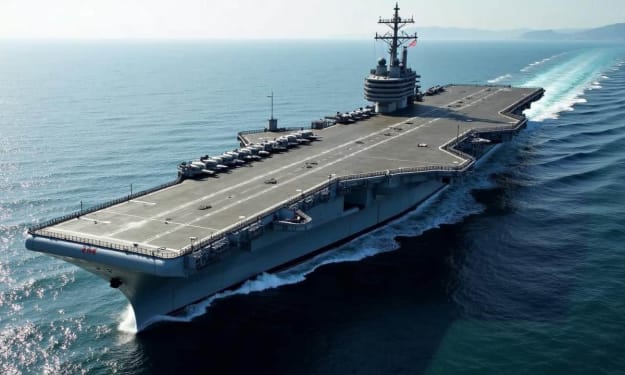
With Its 337 Meters and 100,000 Tons, the World’s Largest Aircraft Carrier Rules the Oceans
Stretching an astonishing 337 meters in length and weighing close to 100,000 tons, the world’s largest aircraft carrier is not just a ship—it is a floating symbol of modern military power, engineering excellence, and global influence. Often described as a mobile airbase at sea, this colossal vessel dominates the oceans, reshaping how naval warfare, diplomacy, and power projection are conducted in the 21st century. A Giant of the Seas To grasp the scale of this aircraft carrier, comparisons help. At 337 meters, it is longer than three football fields placed end to end. Its displacement of around 100,000 tons makes it heavier than many skyscrapers combined. Powered by advanced nuclear reactors, the carrier can operate for decades without refueling, allowing it to remain at sea for extended missions across the globe. This immense size is not for spectacle alone. The carrier is designed to support a full air wing of more than 70 aircraft, including fighter jets, early warning planes, helicopters, and unmanned aerial systems. Its flight deck is a carefully choreographed space where aircraft take off and land every few minutes, day and night, in all weather conditions. Engineering at Its Finest Building such a vessel is one of the most complex engineering challenges humanity has mastered. Thousands of engineers, technicians, and naval architects work for years to bring an aircraft carrier to life. From its reinforced steel hull to its advanced radar systems, every component is designed to withstand extreme conditions, including rough seas, combat damage, and long-term deployment. The nuclear propulsion system is a defining feature. Unlike conventional ships, this carrier does not rely on diesel or gas fuel. Its reactors generate enormous power, not only for propulsion but also for onboard systems such as radar, weapons, and aircraft launch mechanisms. This allows the ship to reach high speeds and maintain them over vast distances without logistical constraints. A Floating City Life aboard the world’s largest aircraft carrier resembles that of a small city. More than 5,000 sailors and aviators live and work on the ship during deployments. There are sleeping quarters, medical facilities, kitchens capable of serving thousands of meals a day, gyms, and even onboard shops. The crew operates around the clock, ensuring that the carrier remains combat-ready at all times. Pilots train continuously, engineers maintain critical systems, and command staff coordinate operations that may span multiple regions. Discipline, precision, and teamwork are essential, as a single mistake on such a complex platform can have serious consequences. Power Projection and Global Influence Beyond its technical marvels, the true significance of the world’s largest aircraft carrier lies in its strategic role. Wherever it sails, it sends a powerful message. An aircraft carrier strike group—typically consisting of destroyers, cruisers, submarines, and supply ships—represents one of the most formidable military forces on Earth. This capability allows its operator to respond rapidly to crises, whether through combat operations, humanitarian assistance, or deterrence. From disaster relief missions to enforcing no-fly zones, aircraft carriers offer unmatched flexibility. Their presence alone can influence diplomatic negotiations, reassure allies, or discourage potential adversaries. Changing the Nature of Warfare Modern aircraft carriers have evolved far beyond their World War II predecessors. Advanced sensors, stealth aircraft, electronic warfare systems, and missile defenses have transformed them into highly resilient platforms. The integration of unmanned systems is further expanding their reach, allowing surveillance and strike missions without putting pilots at risk. However, the rise of advanced anti-ship missiles and submarine technologies has also sparked debate. Critics argue that such massive vessels are vulnerable targets in high-intensity conflicts. Supporters counter that layered defenses, mobility, and escort fleets make aircraft carriers far more survivable than they appear. A Symbol of National Ambition Possessing the world’s largest aircraft carrier is also a matter of prestige. It reflects a nation’s industrial capacity, technological sophistication, and long-term strategic vision. Only a handful of countries have the resources and expertise to build and operate such ships, making them exclusive symbols of great-power status. For the public, these carriers often capture the imagination. Images of jets launching from their decks, crews working in synchronized precision, and the sheer scale of the vessel inspire awe and curiosity, reinforcing their status as icons of modern naval power. Conclusion At 337 meters long and weighing around 100,000 tons, the world’s largest aircraft carrier truly rules the oceans. It is a masterpiece of engineering, a floating city, and a central pillar of modern military strategy. While debates continue about the future of naval warfare, one thing remains clear: as long as nations seek to project power, protect interests, and influence global events, these colossal carriers will remain at the heart of maritime dominance.
By Fiazahmedbrohi about 9 hours ago in The Swamp
If You Love Me, You'll Do It
I met Jason when I was five years old. I could say that I loved him from the moment I saw him. He was so handsome to me and I felt in awe by his presence. When they introduced him as the new kid in school, I wanted to be his friend right away. I remember it like it was yesterday. I remember his smile and how he didn't seem shy. He appeared confident and ready to learn. I waved at him and said "hello," before anyone else could even say a word. He sat next to me, and I asked him if he wanted to be friends. He looked so happy as he said, "Yes!"
By Sidney Smith (Sid Smith)6 days ago in Fiction



Comments
There are no comments for this story
Be the first to respond and start the conversation.