
Donald Trump, Self-Proclaimed Peacemaker
Why the Man Who Wants a Nobel Prize Is No Modern Gandhi

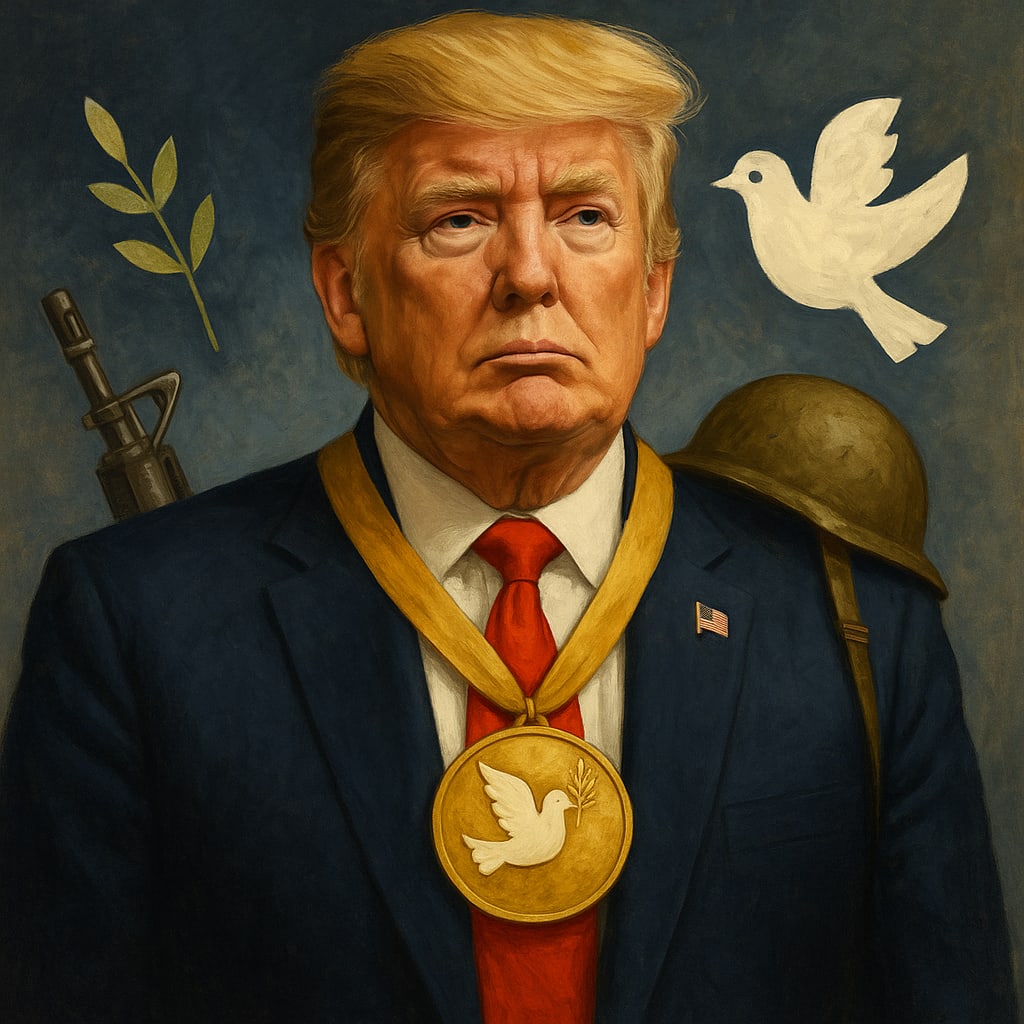
Donald Trump has never been shy about declaring himself the greatest at something. His latest — and perhaps most audacious — claim is that he deserves the Prix Nobel de la paix. For years, Trump has repeated that his diplomatic maneuvers, particularly in the Middle East and on the Korean Peninsula, should earn him a place among the pantheon of peacemakers.
It’s a claim that fascinates as much as it provokes. During his presidency (2017–2021), Trump indeed stood out from many of his predecessors by avoiding the launch of a major new war. This fact has allowed his supporters to paint him as a pragmatic leader who “brought American troops home” and broke with the interventionist tradition that defined U.S. foreign policy for decades.
But a closer examination reveals a more complex and less flattering reality. Trump’s foreign policy was never guided by a philosophy of peace. It was shaped by transactional calculations, coercive diplomacy, and strategic self-promotion. He was not building peace; he was managing power — and managing his image.
1. The Nobel Peace Prize: A Political Instrument, Not a Moral Badge
The Prix Nobel de la paix has always carried a heavy political charge. Its history is filled with recipients whose legacies were contested, controversial, or incomplete. Figures like Henry Kissinger (1973) and Barack Obama (2009) remind us that this prize often rewards symbolic gestures rather than achieved, lasting peace. It can be an instrument of influence, designed to encourage a trajectory rather than consecrate an outcome.
Trump has tried to insert himself into this tradition. He frequently cites his administration’s role in brokering the Accords d'Abraham — normalization agreements between Israël and several Arab states, including Émirats arabes unis and Bahreïn — as proof that he is a maker of peace. These agreements were indeed historic in their optics: they represented a rare moment of diplomatic détente in a region defined by entrenched conflict.
He also highlights his summits with Kim Jong-un, unprecedented encounters between a sitting U.S. president and the North Korean leader. These highly choreographed meetings — featuring handshakes at the DMZ, optimistic soundbites, and grandiose promises — seemed to signal the dawn of a new diplomatic era.
But beneath the spectacle, the substance was thin. The Abraham Accords, while diplomatically noteworthy, did not address the core issues that sustain conflict in the Middle East, particularly the Palestinian question. They normalized relations without building peace. The North Korea meetings yielded photo ops, not denuclearization. They were theatrical events, carefully engineered for maximum political visibility and minimum structural change.
Trump understood perfectly well the value of such gestures. A handshake is cheaper than a treaty, and often more effective in shaping a public narrative. But the Nobel Peace Prize, despite its political flexibility, has historically rewarded transformative or at least stabilizing actions. Trump offered symbolism, not transformation.
2. Isolationism Is Not Pacifism
A central argument in Trump’s self-portrait as a “man of peace” is his record: no major wars initiated during his presidency. This claim is factually correct — and politically potent. After two decades of costly interventions in Afghanistan, Iraq, and elsewhere, Americans were weary of endless wars. Trump positioned himself as the antidote to this fatigue, promising to put “America First” and avoid foreign entanglements.
But equating non-intervention with pacifism is a dangerous simplification. Trump’s foreign policy was not animated by a belief in the inherent value of peace or in reducing global tensions. It was driven by a transactional, nationalist logic: if an international engagement does not directly and measurably benefit the United States, it is not worth pursuing.
This was evident in his open hostility toward Organisation du traité de l'Atlantique nord (NATO). Trump repeatedly accused U.S. allies of freeloading, threatening to withdraw support unless they increased military spending. His rhetoric destabilized long-standing alliances, creating uncertainty about America’s commitment to collective defense. This was not a strategy of peace; it was a strategy of leverage.
Trump’s so-called “withdrawals” often masked strategic repositioning rather than true disengagement. In Afghanistan, his drawdown agreement set the stage for a messy transition rather than a sustainable peace. In Syria, his sudden announcement of troop withdrawals — later partially reversed — left allies scrambling and adversaries emboldened. These moves reflected a desire to reduce visible costs, not to foster stability.
Moreover, Trump presided over a significant expansion of U.S. military spending, ensuring that the architecture of global projection remained firmly intact. An isolationist posture rhetorically, but not materially, is not pacifism. It’s cost control dressed up as statesmanship.
3. Power Politics, Not Peacebuilding
If Trump avoided starting new wars, it wasn’t because he disavowed military force. On the contrary, he wielded it — or the threat of it — as a central instrument of his diplomacy.
One of the most revealing episodes came in January 2020, with the assassination of Qasem Soleimani, a top Iranian general. The strike, authorized without congressional approval, was one of the most provocative U.S. military actions in years. It brought the U.S. and République islamique d'Iran to the brink of open conflict. Trump presented the strike as decisive leadership; critics called it reckless escalation. Either way, it was hardly the act of a pacifist.
Beyond Iran, Trump’s foreign policy leaned heavily on coercive tactics. He expanded economic sanctions to unprecedented levels, applying them against Iran, Venezuela, Cuba, and République populaire de Chine, among others. He weaponized tariffs, embargoes, and financial isolation, not as tools of long-term peacebuilding but as instruments of pressure designed to force concessions.
He also cultivated close ties with authoritarian regimes — notably Arabie saoudite — even as they engaged in devastating conflicts, like the war in Yemen, which has produced one of the worst humanitarian crises of the century. Under Trump, U.S. arms sales to Saudi Arabia soared. Far from championing demilitarization, he monetized militarism.
His rhetoric mirrored this posture. From threatening North Korea with “fire and fury” to praising the size of the U.S. nuclear arsenal, Trump wielded the language of intimidation fluently. His diplomacy was performative power politics: talk loudly, act unpredictably, and keep the military option visible.
In this worldview, peace is not a goal; it’s a temporary condition between threats.
4. Image Crafting: The Prize as Political Capital
To understand Trump’s pursuit of the Nobel Peace Prize, one must understand his obsession with optics. For Trump, politics has always been as much about spectacle as about substance. The Nobel is not, in his view, a moral recognition; it is a symbolic trophy, proof of superiority over rivals — especially Barack Obama, whose Nobel win he has repeatedly referenced with resentment.
Trump knows that the image of a president who “didn’t start any wars” resonates with voters, particularly in a post-interventionist America. His messaging simplifies the narrative: Obama got a Nobel while waging wars; Trump deserves one for not waging them. It’s a powerful political line, even if it glosses over the nuances of his actual record.
His foreign policy strategy often prioritized symbolic wins over structural change. A dramatic summit, a signature on an agreement, a bold tweet — these were his tools. By controlling the story, Trump presented himself as a peacemaker without making the structural compromises, alliances, or institutional investments that genuine peacebuilding requires.
This strategy has worked with segments of his base, who view him as a pragmatic leader uninterested in “globalist” wars. But among foreign policy experts, it is widely recognized as a carefully constructed mirage. His administration did not dismantle the military-industrial complex; it fed it. It did not build a new global order; it destabilized the old one without offering a replacement.
The Nobel Prize, in this context, would serve not as a validation of peace, but as a branding coup.
5. A Deeper Question: What Does “Peace” Mean Anymore?
Trump’s case forces us to confront a deeper question about the meaning of the Nobel Peace Prize — and of “peace” itself in contemporary geopolitics. Should the absence of war be enough to claim the mantle of peacemaker? Or should the prize honor active, transformative contributions to a more stable and just world order?
There is no doubt that Trump avoided large-scale invasions or new long-term occupations. But he also left behind a fractured international landscape: weakened alliances, emboldened autocrats, unresolved conflicts, and an expanded machinery of coercion. His approach to diplomacy was transactional, volatile, and unilateral, often undermining the very norms that make peace sustainable.
Real peace requires more than restraint; it requires architecture. It demands building trust, fostering institutions, supporting diplomacy, and investing in multilateral solutions even when they yield no immediate political gains. Trump, by contrast, invested in narratives that benefited him politically, not in processes that could outlast him.
Awarding a Nobel Peace Prize on the basis of not starting a war would signal a dramatic lowering of the bar. It would redefine peace not as a positive project, but as the mere absence of chaos — however temporary and self-serving.
Conclusion: The Mirage of the Peacemaker
Donald Trump is not a pacifist. He is a tactician of perception — a master of reframing power as peace, spectacle as substance. His presidency did not mark a break from militarism, but a rebranding of it.
His foreign policy was isolationist in rhetoric, coercive in practice, and opportunistic in symbolism. It avoided new quagmires, yes, but it did so by outsourcing instability, shifting costs, and amplifying unpredictability. In many ways, this made the world less stable, not more.
Trump’s quest for the Nobel Peace Prize is less about peace and more about legacy and legitimacy. It reveals how the meaning of peace itself can be contested — shaped, manipulated, and leveraged.
The real question is not whether Donald Trump deserves a Nobel. It’s whether we are willing to let the absence of war stand in for the construction of peace. If the answer is yes, then the prize ceases to celebrate peacemakers — and starts rewarding those who simply don’t press the button.
About the Creator
Alain SUPPINI
I’m Alain — a French critical care anesthesiologist who writes to keep memory alive. Between past and present, medicine and words, I search for what endures.
Keep reading
More stories from Alain SUPPINI and writers in The Swamp and other communities.
Mastering French Without Losing Your Sanity: A Realistic Guide for Beginners
Learning French can feel like solving a Rubik’s Cube blindfolded. The tricky pronunciation, the never-ending grammar rules, and the surprising exceptions make it seem impossible. But don’t worry—equipping yourself with key expressions and effective strategies can turn frustration into fluency. Let’s simplify French and make learning enjoyable.
By Alain SUPPINIExclusive • about a year ago
Parallel Protests
I haven't written for quite some time, but I have A LOT of thoughts about yesterday's protest rally against our government's involvement and complicity in America's war on Iran, on the harbourside of my home city Bristol, and I need to put them somewhere. My gorgeous girlfriend is always a loving and listening ear and sharing it all with her will always be a healthy and happy way of processing the mental and emotional weight, but getting it straight in my brain to share means writing it all down in straight lines, so, here we are and thanks for being here.
By Steph Cole7 days ago in The Swamp
China Says It Seeks Communication With U.S. but Vows to Hold Its 'Red Lines'
China has signaled a willingness to maintain dialogue with the United States amid growing tensions over trade, technology, and regional security, but officials emphasized that Beijing will firmly defend what it describes as its “red lines.” The statement comes at a time of heightened friction across multiple fronts, including Taiwan, the South China Sea, and sensitive export controls, reflecting China’s desire to balance engagement with assertiveness. According to Chinese foreign ministry spokespersons, Beijing is prepared to pursue “constructive and pragmatic” channels of communication with Washington to prevent misunderstandings and manage competition. “We do not seek conflict, but we will not compromise on core national interests,” said the spokesperson. “China’s sovereignty, territorial integrity, and key security concerns are non-negotiable, and any attempt to cross these red lines will be firmly resisted.” Dialogue Amid Rising Tensions The statement follows recent U.S. diplomatic and military activity in East Asia, including increased naval presence near disputed areas and ongoing restrictions on Chinese access to certain high-tech goods. U.S. officials have reiterated the importance of maintaining a rules-based order while protecting American economic and security interests. Analysts suggest that Beijing’s announcement is intended both for a domestic audience and international observers. Domestically, emphasizing red lines reinforces the government’s narrative of strength and vigilance. Internationally, it signals that China is open to talks, even as it seeks to deter what it perceives as encroachment on its sovereignty. Core Issues at Stake Several flashpoints underpin the current strain in U.S.–China relations: Taiwan: Chinese officials continue to assert that Taiwan is an inalienable part of China, while U.S. policy supports defensive capabilities for the island without endorsing formal independence. Military exercises, arms sales, and diplomatic visits have contributed to heightened tensions. Technology and Trade: Washington has imposed restrictions on exports of advanced semiconductors and other critical technologies to China, citing national security concerns. Beijing views these measures as attempts to curb its technological rise and has warned of retaliatory actions. South China Sea and Regional Security: U.S. naval patrols and freedom-of-navigation operations challenge Beijing’s claims in disputed maritime zones. China maintains that it will protect territorial waters and maritime rights in the region. Seeking Stability While Asserting Authority Despite these tensions, both sides recognize the need to manage competition to avoid escalation. U.S. and Chinese officials have previously engaged in high-level talks to clarify intentions and set frameworks for cooperation in trade, climate, and global health. Chinese analysts argue that careful management of communication channels is critical to prevent miscalculations that could trigger conflict. “The message from Beijing is clear: we are willing to talk, but our core interests are off-limits,” said a regional security expert. “This is about asserting authority without losing the benefits of dialogue.” Global Implications The U.S.–China relationship remains a key determinant for global stability. Investors, international organizations, and regional powers are closely watching how both countries navigate tensions while maintaining channels for crisis management. Disruption in communication or escalation over red-line issues could have significant consequences for global trade, energy supply chains, and military balance in Asia. Looking Ahead Analysts expect China to continue emphasizing dialogue, particularly in forums such as the U.S.–China Strategic and Economic Dialogue and military-to-military communication channels. At the same time, Beijing is likely to publicly reaffirm its red lines on sovereignty, Taiwan, and national security, ensuring that any engagement with Washington occurs on terms favorable to Chinese interests. For Washington, the challenge lies in maintaining a balance: encouraging constructive communication while defending allies, upholding international norms, and protecting strategic interests. Both countries appear committed to managing tensions without triggering open confrontation, but the line between engagement and escalation remains thin. The coming months will be critical in determining whether U.S.–China relations can sustain strategic dialogue while respecting red lines, or whether competitive pressures and domestic politics in both countries will intensify confrontation. This approach captures China’s dual strategy of openness to dialogue combined with a firm defense of core national interests amid complex regional and global dynamics.
By Fiaz Ahmed 6 days ago in The Swamp
From ad men to mad men
It's after 2am in the morning when a local police patrol vehicle in Northern New Jersey spots a figure costumed as Quasimodo, The Hunchback of Notre Dame, proceeding southbound on the sidewalk along Lydecker Street. Though the hunchback’s costume stuffing offers added insulation, it's January, and friggin’ freezing. Carefully, the officers slow down, gently question the subject, and offer him a ride home.
By David W. Maury5 days ago in Humor



Comments (1)
He doesn't even deserve a participation trophy.