
Don Lemon Pleads Not Guilty to Civil Rights Charges After Minnesota Anti-ICE Protest: Press Freedom or Protest Overreach?
A high-profile federal case in Minnesota is igniting a national debate over press freedom, religious rights, and the limits of protest under U.S. law.

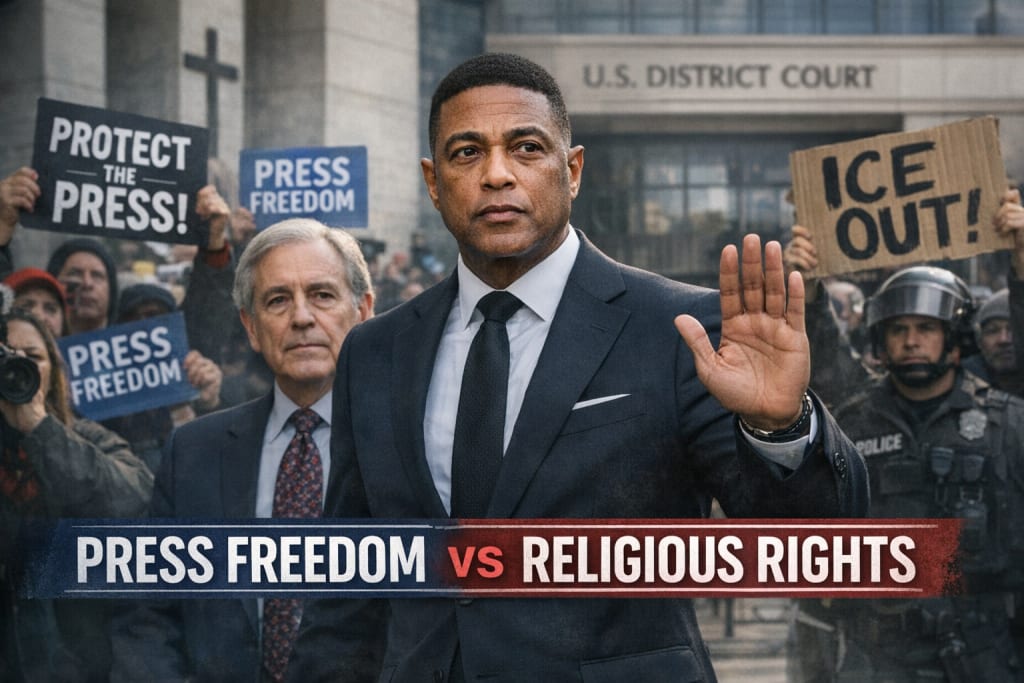
Former CNN anchor and independent broadcaster Don Lemon appeared in federal court in St. Paul, Minnesota, on February 13, 2026, where he formally pleaded not guilty to federal civil rights charges tied to his presence at an anti-ICE protest that disrupted a church service earlier this year.
The case is already shaping up to be more than a courtroom battle. It has become a flashpoint in America’s ongoing cultural and legal tensions over immigration enforcement, the First Amendment, and religious liberty.
________________________________________
What Happened at the Minnesota Protest?
The charges stem from a January 18 protest at Cities Church in St. Paul. Demonstrators gathered to protest Immigration and Customs Enforcement (ICE) policies following the fatal shooting of Renee Good by an ICE agent — an incident that sparked widespread outrage and protests across Minnesota.
According to federal prosecutors, the church service was interrupted by chanting demonstrators shouting slogans such as “ICE out.” Authorities allege that the protest interfered with worshippers’ ability to practice their religion freely.
Lemon was among nine individuals charged in connection with the event.
However, Lemon maintains he was not a participant in the protest — but a journalist covering it.
________________________________________
The Federal Charges Explained
Prosecutors charged Lemon under multiple federal statutes, including:
• Conspiracy to deprive civil rights, alleging coordinated efforts to intimidate or interfere with religious freedom.
• Violation of the Freedom of Access to Clinic Entrances (FACE) Act, a law commonly used to prohibit obstruction at reproductive health clinics and houses of worship.
The federal government argues that Lemon’s presence among demonstrators contributed to an atmosphere that obstructed religious activity.
If convicted, Lemon and other defendants could face fines and possible prison time, though sentencing details remain unclear.
Supporters of the prosecution say the law protects worshippers just as strongly as it protects protesters. They argue that disrupting a church service crosses a legal line, regardless of the political cause.
________________________________________
Lemon’s Defense: “I Was There as a Journalist”
Lemon’s legal team has anchored its defense in the First Amendment.
He insists he was livestreaming, interviewing participants, and documenting the protest for his independent show — not organizing or participating in the demonstration.
Outside the courthouse, Lemon declared:
“I will not be silenced.”
His attorney, Abbe David Lowell, argued that Lemon was engaged in core journalistic activity. The defense has also sought the return of Lemon’s confiscated phone, claiming it contains protected journalistic materials seized without sufficient justification.
The legal argument centers on a crucial question:
When does reporting on a protest become participation in it?
If Lemon’s actions are deemed protected newsgathering, the case could reinforce press protections. If not, it may redefine legal boundaries for journalists covering volatile events.
________________________________________
Press Freedom vs. Religious Freedom
At the heart of the case lies a constitutional tension:
• The First Amendment protects freedom of the press and speech.
• Federal civil rights laws protect the free exercise of religion.
Both are foundational American principles. The challenge is determining whether one was unlawfully infringed upon in this situation.
Press freedom organizations, including the National Association of Black Journalists, have criticized the charges, warning they could create a chilling effect on reporters covering controversial protests.
Dozens of Lemon supporters gathered outside the courthouse, chanting “Protect the Press.”
They argue that criminalizing the presence of journalists at protests risks discouraging independent coverage of politically sensitive events.
On the other hand, some religious leaders and conservative commentators say journalists cannot claim immunity if their actions contribute to unlawful disruption.
________________________________________
The Broader Context: Immigration and National Tensions
The protest was part of a broader wave of demonstrations across the United States following fatal encounters involving federal immigration agents.
Immigration enforcement has long been one of America’s most divisive political issues. The deaths of Renee Good and Alex Pretti intensified debates about:
• Federal immigration authority
• Use of force by ICE agents
• Civil liberties
• Community oversight
Against this backdrop, the Minnesota protest reflected deep public frustration.
Lemon’s presence — given his national profile — elevated the event’s visibility and may have influenced how authorities responded.
________________________________________
Legal Complexity: A Rare Application of the FACE Act?
The FACE Act is most commonly associated with protests outside abortion clinics. Its application in a church protest context — especially involving a journalist — raises novel legal questions.
Legal analysts say the case could hinge on several factors:
• Whether Lemon actively participated in chanting or organizing
• Whether his conduct directly obstructed worship
• Whether prosecutors can prove coordinated intent
• How broadly the court interprets journalistic protections
The case may ultimately set precedent for how civil rights statutes are applied to protest coverage.
________________________________________
What This Means for Journalists Nationwide
The outcome of this case could have significant implications for media professionals.
If Lemon prevails, the ruling could reinforce strong protections for journalists covering demonstrations — even when those events turn disruptive.
If prosecutors succeed, reporters may face heightened legal risk when embedded within protest movements.
Independent journalists, livestreamers, and digital creators may be especially affected, as they often operate without large institutional legal support.
The case underscores the blurred lines in modern media. In the age of social media and citizen journalism, physical proximity to activism can complicate legal distinctions between observer and participant.
________________________________________
What’s Next in the Case?
With Lemon’s not guilty plea formally entered, the case now moves toward pretrial proceedings.
Key developments to watch include:
• Motions to dismiss based on First Amendment grounds
• Arguments over the seizure of Lemon’s phone
• Potential release of grand jury transcripts
• Clarification of sentencing exposure
A trial date has not yet been announced, but legal observers expect intense scrutiny as the case unfolds.
________________________________________
A Defining Test of Constitutional Boundaries
For Lemon and his supporters, this case symbolizes resistance against government overreach.
For critics, it represents the enforcement of laws designed to protect religious worship from disruption.
For the broader public, it poses an enduring question:
How do we balance protest rights, press freedom, and religious liberty in an increasingly polarized society?
The courtroom battle in Minnesota may not resolve that debate entirely. But it will likely shape how those boundaries are defined moving forward.
As legal arguments intensify, one thing is clear: this is more than a local protest case. It is a national test of how America interprets its most fundamental freedoms in an era of protest, polarization, and digital media transformation.
About the Creator
Adil Ali Khan
I’m a passionate writer who loves exploring trending news topics, sharing insights, and keeping readers updated on what’s happening around the world.
Keep reading
More stories from Adil Ali Khan and writers in The Swamp and other communities.
US Pressures Vanuatu at the UN After International Court of Justice Climate Ruling: A Turning Point in Global Climate Accountability?
A diplomatic storm is brewing at the United Nations after reports emerged that the United States applied pressure on Vanuatu following a landmark climate advisory opinion issued by the International Court of Justice (ICJ). The ruling, widely celebrated by climate-vulnerable nations, declared that states have a legal duty to prevent environmental harm caused by greenhouse gas emissions.
By Adil Ali Khana day ago in The Swamp
Why Black History Matters in America?
The United States of America is celebrating their 250th anniversary in 2026. I'm proud to be an American and as someone who was born here, I wouldn't imagine myself living anywhere else. This is a country where opportunities are possible. Where anyone can be successful in anything they desire to do. Equality, community, and togetherness are the backbones of what America is and should be about. However, we have an administration who wants to erase and disregard those who have made positive, meaningful impacts in our country, specifically Black figures, such as Martin Luther King, Jr., Rosa Parks, and Maya Angelou. President Trump and his administration have been constantly complaining and fighting against what they call the "Woke agenda". They use this excuse as a distraction from other issues they refuse to address, such as the high cost of living, climate change, and inflation. That equality is dividing America, when in reality, it's bringing us together. Being woke is not tied to a specific political party. No matter where you stand on the political spectrum, you can still care about other people and their plights. Compassion and empathy for others isn't tied to a political party, either. We were taught as children to treat others the way we want to be treated and not judge others because they're different from us. Caring about others isn't a personal attack on your beliefs. It doesn't make you any less of a person. People who are easily offended over African American figures, past or present, or anything related to it, are grasping at straws. Current and future generations need to know who people like Harriet Tubman and Shirley Chisholm were, especially in the classroom. Black History is part of American History. It should be recognized, not hidden or forgotten. Besides, you can't shield children from everything, just because your feelings are easily hurt.
By Mark Wesley Pritchard 13 days ago in The Swamp



Comments
There are no comments for this story
Be the first to respond and start the conversation.