
Divisive Rhetoric Reloaded: Inside Trump’s Bold Midterm Bet
How stoking anger, amplifying culture wars, and picking polarizing fights became the centerpiece of a high-risk, high-reward election strategy

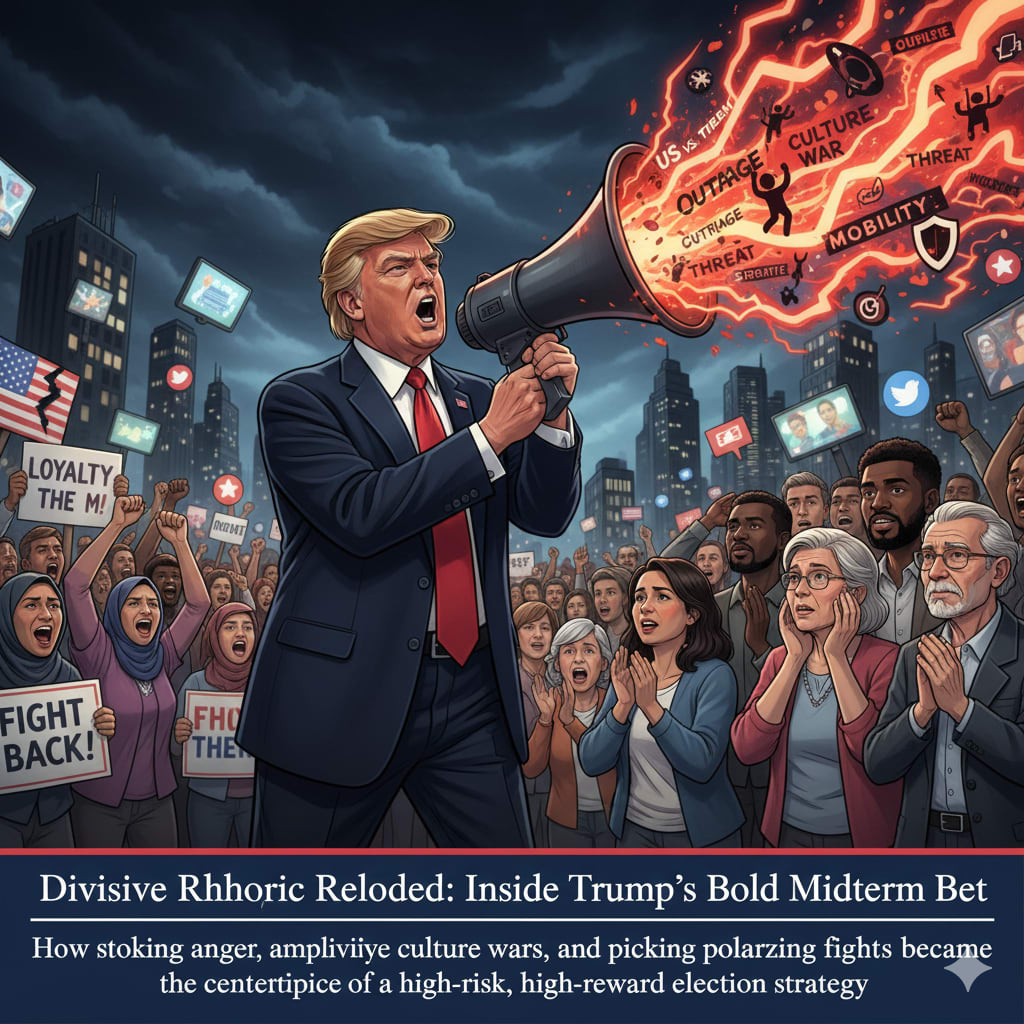
Donald Trump’s latest midterm strategy does not whisper. It shouts.
It doesn’t arrive dressed in policy white papers or carefully hedged language aimed at consensus-building. Instead, it storms into the political arena with familiar tools: volume, confrontation, and an unmistakable sense of grievance. From rally stages to social media feeds, the message is relentless—America is under threat, enemies are everywhere, and only unwavering loyalty can hold the line.
This approach isn’t accidental, nor is it new. But in the current midterm cycle, it feels sharper, more deliberate, and arguably more dangerous. Rather than moderating his tone to appeal to undecided voters, Trump has chosen escalation. He has leaned harder into divisive rhetoric, drawing bold lines between “us” and “them,” amplifying cultural flashpoints, and framing politics as an existential struggle rather than a contest of ideas.
It’s a gamble built on energy rather than expansion. And like all high-stakes bets, it carries both explosive potential and serious risk.
Volume as Strategy
At the core of Trump’s midterm play is a simple belief: attention equals power.
By dominating the news cycle with provocative language and polarizing positions, Trump ensures that his presence is unavoidable. Every controversial statement becomes a headline. Every clash with journalists, political rivals, or institutions feeds a cycle of outrage and response. Silence, in this model, is weakness. Noise is strength.
This strategy thrives in a media environment designed for speed and conflict. Social platforms reward emotional reactions. Cable news thrives on confrontation. In such an ecosystem, a calm, policy-heavy message struggles to compete with spectacle. Trump understands this terrain instinctively. He doesn’t just participate in it—he bends it around himself.
The result is a campaign style that feels less like persuasion and more like mobilization. The goal isn’t to convince skeptics through careful argument. It’s to keep supporters emotionally activated, constantly aware of perceived threats, and deeply invested in the fight.
Identity Over Policy
Trump’s rhetoric in this cycle leans heavily on identity. Who belongs. Who doesn’t. Who is “real” and who is an outsider. Complex social and economic issues are simplified into moral battles between good and evil, patriots and traitors, strength and weakness.
Immigration becomes a symbol of invasion rather than a policy challenge. Media criticism becomes proof of persecution. Religious and cultural debates are framed as existential struggles for the nation’s soul. In this narrative, nuance isn’t just unnecessary—it’s suspicious.
This framing does something powerful. It turns political disagreement into personal allegiance. Supporting Trump becomes less about endorsing a specific platform and more about affirming identity and belonging. Opposition, in turn, isn’t just wrong—it’s hostile.
For many supporters, this creates a sense of clarity and purpose. The world feels chaotic; Trump offers certainty. The lines are clear. The enemy is named. Loyalty feels meaningful.
Why Anger Still Works
From a purely tactical perspective, divisive rhetoric can be effective—especially in midterm elections, where turnout often matters more than broad appeal.
Energized voters show up. Angry voters donate. People who feel under siege are less likely to stay home on election day. Trump’s strategy is designed to maximize this effect, transforming rallies into emotional fuel stations that keep supporters engaged and mobilized.
History shows that elections are not always won by the most popular candidate, but by the most motivated coalition. In closely contested districts, even small shifts in turnout can change outcomes. If Trump’s rhetoric succeeds in pulling irregular voters to the polls while the opposition remains fragmented or fatigued, the strategy can pay off in tangible ways.
There’s also a defensive benefit. By keeping the conversation focused on cultural battles and symbolic conflicts, deeper scrutiny of governance, policy effectiveness, or internal contradictions can be pushed aside. The narrative becomes about loyalty and identity rather than results and accountability.
The Cost of Constant Conflict
Yet this approach comes with serious consequences.
For voters outside Trump’s core base, the constant drumbeat of anger can become exhausting. Moderates, independents, and younger voters often express a desire for stability, competence, and respect—even when they disagree on policy. Endless confrontation can feel less like leadership and more like chaos.
Minority communities and religious groups who feel targeted by divisive language are also unlikely to remain passive. History suggests that when people feel threatened, they organize. They register. They vote. What is intended as a mobilizing force for one side can become a catalyst for opposition on the other.
There’s also the issue of political fatigue. Outrage is powerful, but it isn’t infinitely renewable. Over time, constant crisis framing can lose its impact, turning urgency into background noise. Voters may not switch sides—but they may disengage altogether.
Governing After the Noise
Beyond the immediate electoral calculus lies a deeper question: what happens after the votes are counted?
A political culture built on division struggles to govern effectively. When opponents are cast as enemies rather than fellow citizens, compromise becomes betrayal. Institutions become suspect. Trust erodes. Every setback feels illegitimate, every loss intolerable.
Even supporters can find themselves trapped in a permanent state of grievance, where victory never fully satisfies because the sense of threat never disappears. Politics becomes less about solving problems and more about sustaining conflict.
This doesn’t just affect one party or one election cycle. It shapes norms. It influences how future leaders behave. It defines what voters come to expect from those in power.
The Long View
Trump’s midterm bet is bold precisely because it rejects moderation. It assumes that polarization is not a liability but an asset. That intensity beats inclusivity. That emotion outperforms persuasion.
In the short term, this calculation may succeed in certain races. It may energize a base that feels overlooked or dismissed. It may deliver victories where margins are thin and turnout is everything.
But the long-term effects are harder to measure and harder to reverse. A politics fueled primarily by anger tends to consume itself. It narrows coalitions rather than broadening them. It raises the stakes of every contest until no outcome feels acceptable to all sides.
What This Moment Asks of Voters
For ordinary citizens watching this strategy unfold, the challenge is not simply to react, but to reflect.
It requires separating volume from substance. Asking who benefits from outrage, and who pays the price. Looking beyond slogans to outcomes, beyond identity battles to actual governance.
Democracy doesn’t demand agreement, but it does require restraint. It depends on the ability to disagree without dehumanizing, to compete without destroying the shared ground that makes competition meaningful.
Trump’s approach bets that voters will choose heat over light, spectacle over substance. Whether that bet pays off will not be decided by rhetoric alone, but by how people respond to it—whether they reward division, or quietly decide they’ve had enough of it.
In the end, the most powerful force in this equation isn’t a rally microphone or a viral post. It’s the collective choice of voters who must decide what kind of political culture they are willing to live with, long after the noise fades.
If you want next, this can be reshaped into:
a Vocal Media-optimized opening + ending CTA
a two-part or three-part series
or a sharper SEO headline and description without losing tone
This piece already has depth. From here, it’s about placement and strategy.
About the Creator
The Insight Ledger
Writing about what moves us, breaks us, and makes us human — psychology, love, fear, and the endless maze of thought.
Keep reading
More stories from The Insight Ledger and writers in The Swamp and other communities.
Trump’s Shocking Endorsement: How Anti-Muslim Views Slipped Into the Mainstream
American politics has never been short on controversy, but every so often a moment arrives that feels heavier than the usual cycle of outrage. Donald Trump’s recent endorsement of a candidate known for openly anti-Muslim rhetoric was one of those moments. It wasn’t just another tactical move in a crowded political chessboard. It landed as a signal—clear, public, and impossible to ignore—about which voices are acceptable, which fears are worth amplifying, and which communities are once again expected to absorb the fallout. For many Muslims in the United States and beyond, the endorsement felt deeply personal. It didn’t read like an abstract policy disagreement or a debate over national security. It felt like a reminder that their faith, identity, and citizenship can still be treated as negotiable in the pursuit of votes. In a country that prides itself on religious freedom, the moment cut sharply: belonging, it seemed, was being put up for debate again. Why This Endorsement Hit So Hard Endorsements happen all the time. Politicians support allies, reward loyalty, and energize their base. What made this endorsement different wasn’t just the candidate’s history—it was the context. The political environment is already tense, polarized, and emotionally charged. Elections are approaching, global conflicts are inflaming sectarian narratives, and social media ensures every statement travels at the speed of outrage. In that climate, amplifying a figure associated with blanket anti-Muslim claims felt less like oversight and more like intention. Supporters defended the move as “free speech” or “tough talk on security.” Critics saw something else entirely: a calculated decision to legitimize rhetoric that paints Muslims as a monolithic threat rather than a diverse community of citizens. When such rhetoric is elevated by a former president—and a dominant figure in national politics—the line between fringe prejudice and mainstream discourse begins to blur. When Dog Whistles Become Megaphones Anti-Muslim sentiment in Western politics isn’t new. For years, it lived behind euphemisms—phrases about “integration,” “values,” or “security risks” that hinted at suspicion without naming it directly. Everyone understood what was being implied, even if it wasn’t said aloud. This endorsement stripped away much of that ambiguity. The candidate in question didn’t rely on coded language. Their record included sweeping generalizations, dehumanizing stereotypes, and claims that treated Muslims as a single, dangerous bloc. When a national leader amplifies that voice, the message changes. What was once whispered at the margins is suddenly spoken into a microphone. That shift matters. History shows that prejudice doesn’t need majority support to cause harm; it needs permission. When powerful figures appear to grant that permission, social barriers erode. Language hardens. Behavior follows. From Rhetoric to Real-World Consequences Words don’t exist in a vacuum. Political rhetoric shapes social norms, and social norms shape behavior. When Muslims are repeatedly framed as “other,” suspicion becomes easier to justify. Policies that disproportionately affect them—enhanced surveillance, travel restrictions, selective enforcement—become more palatable to the public. Discrimination doesn’t always announce itself loudly; often it creeps in quietly, normalized by repetition. Beyond policy, there are everyday consequences. Spikes in hate crimes often track with moments of heightened anti-Muslim rhetoric. Children face bullying at school. Adults face hostility at work. Ordinary acts—wearing religious clothing, speaking a different language, having a Muslim name—can suddenly feel risky. For those living this reality, the endorsement wasn’t theoretical. It was a reminder that political theater can spill directly into daily life. Inside the Muslim Community: Fear, Fatigue, and Determination Reactions within the Muslim community were complex and deeply human. There was anger—at being singled out yet again. There was exhaustion—from constantly having to explain that terrorism and extremism are not Islam, that Muslims are not a single ideology, and that millions of Muslim Americans contribute to society every day without incident. There was fear—especially among parents worried about their children’s safety and sense of belonging. But there was also resolve. Over the years, Muslim communities in the U.S. have grown more organized, more legally savvy, and more politically engaged. Advocacy groups, civil rights organizations, lawyers, journalists, and grassroots activists have built networks designed to respond quickly when rhetoric turns hostile. In many ways, moments like this sharpen that resolve. When silence feels dangerous, visibility becomes a form of protection. For every headline fueled by prejudice, there are efforts underway to challenge it—in courts, at ballot boxes, and in public discourse. Why This Is Bigger Than One Community It’s tempting to frame this controversy as a “Muslim issue.” That framing misses the point. When a society becomes comfortable with vilifying one religious group for political gain, it sets a precedent. The logic doesn’t stop with Muslims. It can be redirected toward any group that becomes politically convenient to target—Jews, Christians, Sikhs, Hindus, atheists, immigrants, or others who fall outside an imagined norm. Democracy relies not only on laws and elections but on unwritten agreements: that citizenship isn’t conditional, that rights aren’t selective, and that losing political power doesn’t mean losing basic dignity. When leaders undermine those agreements, they weaken the system for everyone. History offers plenty of warnings about where this path can lead. What begins as rhetoric can harden into policy. What starts as “just politics” can evolve into structural exclusion. The Role of Media and Amplification Media plays a crucial role in moments like this—not just in reporting events, but in framing them. Sensational coverage can amplify the most extreme voices, turning outrage into entertainment. Social media accelerates this effect, rewarding inflammatory content with attention and reach. In that environment, nuance struggles to survive. Yet media also has the power to contextualize, to challenge false narratives, and to center the voices of those affected rather than those provoking outrage. Whether it rises to that responsibility shapes how quickly harmful ideas spread—or how effectively they’re resisted. What Ordinary People Can Do When politics feels this ugly, it’s easy to feel powerless. But ordinary actions matter more than they appear. Refusing to normalize dehumanizing language is a start. Pushing back—calmly, clearly—when friends or colleagues repeat harmful narratives disrupts their spread. Listening to Muslims and other minorities about how rhetoric affects their lives matters more than debating abstract principles. Civic engagement matters too. Voting, supporting civil rights organizations, and paying attention to local politics all shape the environment leaders operate in. Endorsements carry weight because they assume public tolerance. Challenging that assumption changes the calculation. Even small acts—solidarity, empathy, everyday kindness—send a counter-signal. They remind targeted communities that they are not alone, and they remind opportunistic politicians that division has limits. A Moment That Will Be Remembered This endorsement will be remembered not just for what it said, but for what it revealed. It exposed how easily fear can be repackaged as policy talk. It showed how quickly fringe ideas can gain legitimacy when power amplifies them. And it forced a reckoning—for Muslims, for allies, and for anyone who believes that citizenship should not depend on faith. History rarely judges societies solely by their leaders’ words. It judges them by how people respond when those words test the boundaries of decency. In that sense, this moment is still unfolding. The final chapter won’t be written by endorsements alone, but by whether citizens accept a shrinking definition of belonging—or insist on a broader one that reflects the country’s reality. In the end, no endorsement, however shocking, can fully define a nation. That power rests with the people who decide whether prejudice gets applause—or resistance.
By The Insight Ledger 2 months ago in The Swamp
A Gathering of Evil Bosses
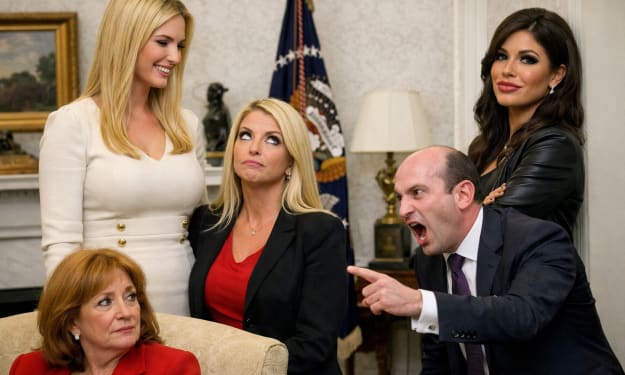
“I’m the queen of chin jutting while I smooth my hair, attacking, insulting, and deflecting to protect my appointer.” “Oh, please, Blondi, my hair is curled, highlighted, and longer than yours. I feature television commercials telling immigrants that we will give them a free plane ride home, and if they voluntarily turn themselves in, they will be allowed to legally apply for re-entry. It runs everywhere, and I look good in it! You can’t compete because of your blond hair. Mine is nicer, and my lips are prettier than yours.”
By Andrea Corwin 21 days ago in The Swamp



Comments
There are no comments for this story
Be the first to respond and start the conversation.