
Demonstrators Flood Minneapolis Streets as Hundreds of Businesses Close to Protest ICE
A Citywide Show of Solidarity Brings Economic Activity to a Halt as Residents, Workers, and Business Owners Unite Against Federal Immigration Enforcement Policies

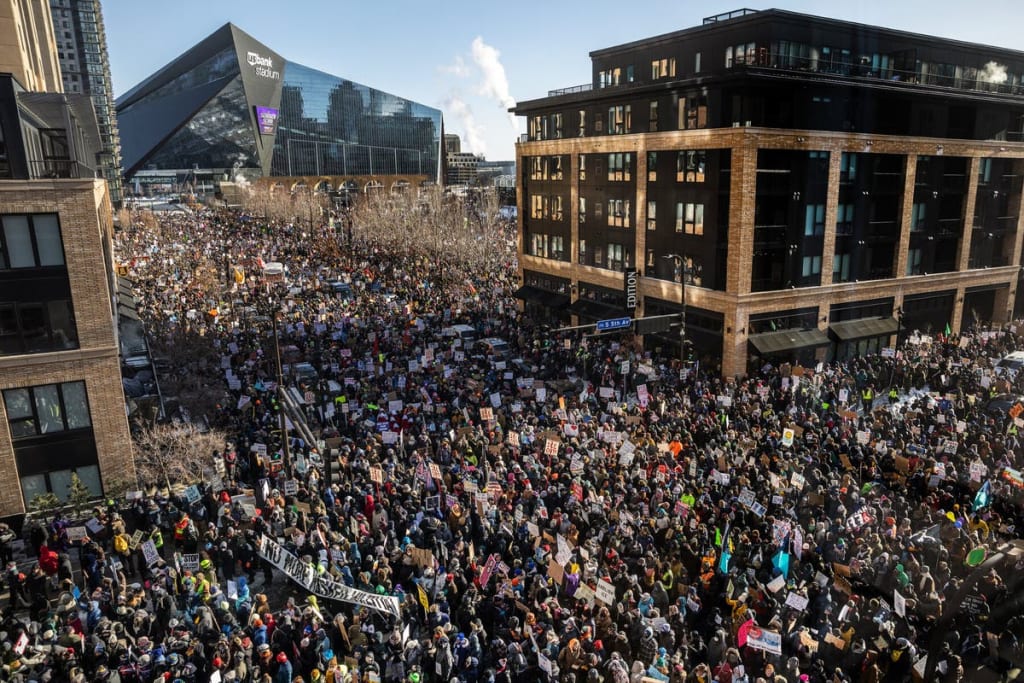
Mass demonstrations against U.S. Immigration and Customs Enforcement bring economic pause, civic debate, and renewed attention to immigration policy in Minnesota’s largest city.
Minneapolis witnessed a sweeping wave of demonstrations as thousands of protesters flooded major streets, prompting hundreds of local businesses to close their doors in solidarity. The coordinated action was organized to protest the practices and presence of U.S. Immigration and Customs Enforcement (ICE), reflecting growing national and local opposition to federal immigration enforcement methods. The demonstrations, largely peaceful, marked one of the most significant civic mobilizations in the city in recent years and underscored deep community concerns about immigration, racial justice, and public accountability.
From early morning, demonstrators gathered across downtown Minneapolis and surrounding neighborhoods, carrying signs, chanting slogans, and marching through key commercial corridors. Organizers described the protests as a response to what they see as aggressive immigration enforcement tactics that disproportionately affect immigrant communities, particularly people of color. Many participants emphasized that the demonstrations were not only about immigration policy but also about human rights, family unity, and the role of local governments in cooperating with federal agencies.
A City at a Standstill
As crowds grew, the economic impact became immediately visible. Restaurants, retail shops, cafes, and small businesses shuttered operations for the day, some posting signs in their windows explaining their decision to stand with protesters. Business owners cited solidarity with immigrant workers and customers, many of whom form the backbone of Minneapolis’s service and construction industries.
For some employers, the closures were symbolic; for others, they were practical. With streets blocked and public transportation rerouted, operating normally became difficult. Yet many owners said the temporary loss of revenue was worth drawing attention to an issue they believe affects the moral and economic fabric of the city.
Minneapolis has long been known for its progressive civic culture, and the mass closures echoed previous moments of collective action, including protests following high-profile cases of police violence. This time, the focus shifted squarely to immigration enforcement and the perceived role of ICE in creating fear within local communities.
Voices From the Streets
Protesters came from diverse backgrounds, including immigrant families, students, labor unions, faith leaders, and civil rights organizations. Speakers at rallies shared personal stories of family separations, detentions, and deportations, highlighting the emotional toll of enforcement actions. Chants calling for the abolition of ICE or significant reforms to federal immigration policy echoed through the city.
Many demonstrators also criticized cooperation agreements between local law enforcement and federal immigration authorities, arguing that such partnerships erode trust and discourage immigrants from reporting crimes or seeking essential services. Community leaders stressed that public safety depends on inclusivity and trust, not fear.
At the same time, organizers repeatedly urged participants to remain peaceful. Volunteer marshals helped direct crowds, de-escalate tensions, and coordinate with city officials to ensure emergency routes remained accessible.
Official Response and Public Safety
City officials acknowledged the demonstrations and emphasized the importance of protecting the right to protest while maintaining public safety. Minneapolis authorities deployed traffic control measures and adjusted transit services to accommodate the large crowds. Law enforcement presence was visible but generally restrained, reflecting lessons learned from past protests where heavy-handed tactics escalated tensions.
Local leaders reiterated the city’s stance on being a welcoming community for immigrants, though they stopped short of endorsing all demands raised by protesters. Statements from city hall emphasized dialogue, legal processes, and the need for comprehensive federal immigration reform rather than unilateral local actions.
The Broader National Context
The Minneapolis demonstrations are part of a broader national movement challenging ICE’s role and methods. Across the United States, cities have seen protests calling for changes to detention practices, deportation policies, and border enforcement. Advocates argue that the current system is overly punitive and fails to address the root causes of migration, such as violence, economic instability, and climate displacement.
Supporters of ICE, however, contend that the agency plays a necessary role in enforcing federal law and maintaining border security. This divide has fueled intense political debate, placing cities like Minneapolis at the center of a national conversation about federal authority, local autonomy, and human rights.
Looking Ahead
As streets reopened and businesses prepared to resume normal operations, the impact of the demonstrations lingered. Organizers vowed that the protests were not a one-day event but part of a sustained campaign to pressure policymakers at the local, state, and federal levels. Planned follow-up actions include community forums, voter registration drives, and continued advocacy for immigrant protections.
For Minneapolis, the day served as a powerful reminder of the city’s capacity for collective action and civic engagement. Whether the protests will translate into concrete policy changes remains uncertain, but they have undeniably amplified the voices of those demanding a reexamination of immigration enforcement in America. In the process, Minneapolis once again found itself shaping — and reflecting — a national debate with local streets as its stage.
About the Creator
Asad Ali
I'm Asad Ali, a passionate blogger with 3 years of experience creating engaging and informative content across various niches. I specialize in crafting SEO-friendly articles that drive traffic and deliver value to readers.
Jake Lang and the Silence Between Protest, Power, and Pain
Some names arrive quietly and leave little trace. Others settle into public life like a bruise, tender long after the moment that caused it. Jake Lang is one of those names. You may hear it in political debates, tense community meetings, or whispered conversations where people lower their voices without realizing it. His story sits at the edge of protest and consequence, belief and fear. It is not just about what he did, or where he stood, but about how society reacts when lines are crossed and meanings collide. To understand Jake Lang is to step into discomfort, where emotions matter as much as facts, and where silence often speaks louder than shouting.
By Muqadas khan7 days ago in The Swamp
Canada’s Tariff Cut Just Made This High-Tech Chinese EV 50% Cheaper
If you’ve been dreaming of owning a high-tech electric vehicle (EV) but were scared off by the price tag, Canada’s latest trade move might just make that dream a lot closer to reality. Thanks to a dramatic cut in tariffs on Chinese-made EVs, one of the most advanced electric SUVs in the world is now up to 50% cheaper for Canadian buyers. Yes, you read that right — half off on a high-performance EV.
By Muhammad Hassan6 days ago in The Swamp
Affection and Healing for Yourself
During the night of the last quarter moon, I gathered my ritual supplies. I carefully handled the chunk of black tourmaline that would protect me from your overall negative and narcissistic energy. I carefully walked the house with my stick of selenite in hand, asking the universe to cleanse our working space.
By Alisha Wilkins ✒️🦋🖋️5 days ago in Fiction



Comments
There are no comments for this story
Be the first to respond and start the conversation.