
Capitalism Will Not Die, It's Already Dead
And corporations are the ones that killed it.


The world Adam Smith, the founder of capitalist theory, described in his book The Wealth of Nations was a radically different world than the one we live in today. That is what I thought when I was an undergraduate at Kansas State University.
As I entered the workforce after graduating, I began to notice how America’s new gig economy and “hustle” culture resemble the working conditions and culture of 16th-century society described by Adam Smith. Instead of guilds, we have university degrees and professional licenses; instead of castles, we have mega-mansions and real estate companies; instead of feudal lords, we have billionaires. Society now resembles society in the 16th-century; we just adjusted our vocabulary.
The Birth of A Nation

Explaining just how radical and revolutionary Adam Smith’s new Capitalist theory was at the time of its conception is a topic all on its own. As an economic student, it was drilled into us that the advent of capitalism completely rewove the fabric of society. Basically, if feudalism was a kingmaker, then capitalism was a throne-breaker.
In The Wealth of Nations, Adam Smith also warned about the vulnerabilities of his framework. Smith warned that under the structure of capitalism, those in power would stay in control through exploitation, monopolization, and accumulation of wealth.
The birth of America was influenced, in part, by capitalism. Capitalism was responsible for its explosive growth and industrialization. America’s new bustling metropolitan cities, full of industrial factories surrounded by rural farmland, became the center for the evolution of Economic thought. However, academics often forget that the people implementing policies from philosophies are not philosophers; they are legislators.
Modern American Capitalism

The capitalism that 21st-century American politicians and corporate executives vehemently describe as the vehicle for prosperity is very different from capitalism’s theory described in The Wealth of Nations. It is this new American Capitalism that will ultimately lead to the demise of capitalism itself.
Like the working class of the 17th-century, the middle class of the 21st-century realizes that the promise of this new type of capitalism is actually the root cause of most contemporary problems. Today’s businesses focus on growing fast, growing continuously, and constantly optimizing. The end goal of most startups is either to acquire or get acquired.
It has been a long and toilsome journey for the American thinkers who have transformed capitalism. American executives and politicians have contoured the philosophy of capitalism to benefit themselves and concentrate power.
Peter Thiel and Elon Musk, two titans of the 21st-century economy, used to work together on a website that would eventually become PayPal. PayPal was so ahead of its time that it completely changed how we exchange money around the world. For their efforts, the team that created PayPal became extremely wealthy as a result. The people that initially worked on PayPal are shareholders and founders of the world’s most influential technology companies.

When capitalism was born, the driving economic theory was Mercantilism. The gist of it was for nations to centralize, protect, and grow their wealth by extracting raw resources through colonialism, accumulating large amounts of gold and silver through trade restrictions, and ultimately consolidating wealth and power for the wealthy leaders of nations.
If we look at the principles of American Capitalism through the lens of the contemporary corporate executive and politician, they are very similar to the principles of Mercantilism. Peter Thiel encourages monopolization in Zero to One; the main idea conveyed by one of the chapters is that the best startup is the one that has a monopoly on its market early on. Mitch McConnel enables corporations to use their wealth to buy influence. Legislators write laws that take wealth from the middle class and give it to millionaires and billionaires.
These are a few examples of how the rich and powerful use their influence to perpetuate a cycle of accumulation and growth. The price of their wealth can now be seen by an overworked, blighted working class, a financially unstable and debt-ridden middle class, the scorched earth left behind after extracting all valuable resources from the land.
The Death of Capitalism

It is a sick and evil irony that America, a country that prospered the most from capitalism, is also the one driving its demise. American Capitalism has been usurped by executives and legislators. What once was a force driving unprecedented technological improvement is now a force driving environmental destruction, human exploitation, and income inequality.
Adam Smith was a thinker ahead of his time to most academics. He sparked the capitalist revolution and sparked the birth of a nation whose economic foundation was built using Smith’s philosophy. The average American will tout the successes of capitalism and how it built America into what it is today. However, to say that America was built by capitalism ignores the countless warnings Smith foresaw with his economic philosophy. As I grow into a young professional, I realize that America wasn’t built by capitalism. On the contrary. America influenced capitalism by exploiting its weaknesses to empower the ruling class.
Adam Smith lived in a world controlled by the wealthy elites and bourgeoisie of his time. When Smith published The Wealth of Nations, it sparked an economic revolution that changed society, but a revolution follows a circular path. The capitalist revolution started more than 200 years ago, now in 2021, we have realized that revolutions bring you back to where you started.
About the Creator
Victor Valdez
A man trying to influence culture through words and actions. I write about code, crypto, economics, politics, and more! I approach topics from the middle and provide quality content by looking at diverse perspectives.
Twitter: @the_VictorV
Keep reading
More stories from writers in The Swamp and other communities.
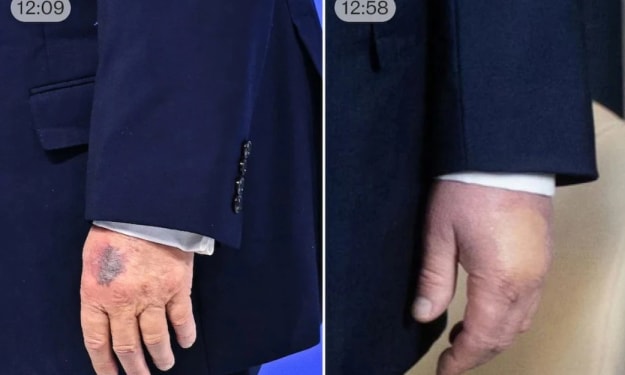
Trump Injured Hand in Davos Signing Ceremony, White House Claims
A routine signing ceremony at the World Economic Forum in Davos unexpectedly drew attention this week after the White House confirmed that former U.S. President Donald Trump sustained a minor hand injury during the event. The incident, which occurred amid high-profile meetings and media scrutiny, sparked speculation online before officials clarified the nature of the injury.
By Aarif Lashari2 days ago in The Swamp
The Buyout: How the "War" for Greenland Was Just a Distraction
We all just breathed a sigh of relief. For the last three weeks, the world watched in horror as President Trump threatened to take Greenland "one way or the other." We saw Danish troops mobilizing in the North Atlantic. We saw NATO invoking Article 5. We saw the doomsday clock tick forward.
By Radical Left Scuma day ago in The Swamp
Autonomy Is The Real Privilege
Good morning, freedom-seekers! Today we’re gonna be looking at autonomy. A strange word, I know; one many would probably look at blankly and run away from on sight. We’re gonna figure out what it actually means, consider how it’s achieved, and decipher just how deeply most of us are tangled up in dependence without realising it.
By That ‘Freedom’ Guy4 days ago in Humans



Comments
There are no comments for this story
Be the first to respond and start the conversation.