
"Burhan Wani: The Rebel Who Awakened a Valley
On His Martyrdom Anniversary, Remembering the Young Face of Kashmir's Resistance and the Legacy He Left Behind
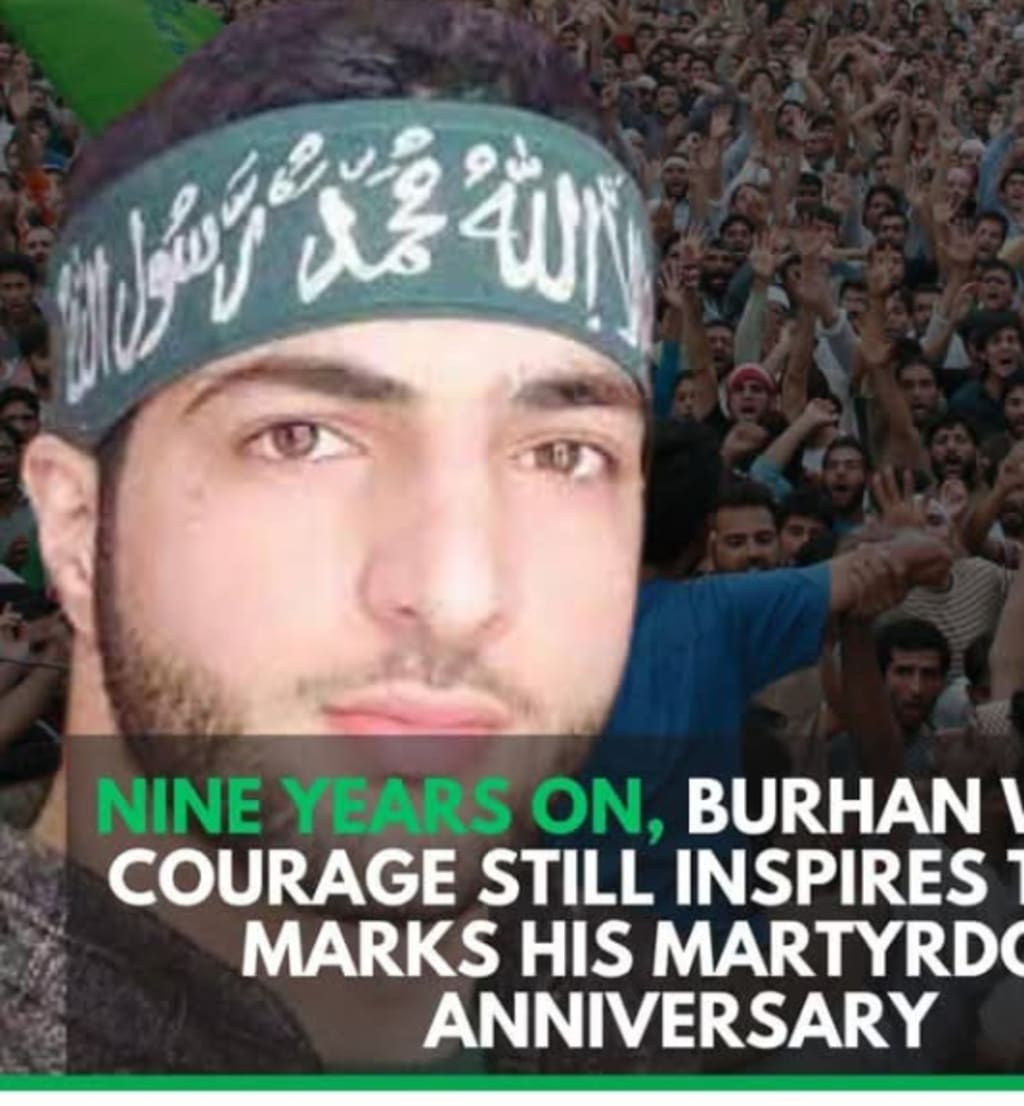
Burhan Wani: The Rebel Who Awakened a Valley
On His Martyrdom Anniversary, Remembering the Young Face of Kashmir's Resistance and the Legacy He Left Behind
Introduction: A Name That Echoes Across Mountains
On July 8, 2016, the killing of a 22-year-old Kashmiri militant commander, Burhan Muzaffar Wani, sent shockwaves across the Indian-administered region of Jammu and Kashmir. What followed was not just mourning but a massive uprising—one that reignited the decades-old conflict in Kashmir, stirred the conscience of millions, and forever etched Burhan's name into the history of the region.
Nine years have passed, but his image—young, bearded, and wearing camouflage, smiling into a camera—still floats across social media, posters, and the collective memory of a people struggling between occupation and aspiration. His death sparked months of protests, civilian deaths, mass blindings due to pellet guns, and global headlines.
But who was Burhan Wani? Why does his martyrdom still provoke such powerful emotions?
The Making of a Rebel: From Tral to the Trenches
Burhan Wani was born on September 19, 1994, in Dadsara village in Tral, a region in South Kashmir. He belonged to a middle-class, educated family. His father, Muzaffar Wani, was a school principal—a symbol of aspiration for many families in the region. Burhan was described as intelligent, studious, and ambitious. He had dreams like any teenager: motorcycles, cricket matches, and mobile phones.
But everything changed in 2010.
That year, a brutal assault on Burhan and his brother Khalid by security personnel reportedly radicalized the teenager. While the state denied the incident, those close to him say this moment planted the seed of resistance in his mind. A year later, at just 15, Burhan disappeared—and resurfaced months later as a militant.
This wasn’t just another rebel vanishing into the forest. Burhan represented something new.
Social Media and a New Form of Resistance
In a region where militants often operated in the shadows, Burhan brought insurgency into the digital age. He used Facebook, WhatsApp, and YouTube to communicate directly with Kashmiris. His group—the Hizbul Mujahideen—appeared in selfies, video messages, and Eid greetings.
He wasn't masked or anonymous. His identity was public. His message: defiance.
This bold visibility made him a hero among many young Kashmiris who saw in him a brother, a son, a voice. Unlike militants of previous generations, Burhan’s appeal wasn't just religious or ideological—it was deeply personal and rooted in lived experiences of humiliation, curfews, crackdowns, and killings.
In the eyes of many Kashmiris, Burhan wasn’t a terrorist—he was a symbol. A generation’s frustration in human form.
Martyrdom: The Day That Changed Kashmir Again
On July 8, 2016, Indian security forces cornered Burhan and two of his companions in a house in Kokernag. A gunfight ensued. When the dust settled, Burhan Wani was dead.
The reaction was instant—and volcanic.
More than 200,000 people reportedly attended his funeral in Tral, chanting slogans, raising flags, and carrying his body shoulder-high like a fallen general. His death triggered months of protests across the valley. Over 100 civilians were killed in clashes with security forces. Thousands were injured. The use of pellet guns left hundreds blinded or permanently maimed.
Schools closed. Internet shut down. Curfews imposed. But the streets of Kashmir kept echoing with the name: Burhan Wani.
To the Indian state, he was a threat neutralized. To many Kashmiris, he became a martyr—an eternal youth who gave up comfort for a cause.
Beyond the Grave: The Aftermath and the Legacy
Burhan’s killing did not end the conflict. It deepened it. His death became a turning point—one that redefined how the youth viewed the armed struggle and their relationship with the Indian state.
Recruitment into militant ranks reportedly surged in the following months. New commanders emerged, inspired by Burhan’s image and ideology. His videos continued circulating. His legacy grew larger in martyrdom.
International organizations took note. Human rights groups raised concerns over the state’s use of force. Global media carried headlines that hadn’t focused on Kashmir in years.
More importantly, Burhan Wani's death forced a larger conversation: Why would a boy with everything—education, family, opportunities—choose the gun?
The Politics of Martyrdom: Perception and Propaganda
While the Indian government branded Burhan Wani as a terrorist who recruited youth into violence, many in Kashmir and parts of the international community viewed him differently. The disconnect of perception lies at the heart of the Kashmir crisis.
For Delhi, Burhan represented Pakistan-backed insurgency. For Kashmiris, he was a product of local anger, not foreign interference.
This conflicting narrative played out in television debates, newspapers, and political statements. In 2016, then-Chief Minister Mehbooba Mufti stated that had the forces known Burhan’s identity, he might have been spared—a comment that caused controversy. For the ruling BJP, he was a clear enemy of the state. For separatist leaders, he was a shaheed.
And for many families, especially those who lost sons in the 2016 uprising, Burhan was the spark and the sacrifice.
The Human Cost: Blind Eyes and Silent Cries
Perhaps the most haunting legacy of Burhan Wani’s martyrdom is the human cost—not just in deaths, but in the shattered lives that followed.
The mass use of pellet guns by security forces during the 2016 protests left more than 1,000 people partially or fully blind. Young boys, some barely in their teens, lost their vision forever. Journalists, bystanders, ambulance drivers—no one was truly safe.
Hospitals overflowed. Medical supplies ran short. Parents wept in corridors, holding up X-rays and reports. The summer of 2016 became the summer of blind eyes and silent cries.
And still, posters of Burhan kept appearing on walls, flags fluttered, slogans were shouted from mosques, and stories passed from lips to ears.
Remembering Burhan: 9 Years Later
As we mark another anniversary of Burhan Wani's death, Kashmir remains in a state of suspended resolution. Article 370 was abrogated in 2019, splitting the region into union territories. Communication blackouts have become frequent. Political leaders have been jailed, and civic space is shrinking.
But Burhan’s image—smiling with an AK-47 in hand—remains a permanent fixture in the Kashmiri psyche. For some, he symbolizes hope and courage. For others, he is a tragic reminder of what happens when peaceful voices are ignored and anger is allowed to fester.
Regardless of one’s politics, it is clear: Burhan Wani was not just a person—he was a phenomenon.
Conclusion: A Story Still Being Written
Nine years on, Burhan Wani's story continues to evolve. His name continues to stir debate, his memory continues to inspire, and his death continues to demand questions no one has fully answered.
Was he a misguided youth? A hero? A product of a broken system? Or simply a mirror—reflecting a truth many are unwilling to see?
Whatever history decides, one thing is certain: Burhan Wani’s martyrdom did not silence the valley—it made it louder.
About the Creator
Hasbanullah
I write to awaken hearts, honor untold stories, and give voice to silence. From truth to fiction, every word I share is a step toward deeper connection. Welcome to my world of meaningful storytelling.
Keep reading
More stories from Hasbanullah and writers in The Swamp and other communities.
"The Running Man (2025): A Dystopian Sprint into the Future"
When The Running Man hits theaters on November 7, 2025, it will stake its claim not just as another action‑thriller—but as a faithful and electrifying reinvention of Stephen King’s 1982 dystopian novel (published under the Richard Bachman pseudonym) . Directed by genre virtuoso Edgar Wright and co‑written with longtime collaborator Michael Bacall, the film sheds the carnival‑esque tone of the 1987 Schwarzenegger version in favor of a darker, more urgent vision—one rooted in social collapse and televised spectacle .
By Hasbanullah6 months ago in The Swamp
Danish PM Says US ‘Ambition to Take Over Greenland’ Is Intact After Washington Meeting – As It Happened
Denmark’s Prime Minister has stated that the United States’ “ambition to take over Greenland” remains intact, following a high-level meeting in Washington that has drawn global attention. The comments come amid renewed diplomatic tension over Greenland’s strategic importance, as climate change, Arctic security, and great-power competition reshape global geopolitics.
By Aarif Lashari2 days ago in The Swamp



Comments
There are no comments for this story
Be the first to respond and start the conversation.