
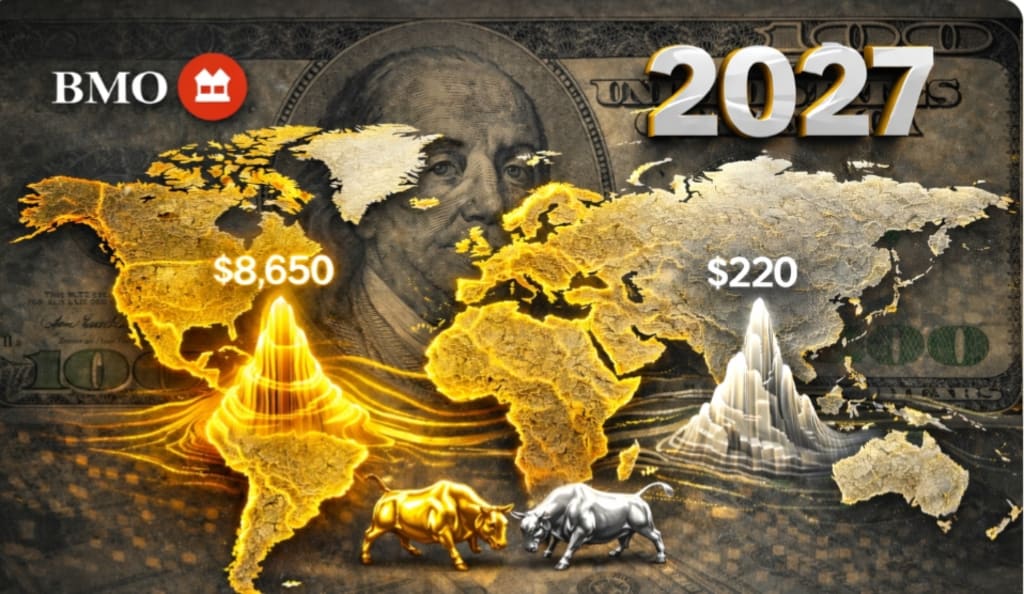
BMO Bullish Scenario Sees Gold at $8,650 and Silver at $220 by 2027
“BMO outlines extreme bullish scenario as central bank demand, ETF inflows, and a weakening dollar could push gold and silver to record highs by 2027.”

A New Era in Precious Metals Markets
In a striking development for investors and markets alike, analysts at BMO Capital Markets have outlined an extraordinary bullish scenario for gold and silver prices. In a recent thought experiment detailed in a market note, BMO projected that, under specific conditions, gold could reach $8,650 per ounce and silver could surge to $220 per ounce by the end of 2027. While this view is not the firm’s “base case,” its implications paint a compelling picture of a financial landscape dramatically different from the past decade.
This scenario has quickly captured attention because it extends far beyond typical forecasts, reflecting deep structural shifts in global economics, monetary policy, and investor behavior. With gold already trading above $5,000 per ounce — a milestone it reached early in 2026 — the bullish outlook is grounded in market realities being shaped today.
---
Understanding the BMO Bull Case
Not Just Another Forecast
BMO’s analysis is not a conventional price forecast; it is framed as a “bull case scenario” — essentially an expanded model that assumes extreme but plausible market conditions. The bank explicitly states this is not a revision of its baseline forecasts, but an exploration of what could happen if global economic stress continues and investor preference shifts heavily toward precious metals.
The underlying thesis of BMO’s model rests on several key assumptions:
Sustained Central Bank Buying: The model assumes average quarterly purchases of gold by central banks at around 8 million ounces.
Robust ETF Inflows: Significant quarterly inflows of around 4–5 million ounces into gold ETFs.
Weakening Real Yields and U.S. Dollar: Continued erosion of real yields and persistent pressure on the dollar, making gold and silver more attractive as stores of value.
Under these conditions, gold could rise to approximately $6,350 by the fourth quarter of 2026, and further climb to $8,650 by the end of 2027. For silver, the projection relies on the gold‑to‑silver ratio compressing to historically low levels (40–50), suggesting prices near $220 per ounce by late 2027.
---
Why These Levels Matter
Gold: A Monetary Anchor in Turbulent Times
Gold traditionally serves as a safe‑haven asset — a protective store of value during periods of uncertainty. BMO’s scenario reflects the idea that the world might be entering an era of heightened monetary, fiscal, and geopolitical instability. With concerns about government debt, currency resilience, and potential shifts in the global monetary order, investors may increasingly seek refuge in gold.
Investors, including central banks, could intensify gold purchases — not just as a hedge, but as strategic reserve diversification, particularly if confidence in major fiat currencies like the U.S. dollar erodes. In such an environment, gold’s role as a monetary asset — not merely a commodity — becomes paramount.
Silver: From Industrial Metal to Safe Haven
Historically, silver has played a dual role: an industrial metal essential in electronics and green technologies, and a precious metal valued for monetary hedging. BMO’s analysts note that silver’s rally above $100 has compressed the gold‑to‑silver ratio to multi‑year lows, indicating that silver may be transitioning into a stronger safe‑haven role.
In the bull case, if the gold‑silver ratio remains at the lower end of its historic range, silver prices could disproportionately benefit, leading to its $220 target by 2027. This represents not just increased investor interest but a revaluation of silver’s monetary relevance.
---
Drivers Behind the Bullish Outlook
1. Central Bank Demand
Central banks have been significant buyers of gold in recent years, driven by the desire to diversify reserves away from traditional currency holdings. This trend is central to BMO’s model. Continued accumulation could reduce available supply and underpin higher prices.
2. ETF and Retail Inflows
Exchange‑traded funds and retail investors have become major players in precious metals markets. Large inflows into gold and silver ETFs support price momentum and provide liquidity that historically was dominated by institutional buyers.
3. Monetary Policy and Currency Pressures
Persistent inflation pressures, dovish monetary policy stances by major central banks, and concerns over the long‑term value of fiat currencies all feed into precious metal demand. A weakening U.S. dollar — as assumed in BMO’s model — makes dollar‑priced commodities like gold and silver more attractive to global buyers.
4. Structural Shifts in Global Financial Systems
BMO’s analysts suggest that traditional models for forecasting gold prices may no longer capture the reality of a rapidly evolving global financial system. Changes in reserve management, shifts in geopolitical alliances, and the emergence of new economic powers could reshape asset preferences in ways not seen since the post‑World War II era.
---
Caveats and Market Risks
It is important to emphasize that BMO’s gold and silver targets are not base case predictions; they are conditional outcomes in an extreme bullish environment. If the assumed factors do not materialize — for example, if the dollar stabilizes, inflation moderates, or central banks ease off on gold purchases — actual prices could diverge significantly.
Moreover, precious metal markets remain volatile. Silver, in particular, has historically exhibited sharp price swings due to its dual role and smaller market size compared to gold.
---
Conclusion: A Bull Case Worth Watching
The BMO bullish scenario paints a visionary but plausible path for gold and silver prices by 2027. While not a default forecast, it highlights how structural shifts, monetary dynamics, and investor psychology could interact to produce unprecedented valuation levels in precious metals.
For investors, policymakers, and market watchers, this scenario serves as a meaningful reminder of both the enduring importance of gold and silver as financial assets and the potential for rapid market evolution in response to global economic and geopolitical stressors.
About the Creator
Keep reading
More stories from Salaar Jamali and writers in The Swamp and other communities.
The Locksmith’s Teeth
How a simple tool became a powerful metaphor for precision, problem‑solving, and hidden craftsmanship In the world of craftsmanship, few tools are as humble yet as indispensable as the locksmith’s pick. But hidden within that phrase — “the locksmith’s teeth” — lies not only a vivid image but also a rich metaphor that spans practical skill, psychological insight, and even cultural symbolism. At once literal and figurative, the idea of the locksmith’s teeth opens a window into the nature of expertise: the ability to penetrate barriers, understand complex systems, and unlock solutions that remain hidden to the untrained eye.
By Salaar Jamaliabout 18 hours ago in The Swamp
Nigerian Military Officers to Face Trial Over Alleged Coup Plot
Nigeria’s Defence Headquarters has formally announced that a group of military officers will be tried over allegations that they conspired to overthrow the government of President Bola Ahmed Tinubu. The decision marks the first official acknowledgment by the country’s military that an internal investigation identified credible evidence of an alleged coup plot — a development that has drawn both domestic and international attention amid regional concerns about political stability in West Africa. �
By Ayesha Lasharia day ago in The Swamp




Comments
There are no comments for this story
Be the first to respond and start the conversation.