
Bezos' Blue Origin Announces Satellite Rival to Musk's Starlink: The Dawn of TeraWave
The Space Billionaire War Heats Up Over Mega-Bandwidth

In the ever-escalating space race between tech titans Jeff Bezos and Elon Musk, a new chapter has unfolded. On January 21, 2026, Bezos' aerospace company, Blue Origin, unveiled TeraWave, a ambitious satellite communications network set to challenge Musk's Starlink dominance in space-based internet.37020a This announcement marks Blue Origin's bold entry into the satellite constellation market, promising ultra-high-speed connectivity that could reshape global data transmission.
Blue Origin, founded by Bezos in 2000, has primarily focused on reusable rockets and space tourism. However, with TeraWave, the company is pivoting toward infrastructure that supports enterprise, data centers, and government users.5a94b6 The network will consist of 5,408 optically interconnected satellites—5,280 in low Earth orbit (LEO) and 128 in medium Earth orbit (MEO)—designed to deliver symmetrical data speeds up to 6 terabits per second (Tbps) anywhere on Earth.106a6c That's a staggering leap from current offerings; for context, Starlink's maximum speeds hover around 400 Mbps, with upgrades planned for 1 Gbps.cc8abe Deployment is slated to begin in the fourth quarter of 2027, targeting remote, rural, and suburban areas where traditional fiber optics are impractical or expensive.ee01a4
Blue Origin Introduces TeraWave, a 6 Tbps Space-Based Network for ...
The rivalry between Bezos and Musk is no secret. Musk's SpaceX has revolutionized space travel with reusable Falcon rockets and now leads the satellite internet space with Starlink's fleet of over 10,000 satellites, serving millions of customers worldwide.06e771 Starlink provides broadband to individuals, businesses, and even military operations, boasting low-latency connections that have proven vital in conflict zones like Ukraine. Bezos, who stepped down as Amazon CEO in 2021 to focus on Blue Origin, has long trailed Musk in orbital achievements. But TeraWave signals a comeback, emphasizing high-throughput data transfer for critical operations rather than consumer broadband.
What sets TeraWave apart? Its architecture prioritizes resilience and speed. By using optical inter-satellite links, the network can route data efficiently across the globe, bypassing ground-based bottlenecks.80c8e8 This setup is ideal for data centers needing massive bandwidth for cloud computing, AI training, or secure government communications. Blue Origin claims TeraWave will offer "additional route diversity," strengthening network reliability in an era of increasing cyber threats and natural disasters.b34a44 Unlike Starlink, which caters to everyday users with portable dishes, TeraWave targets "tens of thousands" of enterprise endpoints, positioning it as a backbone for the digital economy.293a55
This move adds another layer to Bezos' satellite ambitions. Amazon, under his executive chairmanship, is already building its own constellation: Amazon Leo (formerly Project Kuiper), with 3,200 LEO satellites aimed at consumer and business internet.b3141f Leo is in early deployment, focusing on underserved regions. Now, with TeraWave, Bezos controls two complementary networks—one consumer-oriented via Amazon, the other enterprise-focused through Blue Origin. This dual approach could give him an edge over Musk, who has integrated Starlink deeply into SpaceX's ecosystem, including plans for space-based data centers.70efb9
Reactions on social media platform X (formerly Twitter) have been swift and varied. Investors and space enthusiasts are buzzing about the implications. One post highlighted TeraWave's potential synergy with other space tech firms, like AST SpaceMobile ($ASTS), suggesting it could provide high-capacity orbital backhaul for direct-to-device cellular services.ff98a3 "Terawave is not competition for ASTS. It is a force multiplier," noted a user, emphasizing how TeraWave's infrastructure could lower costs and enhance scalability for mobile operators partnering with ASTS.137a9f Others expressed concerns about orbital congestion, with one French mediator warning of "saturation orbitale" as mega-constellations proliferate.c36d0e
Indeed, the announcement raises broader questions about the sustainability of space. With Starlink, Amazon Leo, Chinese networks like Guowang and Qianfan (each planning over 13,000 satellites), and now TeraWave, LEO is becoming crowded.1fbbe2 Experts warn of increased collision risks and space debris, which could hinder future missions. Bezos himself has predicted space-based data centers becoming commonplace in 10-20 years, but this rush might accelerate environmental challenges in orbit.f2586c Regulatory bodies like the FCC and ITU will need to balance innovation with safety.
Economically, TeraWave could disrupt terrestrial networks. By offering 6 Tbps speeds—equivalent to 750 gigabytes per second— it promises to handle the exploding data demands from AI, 5G, and IoT.e1796c For governments, this means secure, resilient communications; for businesses, faster cloud syncing across continents. In regions lacking fiber infrastructure, TeraWave could bridge the digital divide, though its enterprise focus might limit direct consumer benefits.
Blue Origin announces 'TeraWave', a satellite communications ...
Musk, never one to shy from competition, hasn't publicly responded yet, but the stakes are high. SpaceX's Starlink generates billions in revenue and supports Tesla's autonomous driving ambitions. Blue Origin's entry, backed by Bezos' vast wealth (estimated at over $200 billion), could force SpaceX to innovate faster. This billionaire showdown isn't just about satellites—it's about who controls the future of connectivity, from rural broadband to interplanetary networks.
As we look to 2027, TeraWave represents more than a rival to Starlink; it's a testament to the privatization of space. Bezos is betting big on orbital infrastructure, potentially outpacing Musk in throughput and enterprise appeal. Whether this leads to collaboration, fierce competition, or regulatory hurdles remains to be seen. One thing's certain: the stars are getting busier, and the battle for the skies is just heating up.
About the Creator
Keep reading
More stories from Aarif Lashari and writers in The Swamp and other communities.
Index Surges Past 188,000 on Rate Cut Hopes
Global financial markets witnessed a powerful rally as the benchmark index surged past the 188,000 mark, driven largely by growing optimism that interest rate cuts may be on the horizon. Investors responded enthusiastically to signals suggesting easing inflationary pressures and a possible shift in central bank policy, fueling one of the strongest market moves seen in recent months.
By Aarif Lashariabout 18 hours ago in The Swamp
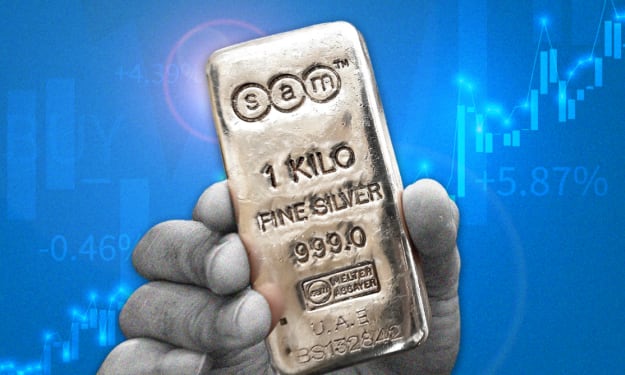
Here’s Everything Investors Need to Know About the Historic Silver Rally in 10 Charts
The precious metals market is experiencing an unusual surge, and silver is stealing the spotlight. After years of relatively muted performance compared to gold, silver prices have recently skyrocketed, attracting renewed attention from retail and institutional investors alike. Analysts describe the rally as historic, not just for its speed, but also for the market dynamics driving it. For anyone with exposure to precious metals—or considering entering the market—understanding what’s fueling the rally is critical. Investors are increasingly turning to visual data, such as charts, to make sense of trends, compare performance, and assess risks. In this article, we break down the silver surge and highlight the most important insights in 10 key charts that explain why this rally is capturing global attention. 1. Silver Price Over the Past Decade The first chart shows silver prices from 2016 to 2026. While the price remained relatively stable for much of the last decade, recent months have seen dramatic upward movement. This spike reflects a combination of increased industrial demand, investor interest, and macroeconomic uncertainty driving safe-haven buying. Key takeaway: Silver is breaking through historical resistance levels, hinting at a potential shift in market sentiment. 2. Gold-to-Silver Ratio Investors often watch the gold-to-silver ratio as a measure of relative value. Traditionally, silver trades at a lower price than gold, but the ratio can signal whether silver is undervalued. Recent charts show the ratio declining sharply, meaning silver is gaining faster than gold—a bullish signal for silver investors. Key takeaway: Historically, periods when the ratio drops have been followed by significant silver price gains. 3. Silver ETFs Inflows Exchange-traded funds (ETFs) are a major driver of precious metal investment. One chart highlights inflows into silver ETFs over the past two years. Surging inflows indicate strong investor demand, particularly from institutional players seeking exposure without owning physical silver. Key takeaway: Investor appetite is at a decade-high, contributing to upward price pressure. 4. Mining Production vs. Demand Supply constraints can fuel rallies. One chart compares global silver mining production to industrial and investment demand. Production has been relatively flat, while demand for electronics, solar panels, and silver bullion has increased. Key takeaway: Tight supply relative to demand is supporting prices and creating upward momentum. 5. Inflation Trends and Precious Metals Silver, like gold, is often considered a hedge against inflation. A chart comparing UK, US, and global inflation rates to silver prices shows a correlation: periods of rising inflation often coincide with rising silver prices. Key takeaway: Inflation fears are likely contributing to the current rally, as investors seek to preserve purchasing power. 6. Silver Futures Trading Volume Futures markets provide insight into investor sentiment and speculation. A chart showing trading volume in silver futures contracts reveals heightened activity in recent months, suggesting that both hedgers and speculators are positioning for further gains. Key takeaway: High futures volume indicates confidence—and volatility—can be expected in the near term. 7. Industrial Demand Segments Unlike gold, silver has major industrial uses in electronics, solar energy, and medical devices. One chart breaks down silver demand by sector, highlighting how growth in renewable energy and tech industries is boosting silver consumption. Key takeaway: Structural demand from technology and energy sectors underpins long-term bullish trends. 8. Retail Investor Interest Retail investors are flocking to silver as part of a broader alternative investment trend. A chart tracking online search interest, social media mentions, and retail trading platforms shows spikes during key market events. Key takeaway: Retail demand can amplify price movements, creating momentum-driven rallies. 9. Comparative Performance With Other Assets Another chart compares silver returns versus gold, equities, and bonds over the past 12 months. Silver has outperformed most traditional asset classes, particularly in periods of market volatility. Key takeaway: Silver’s recent outperformance positions it as a compelling diversification tool for investors. 10. Historical Price Surges Finally, a chart showing historic silver rallies places the current surge in context. While the rally is impressive, past cycles suggest that volatility can be significant, and sharp corrections are possible. Key takeaway: Investors should balance enthusiasm with caution, recognizing that silver’s historical price swings can be extreme. What This Means for Investors The historic silver rally is driven by a mix of macroeconomic, industrial, and speculative factors. Inflation concerns, tight supply, industrial demand, and strong retail and institutional interest have all converged to push silver to multi-year highs. However, like all commodities, silver is volatile, and investors need to consider: Timing and entry points for investment Portfolio diversification to manage risk Long-term versus short-term investment strategies Charts provide clarity, but they also highlight the unpredictable nature of commodities markets. Understanding trends, correlations, and historical patterns is essential for making informed decisions. Final Thoughts Silver is no longer just a “poor man’s gold.” Its historic rally in 2026 demonstrates its relevance as both an investment and an industrial commodity. For investors, the surge offers opportunity—but also risk. By examining these 10 charts, it becomes clear that while momentum is strong, careful research and a long-term perspective remain key. Whether you’re a seasoned investor or new to precious metals, understanding the forces behind the rally will help you make better-informed decisions. Silver’s story in 2026 is a reminder that commodities markets can surprise, reward, and challenge investors all at once.
By Muhammad Hassan4 days ago in The Swamp



Comments
There are no comments for this story
Be the first to respond and start the conversation.