
At Least 28 People Killed as Crane Falls on Train in Northeast Thailand
Deadly rail tragedy raises urgent questions about construction safety and infrastructure oversight

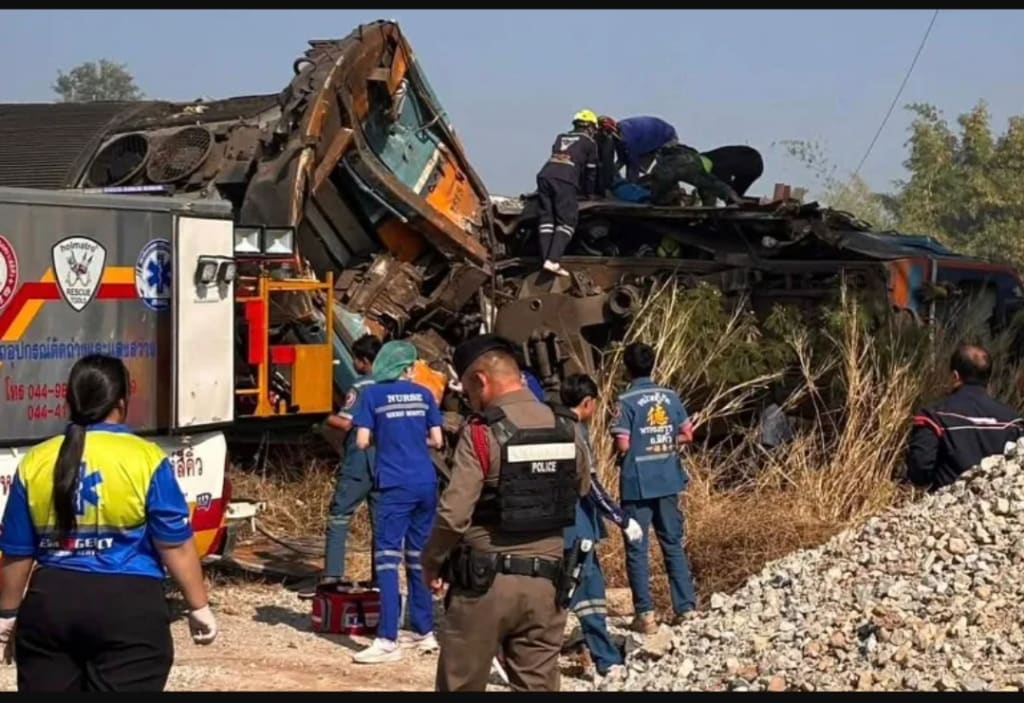
A devastating accident in northeast Thailand has left the nation in shock after a large construction crane collapsed onto a moving passenger train, killing at least 28 people and injuring dozens more. The tragedy unfolded in a matter of seconds, turning a routine rail journey into one of the deadliest transportation disasters the region has seen in recent years.
The incident has not only sparked mourning across the country but has also reignited concerns about safety standards surrounding large infrastructure projects operating near active transport routes.
What Happened: A Routine Journey Turns Tragic
The crash occurred in Nakhon Ratchasima province, a key transport hub in northeastern Thailand. A passenger train traveling from Bangkok to Ubon Ratchathani was passing through the area when a massive crane, used at a nearby construction site, suddenly collapsed onto the tracks.
The falling crane struck several train carriages, causing derailment and extensive damage. Some coaches were crushed, while others were thrown violently off the rails. Panic spread instantly among passengers as emergency brakes were triggered and debris scattered across the site.
Within moments, the scene became one of chaos, with injured passengers trapped inside mangled carriages.
Rising Death Toll and Emergency Response
Thai authorities confirmed that at least 28 people were killed, with dozens more sustaining injuries ranging from minor wounds to critical trauma. Emergency services, including police, firefighters, military units, and medical teams, rushed to the location to assist with rescue operations.
Rescuers worked for hours to cut through twisted metal and locate survivors. Several injured passengers were transported to nearby hospitals, while temporary medical stations were set up close to the crash site to treat victims on the spot.
Officials warned that the death toll could rise further as investigations continue and more victims are identified.
Construction Site Under Scrutiny
Preliminary findings suggest the crane was part of an ongoing rail or infrastructure construction project, possibly linked to Thailand’s expanding transport network. Investigators are now focused on determining why the crane collapsed and whether safety protocols were followed.
Key questions include:
Was the crane properly secured?
Were weather or soil conditions a factor?
Was the construction site operating too close to an active rail line?
Were warning systems in place to stop trains during high-risk operations?
Authorities have launched a formal investigation to establish responsibility and assess whether negligence or regulatory violations played a role in the disaster.
Government Reaction and Official Statements
Senior government officials expressed condolences to the victims’ families and promised full transparency in the investigation. The Ministry of Transport stated that safety inspections would be intensified at construction sites near railways nationwide.
Rail services on the affected line were temporarily suspended as crews cleared debris and assessed damage to the tracks. Officials also announced compensation measures for families of those killed and injured, though details are still being finalized.
The government emphasized that accountability would be enforced if safety failures are confirmed.
Broader Concerns Over Infrastructure Safety
Thailand, like many rapidly developing countries, has invested heavily in large-scale infrastructure projects, including rail expansions and high-speed train networks. While these projects aim to boost economic growth and connectivity, the tragedy has highlighted the risks when safety oversight does not keep pace with development.
Experts warn that construction near active transport corridors requires strict coordination, real-time monitoring, and fail-safe systems. Even a single lapse can result in catastrophic consequences, as seen in this case.
Public calls for stronger enforcement of construction safety laws and independent audits have grown louder in the wake of the crash.
Community Grief and National Mourning
Across Thailand, the tragedy has sparked an outpouring of grief. Families gathered at hospitals and railway stations, anxiously waiting for news of loved ones. Social media filled with messages of condolence, while community groups organized blood donation drives for the injured.
For many, the accident is a painful reminder of how fragile everyday routines can be—and how essential safety measures are in protecting lives.
Conclusion
The deadly crane collapse onto a passenger train in northeast Thailand is more than a tragic accident—it is a stark warning. With at least 28 lives lost, the incident underscores the urgent need for stronger safety oversight, better coordination between construction and transport authorities, and stricter accountability.
As investigations continue, the focus must remain not only on determining what went wrong, but on ensuring that such a disaster never happens again. For the victims and their families, answers and justice cannot come soon enough.
About the Creator
Asad Ali
I'm Asad Ali, a passionate blogger with 3 years of experience creating engaging and informative content across various niches. I specialize in crafting SEO-friendly articles that drive traffic and deliver value to readers.
As Divisions Over Greenland Grow, Europe Examines Its Options
Europe is facing a growing diplomatic and strategic challenge as tensions over Greenland continue to escalate. The Arctic island, a semi-autonomous territory of Denmark, has long held strategic significance due to its location, natural resources, and role in regional security. Now, with renewed interest and pressure from the United States, European leaders are being forced to weigh their options carefully — balancing sovereignty, alliance cohesion, and global influence.
By Aarif Lashariabout 23 hours ago in The Swamp


Comments
There are no comments for this story
Be the first to respond and start the conversation.