
As Ukraine Accuses Russia of Terrorism With Deadly Strike on Train, Is Starlink Helping Moscow Target Civilians?
A devastating railway attack raises urgent questions about modern warfare, satellite technology, and accountability.

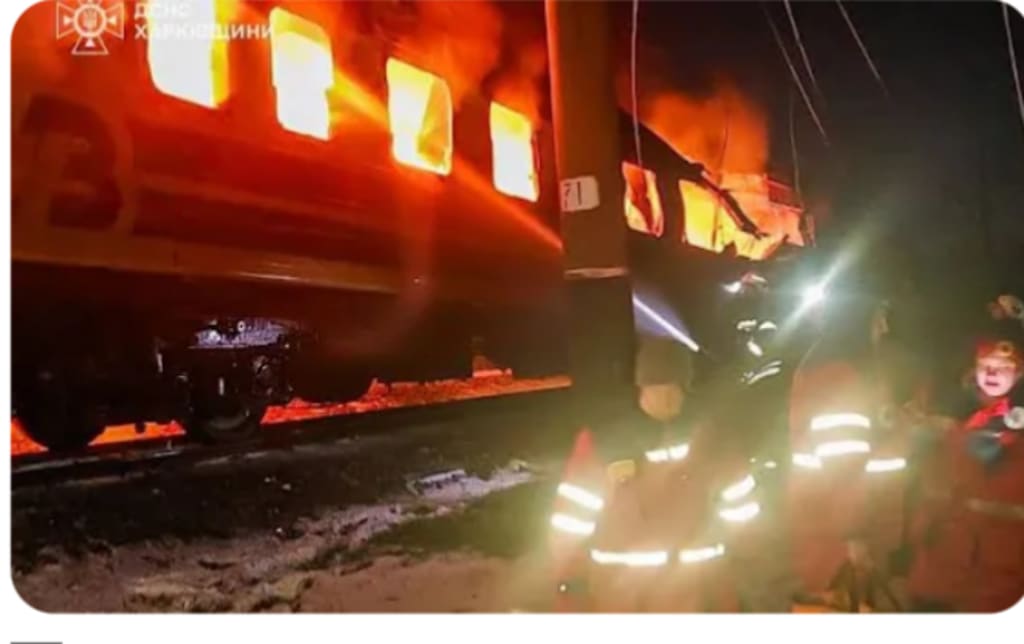
A deadly missile strike on a civilian train in eastern Ukraine has reignited global outrage and deepened accusations that Russia is deliberately targeting civilians. Ukrainian officials have labeled the attack an act of terrorism, claiming the train was clearly marked as a civilian transport route. But beyond the immediate horror of the strike, a new and unsettling question has emerged: could satellite technology such as Starlink be indirectly enabling Russia’s targeting capabilities?
The incident has once again highlighted the evolving nature of warfare in the digital age—where satellites, private technology firms, and battlefield intelligence are intertwined with civilian life.
The Train Strike That Shocked the World
Ukrainian authorities reported that a Russian missile hit a passenger train traveling through a region far from the front lines. Dozens were injured and several passengers were killed, including women and children. Images of mangled rail cars and scorched tracks quickly circulated online, drawing condemnation from European leaders and human rights organizations.
President Volodymyr Zelensky called the strike “a deliberate act of terror,” insisting that there were no military targets in the area at the time of the attack. According to Ukrainian intelligence, the train was transmitting civilian identification signals and following routine schedules.
Russia has not directly acknowledged responsibility for the strike, maintaining its long-standing claim that it only targets military infrastructure. However, analysts note that Russian missile systems rely heavily on satellite navigation and real-time intelligence—raising concerns over how precise targeting information is being obtained.
Starlink Enters the Controversy
Starlink, the satellite internet service operated by SpaceX, has been widely praised for helping Ukraine maintain communications after Russian attacks on its power and telecom infrastructure. Ukrainian forces use Starlink terminals to coordinate troop movements, medical evacuations, and drone operations.
But now, Ukrainian officials and independent experts are raising alarms about whether Russia may be exploiting satellite networks—either directly or indirectly—to identify civilian targets.
The concern is not that Starlink is intentionally helping Russia, but rather that signals data, satellite mapping, or commercial satellite services could be accessed or intercepted by hostile actors. Some analysts argue that any satellite-based communications system used in war zones becomes part of the battlefield, regardless of its original purpose.
This has sparked a broader debate: can private technology companies remain neutral when their systems are embedded in military operations?
Technology and the New Face of War
Modern warfare is no longer confined to tanks and missiles. It now includes:
Satellite communications
GPS and navigation systems
Drones guided by real-time data
Commercial internet services
Artificial intelligence for targeting
Railways, hospitals, and refugee corridors all depend on digital signals to function safely. If those signals are compromised or tracked, civilian infrastructure becomes dangerously exposed.
Military analysts suggest Russia could be combining satellite imagery with intercepted communications and drone surveillance to locate moving civilian assets such as trains and buses. This makes the line between military and civilian targets increasingly blurred, especially in contested airspace.
Ukraine’s Accusation of Terrorism
Under international law, deliberately targeting civilians constitutes a war crime. Ukraine’s terrorism accusation signals an attempt to frame the conflict not only as a military struggle but as a humanitarian crisis driven by systematic attacks on non-combatants.
The train strike is part of a pattern that includes:
Missile attacks on apartment buildings
Bombing of evacuation routes
Strikes on energy infrastructure in winter
Assaults on hospitals and schools
Ukrainian prosecutors are collecting evidence for future war crimes tribunals, and technology companies may soon be drawn into these investigations if their platforms are found to be misused.
Starlink’s Dilemma
Elon Musk has previously stated that Starlink exists to support connectivity, not warfare. However, in Ukraine, the service has become a backbone of battlefield communications. SpaceX has attempted to limit offensive uses of Starlink, especially in drone guidance, but enforcement remains difficult in a war zone.
The current controversy places Starlink in an ethical gray zone:
Should satellite providers restrict access near civilian transport routes?
Can they prevent adversaries from exploiting signal data?
Who is responsible if technology is misused for violence?
These questions reflect a broader issue: private corporations now wield power once reserved for governments.
Global Reactions and Strategic Risks
Western governments have expressed concern over the train attack and are calling for independent investigations. NATO officials warn that attacks on civilian transport could destabilize the region further and risk wider conflict.
There is also fear that similar tactics could be replicated elsewhere. If civilian trains become fair game in modern warfare, international norms protecting non-combatants may erode rapidly.
Experts warn that the war in Ukraine is becoming a testing ground for hybrid warfare—where cyber tools, satellites, propaganda, and missiles work together in coordinated strikes.
The Human Cost Behind the Technology
Lost amid debates about satellites and strategy are the victims: families traveling to safer regions, workers commuting, children fleeing conflict zones. For them, the train represented safety and escape—not a battlefield.
Each technological advancement that enhances military precision also increases the potential for catastrophic misuse. When civilian infrastructure becomes visible through digital eyes in the sky, it becomes vulnerable in ways previous generations never imagined.
What Comes Next?
Ukraine is pushing for stronger international regulations on the use of satellite technology in warfare. Calls are growing for:
Independent investigations into the strike
Clear rules for private tech firms operating in conflict zones
Greater transparency on how targeting data is gathered
Whether Starlink played any role in the attack remains unproven. But the question itself signals a turning point: wars are no longer fought solely by states—they are shaped by networks, satellites, and corporations.
Final Thoughts
The deadly strike on a Ukrainian train has transformed from a tragic battlefield incident into a symbol of modern warfare’s moral crisis. As Ukraine accuses Russia of terrorism, the shadow of satellite technology looms large over the investigation.
If civilian lives can be endangered by invisible digital systems orbiting above Earth, then accountability must extend beyond soldiers and commanders to the tools they use. The future of warfare may depend not just on who fires the missile—but on who controls the data that guides it.
About the Creator
Sajida Sikandar
Hi, I’m Sajida Sikandar, a passionate blogger with 3 years of experience in crafting engaging and insightful content. Join me as I share my thoughts, stories, and ideas on a variety of topics that matter to you.
Keep reading
More stories from Sajida Sikandar and writers in The Swamp and other communities.
US Intelligence Agencies Disagree With Trump’s Opposition to Chagos Deal, Says Starmer
The Chagos Islands have once again found themselves at the center of international controversy—this time involving conflicting voices from within the United States itself. According to UK Prime Minister Keir Starmer, American intelligence agencies continue to support the UK’s sovereignty deal over the Chagos archipelago, despite outspoken opposition from former US President Donald Trump.
By Sajida Sikandarabout 16 hours ago in The Swamp
Guns in homeless housing
In the past several months, I have seen three guns in the apartments of the building I live in, Fusion Studios, which is permanent supportive housing for people experiencing homelessness. This sort of alarmed me because many people who live here suffer from mental illness or addiction. But the truth is, because residents here have signed a lease and the building receives federal funding, they are allowed to own guns.
By David Heitz7 days ago in The Swamp
Jack the Giant Slayer 2: The Sky Scrapers
Fantasy cinema has always thrived on the idea of scale — towering monsters, heroic odds, and worlds far larger than ourselves. Jack the Giant Slayer 2: The Sky Scrapers takes that idea to a bold new level by dragging ancient myth straight into the heart of the modern city. Imagined as a high-stakes sequel to the 2013 fantasy adventure Jack the Giant Slayer, this concept explores what happens when fairy-tale giants are no longer confined to medieval kingdoms, but instead rise among steel towers, glass skylines, and crowded streets. The result is a striking fusion of classic folklore and contemporary disaster spectacle — a story that feels part myth, part apocalypse. A New World, A Bigger Threat Unlike the original film, which unfolded in a medieval fantasy setting filled with castles and clouds, The Sky Scrapers reimagines the conflict on a global scale. Giants are no longer distant creatures from legend — they are immediate, unstoppable forces clashing with modern civilization. Skyscrapers replace castle walls, fighter jets replace archers, and city streets become battlefields. The imagery alone tells a powerful story: massive armored giants striding through urban chaos, iconic landmarks crumbling under their weight, and ordinary people caught between myth and modernity. The giants feel less like fantasy creatures and more like natural disasters — earthquakes with fists. This tonal shift gives the sequel concept a darker, more urgent atmosphere. The film isn’t just about defeating monsters; it’s about survival in a world that suddenly realizes its technology may not be enough. Familiar Faces in an Unfamiliar Reality The poster imagery suggests the return of key characters portrayed by Nicholas Hoult, Anya Taylor-Joy, and Stanley Tucci, now placed in a contemporary setting rather than a fairy-tale kingdom. This contrast strengthens the emotional core of the story. Jack is no longer just a farm boy turned hero — he is a man haunted by a past the world believed was only a legend. Isabelle evolves from a princess into a symbol of resilience, bridging the old world and the new. Meanwhile, Tucci’s character archetype fits naturally into a modern narrative of political ambition, secrecy, and moral compromise when faced with extinction-level threats. Their grounded performances would be essential in selling such an ambitious crossover, anchoring the spectacle in human fear, courage, and responsibility. Themes Beneath the Spectacle While the film leans heavily into large-scale destruction and visual awe, its underlying themes are surprisingly relevant. The Sky Scrapers explores humanity’s overconfidence in technology, the danger of ignoring ancient warnings, and the idea that progress does not erase the past — it simply builds over it. The giants symbolize consequences long buried and forgotten. They are not merely villains, but reminders that some forces cannot be controlled, only respected. In that sense, the film echoes modern anxieties about climate change, unchecked power, and humanity’s fragile dominance over the world it believes it owns. Visual Scale and Cinematic Ambition Visually, the concept promises a stunning blend of fantasy design and modern disaster filmmaking. The contrast between glass skyscrapers and stone-armored giants creates unforgettable imagery. Explosions feel smaller when compared to creatures that can topple buildings with a single step, and that imbalance is exactly what makes the spectacle so effective. The camera work imagined for such a film would favor wide shots, emphasizing scale and helplessness, while close-ups focus on human reactions — fear, disbelief, and determination. A Bold Direction for Fantasy Cinema Jack the Giant Slayer 2: The Sky Scrapers represents an exciting “what if” for the fantasy genre. By merging folklore with a contemporary setting, it challenges traditional boundaries and invites a wider audience — including fans of action, disaster films, and modern sci-fi thrillers. Though imagined as a sequel, the concept stands on its own as a commentary on legends reawakening in an age that no longer believes in them. It asks a simple but chilling question: What if the stories were never meant to stay stories? Final Thoughts Whether viewed as a conceptual sequel or a cinematic thought experiment, The Sky Scrapers captures the kind of ambition modern fantasy needs — fearless scale, emotional grounding, and thematic depth beneath its explosive surface. It reminds us that myths endure not because they are old, but because they still have something to warn us about. In a world obsessed with the future, this film concept suggests the past may yet come crashing down — quite literally.
By Hasbanullah6 days ago in The Swamp




Comments
There are no comments for this story
Be the first to respond and start the conversation.