
Al‑Maliki Is Defiant After Trump Threatens to Withdraw U.S. Support for Iraq
Baghdad’s political crossroads: sovereignty, foreign influence, and the battle over Iraq’s future

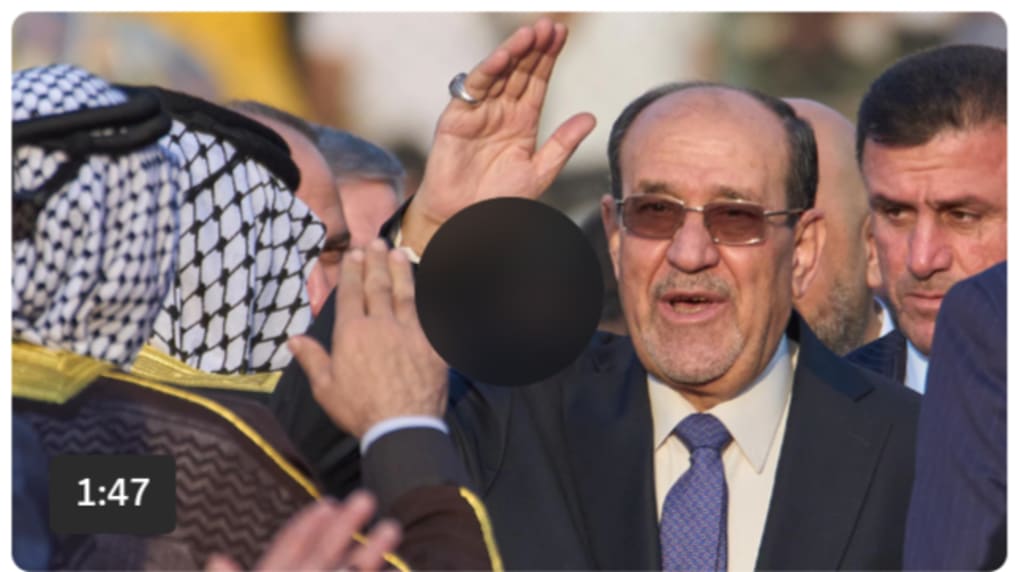
This week, Iraq’s political scene erupted into tension and controversy after former U.S. President Donald Trump publicly threatened to withdraw American support if Nouri al‑Maliki were to return as prime minister. Al‑Maliki, a veteran Iraqi politician, responded defiantly, rejecting the warning as “blatant interference” in Iraq’s internal affairs. The standoff highlights the fragile balance between foreign influence and Iraq’s sovereignty — and underscores how external pressures can shape, but not always dictate, domestic politics.
Trump’s Warning Shakes Baghdad
Trump’s warning was blunt. In a post on social media, he claimed that Iraq “descended into poverty and total chaos” under al‑Maliki’s previous tenure and warned that the U.S. would “no longer help” Iraq if the former prime minister returned to power. Without Washington’s support, Trump argued, Iraq would face “zero chance of success, prosperity, or freedom.”
The message reflects broader U.S. concerns about Iraq’s alignment with neighboring Iran, as well as the influence of Tehran-backed militias and political factions in Baghdad. American officials have long pressured Iraq to maintain independence from Iran while balancing U.S. interests in regional security.
Al‑Maliki Fires Back
Al‑Maliki wasted no time in publicly rejecting Trump’s warning. He called it a violation of Iraq’s sovereignty and insisted that leadership decisions should be made by Iraqis, not dictated by foreign powers.
In a social media post, he emphasized dialogue over threats, framing his political return as being in the “supreme interests of the Iraqi people.” For many Iraqis, Al‑Maliki’s stance struck a chord. Demonstrators rallied outside the U.S. embassy in Baghdad, waving pro-Maliki banners and criticizing Trump’s interference — a vivid sign of rising nationalist sentiment.
A Politician With a Controversial Legacy
Al‑Maliki is no stranger to controversy. He served as Iraq’s prime minister from 2006 to 2014, a period marked by sectarian strife, political fragmentation, and the rise of ISIS. Critics blame his tenure for exacerbating divisions, while supporters praise his role in restoring order after years of instability.
His past alignment with Iran — particularly through Tehran-backed militias — has fueled U.S. distrust. Many American officials fear that a return to power could pull Iraq further into Iran’s orbit, undermining decades of U.S. strategic efforts in the region.
Iraq’s Fragile Political Landscape
The context for this clash is Iraq’s post-election uncertainty. No single party secured a decisive parliamentary majority in the November 2025 elections, leaving government formation dependent on coalition building. The dominant Shiite bloc, the Coordination Framework, nominated al‑Maliki for prime minister after incumbent caretaker leader Mohammed Shia al‑Sudani stepped aside.
Al‑Sudani had tried to balance Iraq’s relationships with both the U.S. and Iran. His withdrawal, however, opened the door for renewed political friction — amplified now by Trump’s warning. Parliamentary sessions scheduled to elect a president and trigger the prime minister appointment were postponed due to low attendance, leaving Iraq in a political limbo.
U.S.–Iraq Relations Under Pressure
Trump’s threat puts Iraq in a difficult position. The country relies on U.S. support for military aid, reconstruction funding, and access to Iraqi oil revenues held in the U.S., giving Washington significant leverage.
Some analysts warn that punitive measures — including sanctions or restricted access to revenue — could have devastating impacts on Iraq’s fragile economy. Yet others see Trump’s warning as a calculated push to steer Baghdad away from Iran-aligned factions and toward a more balanced foreign policy.
Sovereignty vs. Strategic Interests
At the heart of this standoff is a question that has long defined Iraqi politics: Who gets to decide Iraq’s leadership?
Supporters of al‑Maliki argue that U.S. threats undermine Iraq’s sovereignty and democratic process. For a country still scarred by decades of foreign intervention, such interference can fuel nationalist backlash and deepen political divisions.
Critics counter that al‑Maliki’s leadership could destabilize Iraq and increase Iran’s influence — a threat to both Iraqi stability and U.S. regional interests. This clash reflects the larger geopolitical tug-of-war between Baghdad, Washington, and Tehran.
What Happens Next?
Iraq remains in political uncertainty. Coalition negotiations continue, while pressure from Washington and defiance from al‑Maliki raise the stakes. The upcoming months will be crucial in determining Iraq’s trajectory — whether it moves toward independence and political self-determination, or becomes further entangled in foreign power struggles.
Analysts are watching closely. The outcome of this standoff could shape not only Iraq’s domestic politics but also the broader Middle East balance, affecting security, economic stability, and U.S.-Iran relations for years to come.
Conclusion: A Nation at a Crossroads
Al‑Maliki’s defiance in the face of Trump’s warning encapsulates a broader tension: the struggle for sovereignty in a region where foreign powers wield enormous influence. Iraq’s political future, its relationship with the U.S., and its balance with neighboring Iran all hang in the balance.
For Iraqis, this is more than a political squabble — it’s a test of national resilience, a question of who decides the country’s path, and a reminder that sovereignty is a prize not easily won.
As coalition talks continue and foreign pressures mount, Iraq stands at a geopolitical crossroads, navigating the delicate line between internal choice and external influence.
About the Creator
Sajida Sikandar
Hi, I’m Sajida Sikandar, a passionate blogger with 3 years of experience in crafting engaging and insightful content. Join me as I share my thoughts, stories, and ideas on a variety of topics that matter to you.
Keep reading
More stories from Sajida Sikandar and writers in The Swamp and other communities.
Saudi, Israeli Officials Visit D.C. to Talk Possible U.S. Strikes on Iran
This week, Washington, D.C., became the center of a high-stakes diplomatic conversation. Senior officials from Israel and Saudi Arabia traveled to the U.S. capital to meet with top American policymakers about the possibility of military action against Iran. The timing could not be more critical: the region is on edge, the U.S. is signaling readiness for potential strikes, and Iran is responding with warnings of retaliation.
By Sajida Sikandar2 days ago in The Swamp
Is Time a Fundamental Part of Reality? A Quiet Revolution in Physics Suggests Not
Time feels unavoidable. We measure our lives in seconds and years, plan our futures, and remember our pasts through its steady flow. Yet a growing number of physicists are beginning to question something radical: what if time is not fundamental at all? What if it is not a basic ingredient of the universe, but an emergent concept—something that arises from deeper laws of nature? This idea, once confined to abstract philosophy, is now gaining traction in cutting-edge physics. Quietly, and without dramatic headlines, researchers are rethinking one of the most basic assumptions about reality itself. Why Time Has Always Seemed Fundamental In everyday life and classical physics, time appears inseparable from reality. Isaac Newton treated time as absolute—a universal clock ticking away the same for everyone, everywhere. Even Einstein’s theory of relativity, which showed that time can stretch and slow depending on speed and gravity, still treated time as a real dimension woven together with space. Modern physics describes the universe using spacetime: a four-dimensional structure where events occur at specific locations and moments. From this perspective, time is as real as length or mass. So why question it now? The Problem Time Creates in Fundamental Physics The trouble begins when physicists try to reconcile general relativity (which governs gravity and the large-scale structure of the universe) with quantum mechanics (which governs the smallest particles). In quantum mechanics, time is treated as an external parameter—a background clock against which change happens. In general relativity, however, time is dynamic. It bends, slows, and depends on gravity. When researchers attempt to merge these two theories into a single framework of quantum gravity, time becomes deeply problematic. In some of the most important equations, time disappears entirely. This absence has forced physicists to ask a disturbing question: If the most fundamental laws of nature do not include time, where does it come from? The Idea of Timeless Physics Several modern theories suggest that at the deepest level of reality, the universe may be timeless. One influential idea comes from approaches to quantum gravity where the equations describe relationships between physical states, not how those states evolve over time. In these models, the universe is not something that “happens” moment by moment. Instead, it simply is. Change, motion, and time emerge only when observers inside the system describe it in a certain way. This is not to say that nothing changes—but that change does not require time as a fundamental ingredient. Time as an Emergent Phenomenon An increasingly popular view is that time is emergent, similar to temperature. Temperature feels fundamental, but at a deeper level it arises from the motion of particles. No single atom has a temperature; it emerges only when many particles interact. Likewise, time may emerge from relationships between physical systems. When one part of the universe changes relative to another, we interpret that change as time passing. In this view, clocks do not measure a universal time flowing through the cosmos. They simply track correlations between physical processes. The Arrow of Time and Entropy One of the strongest arguments for time’s reality is the arrow of time—the fact that we remember the past but not the future, and that disorder (entropy) tends to increase. However, some physicists argue that the arrow of time does not require time itself to be fundamental. Instead, it may arise from special initial conditions of the universe and the statistical behavior of matter. The laws of physics, at their core, often work the same forward and backward. The sense of direction we associate with time may come from how information is processed and remembered by complex systems like brains. What This Means for Reality and Consciousness If time is not fundamental, the implications are profound. It would mean that the universe does not “unfold” in the way we intuitively imagine. Past, present, and future may not be objectively distinct at the deepest level. Some interpretations suggest that all moments exist equally, and that our experience of “now” is tied to consciousness rather than cosmic structure. This does not mean time is fake in any practical sense. Much like money or language, time could be real because it is useful—even if it is not written into the deepest laws of nature. Why This Revolution Is Happening Quietly Unlike discoveries of new particles or cosmic explosions, this shift in thinking is largely mathematical and conceptual. It unfolds in academic papers, conferences, and theoretical debates rather than laboratories. There is also no single theory that has “proven” time is an illusion. Instead, multiple independent lines of research point in the same unsettling direction. Physicists are cautious. Questioning time itself is not something done lightly. Does This Change Anything for Everyday Life? For now, the answer is no—at least not practically. Time will continue to govern schedules, aging, and physics experiments. But conceptually, this revolution matters deeply. It forces us to rethink what reality is made of and whether our most basic intuitions are shaped more by human perception than by the universe itself. Just as relativity changed how we think about space and simultaneity, a timeless foundation of physics could reshape our understanding of existence. Conclusion: A Universe Without Time? The idea that time may not be fundamental challenges centuries of thought. Yet physics has a long history of overturning what once seemed obvious. Whether time is an illusion, an emergent phenomenon, or something we have not yet fully understood, the quiet revolution underway suggests one thing clearly: our understanding of reality is far from complete. In questioning time itself, physics is once again reminding us that the universe is stranger—and more fascinating—than common sense would ever suggest.
By Aarif Lashariabout 3 hours ago in The Swamp
One Hard Thing
Stop me if you’ve heard this one before: You have the number, you know your schedule- you’ve even picked out the perfect day and time to make this appointment. Shoot, you’ve even picked out alternative days and times just in case their schedules can’t accommodate you!
By Taylor Rigsby5 days ago in Motivation




Comments
There are no comments for this story
Be the first to respond and start the conversation.