


Regarding the Trump presidency, a theory of its trajectory, and the potential outcomes within a four-year timeline— It’s safe to glean from the last 40 years that Trump is a person appears more concerned with himself and how the populous receives him than anything else. More than money, he craves attention. Right now, there are multiple forces at play, nearly equal in influence.
Trump himself.
The Republican Party - which sees Trump as a vessel to enact Project 2025. While I haven’t thoroughly read it, from what I’ve gathered, it aligns with their long-term goals. Given Trump’s character—his extreme narcissism, egotism, and motivations rooted entirely in self-image and self-aggrandizement—he will align with whatever makes him appear great. He doesn’t consider the effects of his decisions on the environment or people. He’ll say what he needs to on stage but, behind the scenes, he will do whatever serves his primary motivator: ensuring he is perceived as the greatest person of our time, if not ever. That appears to be his mindset.
Based on that, nothing he says or does moving forward can truly be trusted. It's reasonable to assume that the worst outcomes are possible, especially considering a third major player:
Elon Musk. - Musk could be the top-tier player here, leveraging Trump and Project 2025 for his own strategic goals. It resembles a modern Game of Thrones within our political system—aligned interests, but not necessarily mutual loyalty.
Musk’s motivations, as I’ve discussed before, seem focused on pushing the world into the 22nd century while ensuring he is the one responsible for that shift. He will do so by any means necessary, even if it involves cutting out certain demographics or stepping on many people along the way. Trump, being easily appeased and not particularly adept in governance, is a malleable tool Musk can use to advance his agenda—especially since Musk himself cannot run for office.
Now, in terms of what to expect moving forward, especially considering Trump’s first 31 days back in office, there has been talk—mainly from his opponents on the left and even some on the right—that he would act as a dictator from day one. However, that’s not how these things happen. You first have to set the stage.
If Musk has any influence here, he has likely advised Trump that before consolidating power, the public’s mindset needs to be shifted. The dial must be turned slowly. The administration will introduce policies, spearhead executive orders, and exhaust legal avenues to expand power, all while pruning away democratic safeguards piece by piece. The goal isn’t an immediate overthrow—it’s gradual restructuring, so that by the time people realize what has changed, they’ve already accepted it as normal.
This is where MAGA’s cult-like nature becomes key. From what I can tell, MAGA functions with the same psychological markers as a cult. Each day, its followers wake up and find that something has changed—one, five, ten things—but their daily lives continue. Because of that continuity, they accept the new reality. They rationalize it because to admit they were wrong would mean confronting their own misjudgments. Over time, this leads to a shift where they’re not just following Trump; they are actively justifying an authoritarian structure.
It’d be like changing clothes, one piece at a time each day. Eventually, you look down and realize you’re wearing a uniform that would have fit perfectly under Hitler’s regime—but because you put it on gradually, you accept it. That process might take six months, a year, or more, but I suspect their timeline is closer to 18-36 months. In that period, they need to shift the mindset from democracy to dictatorship—and make people believe it’s a necessary, even desirable, evolution.
For these followers, it’s not really about policy. They may claim it is, but that’s just political theater. They don’t engage with cause and effect or long-term consequences. Their thinking is team-based, red versus blue, winning at all costs. It has become a sports mentality. As long as their team wins, nothing else matters.
Even those who claim their politics are rooted in Christianity compromise those beliefs in the name of political victory. Many of them are pro-war and pro-military, despite Christianity’s explicit teachings against violence. But because they frame politics as spiritual warfare, they justify their actions, much like soldiers rationalize killing in combat. They tell themselves this is a battle for the soul of the nation, and in war, certain moral rules can be bent.
But Christian theology doesn’t allow for compromise—it is absolute. Even these followers would argue that faith should not be diluted. And yet, when it comes to politics, they abandon critical thinking and engage in purely emotional reasoning.
That’s why, if you tell them today, “You’re supporting a dictatorship,” they’ll deny it outright. But give it the 18 to 36 months, and they’ll not only accept it but justify it. The process happens through daily, incremental shifts. Each day, they wake up and adapt to the latest move, because to resist would mean confronting that they were wrong. Instead of engaging with facts or historical evidence, they fall back on a knee-jerk response of ‘common sense.’
This anti-intellectual stance is another key component of their thinking. Instead of engaging with facts, figures, or analysis, they dismiss complexity outright. The more detailed the explanation, the more they reject it. Their reflex is to say, “I’m just using common sense,” as a defense mechanism against cognitive overload.
This is ‘farmer’s logic.’ It’s a mentality built around brute simplicity: “Don’t overthink it. Just dig the hole and plant the post. Daylight is burning and we don't need to apply long form algebra to get the job done.” This kind of thinking has its place in certain tasks, but when applied to politics, it becomes a liability—because it makes people susceptible to manipulation. If you tell them democracy is dying, but the process is happening slowly and incrementally, they won’t recognize it.
That’s the trajectory I see unfolding. Trump, Musk, and the Republican Party aren’t necessarily fully aligned in their long-term visions, but for now, their goals intersect. Trump wants power and worship; the GOP wants Project 2025 implemented; Musk wants money, technological dominance and control over governance.
Each of them benefits from the erosion of democratic safeguards—but the American public will only notice once it’s too late.
About the Creator
Daniel Pierce
Filmmaker, voice actor, producer. It all start with writing. All writing starts with listening. I’m always listening.
Keep reading
More stories from Daniel Pierce and writers in The Swamp and other communities.
Era of Overstimulation
The commentary that has elevated lately on the supposed downturn in theater attendance and the alleged decline in the quality of films is not new, but does have new information to add to its merit. Yet, I don’t buy the idea that quality is on the downturn. Quite the opposite. In fact, I think we’re in an era where some of the best storytelling and filmmaking in decades are being produced. The problem isn’t with the films themselves; it’s with the sheer volume of distractions competing for our attention.
By Daniel Pierceabout a year ago in Education
A Gathering of Evil Bosses
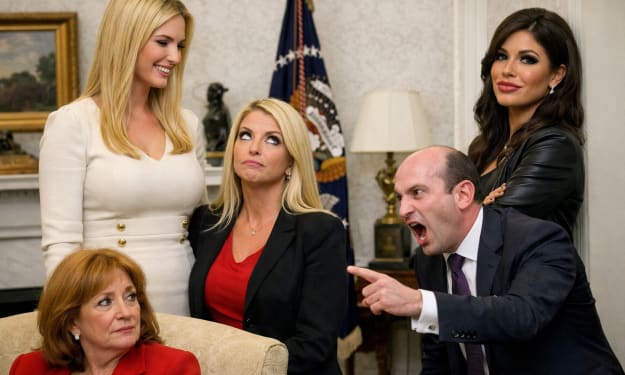
“I’m the queen of chin jutting while I smooth my hair, attacking, insulting, and deflecting to protect my appointer.” “Oh, please, Blondi, my hair is curled, highlighted, and longer than yours. I feature television commercials telling immigrants that we will give them a free plane ride home, and if they voluntarily turn themselves in, they will be allowed to legally apply for re-entry. It runs everywhere, and I look good in it! You can’t compete because of your blond hair. Mine is nicer, and my lips are prettier than yours.”
By Andrea Corwin 11 days ago in The Swamp



Comments
There are no comments for this story
Be the first to respond and start the conversation.