
Comprehensive Guidance About the Diamonds
A Comprehensive Guidance About the Diamonds
About Diamonds
Today I would like to write about the king of gems, diamonds.
Glazed Diamonds Focuses more on accessories, especially Silver accessories, rather than Jewelry, so there are fewer opportunities to use diamonds Compared to brands that specialize in solid Jewelry. However, they still naturally use diamonds in Wedding Rings, for Example, and they sometimes use diamonds even in custom-made Gold or Silver items.
So, naturally, I thought I should write a little about diamonds.
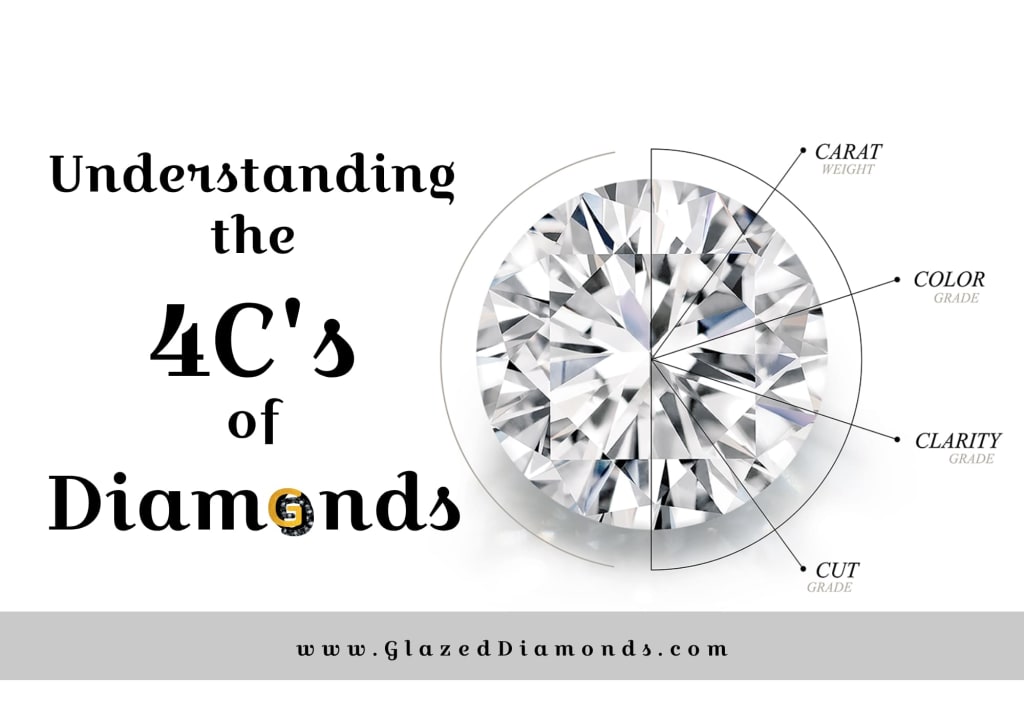
What are the 4Cs?
First of all, the Term 4Cs is Essential when Talking about Diamonds.
The 4Cs are the acronym for the four words:
- CARAT
- COLOR
- CLARITY
- CUT
It's simple, but I'll explain each step.
CARAT
Carat is a unit of measurement for the weight of Precious Gemstones.
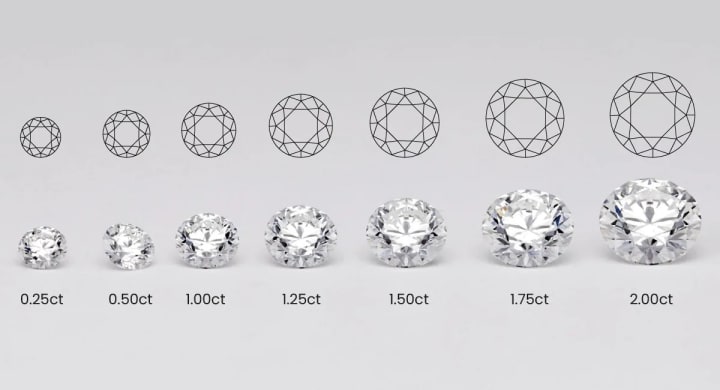
1 carat = 0.200 grams, and is expressed as "ct." (By the way, the "k" in gold is also a carat, but it is different from the one in Jewelry.)
It is usually measured to 1/1000 carat (0.001ct) and recorded on the certificate. Carat is a measure of weight, so it is also a rough guide to the size of a diamond. For diamonds of the same quality, the larger the carat, the more expensive it will be. (Of course, it's big.)
For reference, a rough estimate of the size is approximately 6.5mm for a 1ct diamond
(round brilliant cut).
COLOR
Color, as the name suggests, is the Color of the diamond.
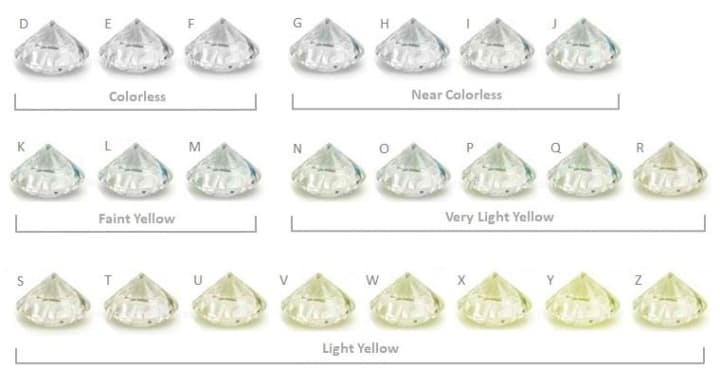
The most Colorless diamonds are called "D Color," and as the Color (Normally Yellow) increases, they are graded from E to F to G to H to I to J... and finally to Z, making up a total of 23 grades.
As for the details of the grades, D to H are Colorless and are Called D (Exceptional White+), E (exceptional white), F (Rare White+), G (Rare White), and H (White), and the Color cannot be seen with the naked eye.
Below, I and J are called (slightly tinted white), K and L are called (tinted white), and M to Z are called (tinted Color).
Diamonds are pure lumps of carbon, but the more nitrogen impurities they contain, the more yellow they become. The evaluation of that yellowness is expressed in the grades D-Z above.
D is (almost) completely Colorless, and the further you go to Z, the stronger the yellowness and the lower the grade becomes. In other words, the price also becomes cheaper.
Some people may wonder why they don't use ABC. It is said that there is still a possibility that a rank of D or higher will be produced.
CLARTY
Clarity refers to the transparency of a diamond.
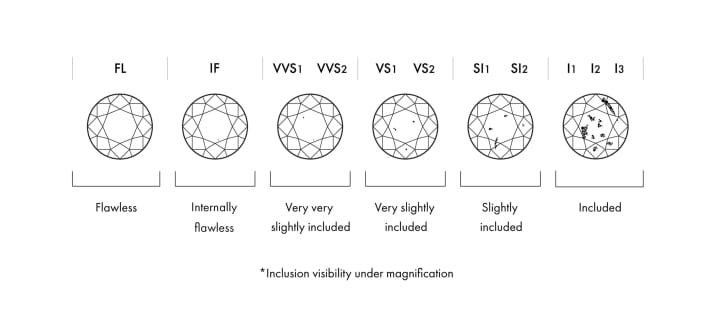
Diamonds may seem colorless and transparent at first glance, but in reality most diamonds contain inclusions. (An extremely small number of diamonds, called flawless, contain no inclusions.)
Clarity grades are determined by the size, position, color, and type of inclusions. So what are inclusions?
They are small crystals of garnet or other minerals that were present in the diamond when it crystallized. In other words, they are minerals other than diamond.
The inclusions (which are called mineral inclusions) = clarity grades are as follows:
・FL = Flawless
A stone that has no visible internal or external inclusions even when examined fewer than 10 x magnifications, it also has no scratches or cracks.
・IF = Internally Flawless:
This refers to stones that have no inclusions even under 10x magnification, but have scratches or cracks on the outside from polishing.
The above two grades are rarely available on the market and are considered to be quite rare.
・VVS1 (Very Very Slightly Included 1) Very Very Slightly Included 1:
A stone containing tiny inclusions that are difficult to see even under 10x magnification. This is usually considered the highest grade.
There is also VVS2 (Very Very Slightly Included 2) which is of the same rank. They are
almost the same, with VVS1 being just a little bit higher.
VS1 (Very Slightly Included 1):
A stone that contains inclusions that can only be found with 10x magnification by an experienced appraiser.
VS2 (Very Slightly Included 1):
A skilled appraiser may see inclusions that are not visible to the naked eye, but which may be visible to some extent (in some locations) only with 10x magnification.
・SI1 (Slightly Included 1) Slightly 1:
A stone that has some inclusions that are difficult for an experienced appraiser to see with the naked eye, but can only be seen with 10x magnification.
・SI2 (Slightly Included 1) Slightly 2:
A stone that has some inclusions that are just visible to the naked eye of an experienced appraiser, but are easily visible under 10x magnification.
I1, I2, I3:
Stones containing inclusions that are clearly visible to the naked eye.
The fewer the inclusions, the fewer the number and size, and stones ranked as I3 may have durability issues. Simply put, the fewer inclusions a gemstone has, the more expensive it is.
CUT
As the name suggests, it is the cut or shape of the stone. There are various cuts, such as round, brilliant, and others. It is an important factor in determining the shape of the diamond.
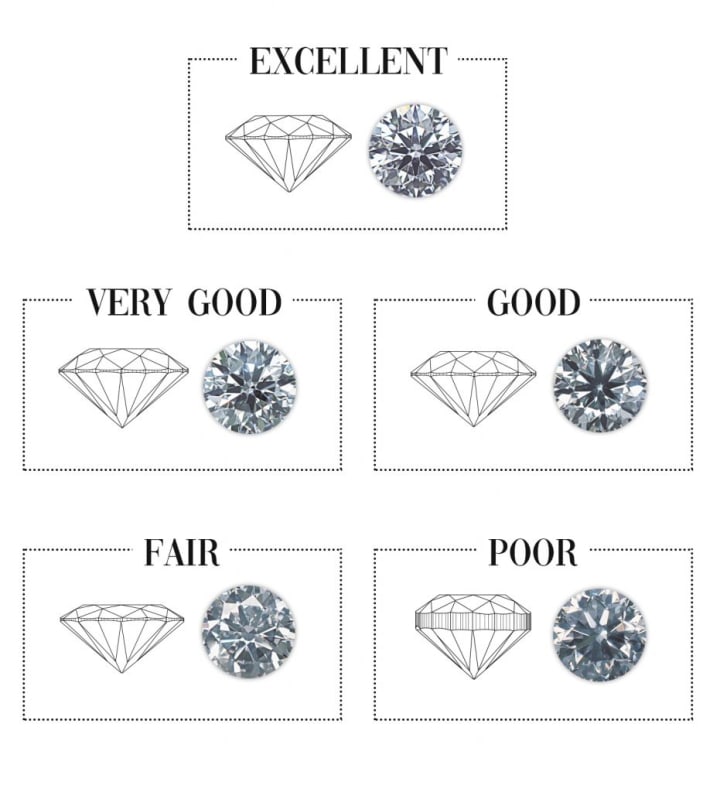
Here we will explain the typical round brilliant cut. A round brilliant cut is a cut that is round when viewed from above, with 33 facets (polished surfaces) on the crown (the upper half of the part (girdle) that protrudes the most when viewed from the side) and 25 on the pavilion (the lower half from the girdle), for a total of 58 facets. This cut is said to bring out the beauty of a diamond to the maximum. For details on round brilliant cut, Emerald Cut, Pear Cut and More Shapes and the names of their various parts, Find Our Different Diamond Shapes.
So, I ended up writing quite a long post.
Diamonds are quite complex, and even just writing a simple explanation has become quite long.
There are many other criteria and factors, so if you are interested, why not look into it? YOu can Also Look at the Many Different Types of Gemstones and see how it Looks for your Engagement Ring And Make it Perfect.
About the Creator
Reader insights
Nice work
Very well written. Keep up the good work!
Top insight
Excellent storytelling
Original narrative & well developed characters
Keep reading
More stories from Rekhaben Lakhani and writers in Styled and other communities.
What is the Meaning of Birthstones?
What are birthstones? "Birthstones" refers to gemstones that are assigned to each month. The history of birthstones dates back to the BC era, and since ancient times, birthstones has been treasured by people as having their own powers and effects. Even today, it is believed that wearing a birthstone will bring happiness, and they are popular gemstones. We will introduce the history of how birthstones were created and how they have come to the present and what meaning each birthstone was named and created with.
By Rekhaben Lakhaniabout a year ago in Styled
What Are Custom Top Tuck Boxes? Evaluate Sizes Styles and Printing Options
Custom top tuck boxes provide a functional yet visually appealing way to package merchandise. Among the many different ways to package items for a consumer, custom top tuck boxes are among the most flexible options today.
By CEO A&S Developers6 days ago in Styled
Silver Screen Magic with Mae West
American actress and singer Mae West became a popular film actress during the Great Depression. She started entertaining in vaudeville, then performed on Broadway, and finally went to Hollywood. She signed up with Paramount Pictures and made her debut in the 1932 film “Night After Night.” She also starred in musicals, comedies, and crime dramas. The American Film Institute named her one of the best classic Hollywood actresses.
By Rasma Raisters5 days ago in Geeks


Comments (1)
Excellent piece , thanks for educating us about diamonds