
You Don’t Need More Motivation (You Need Less Grain)
Why modern psychology says your stuckness is structural, not personal.


You don't always feel tired because the task is hard.
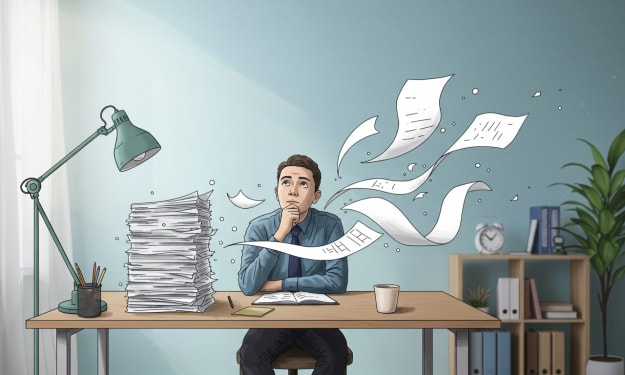
Sometimes, what you're feeling is the drag building under the surface, the kind that makes your body heavy, your thoughts fuzzy, and your motivation feel like it's walking through molasses.
That drag is called Grain.
Grain is mental resistance, and when it builds, it quietly erodes your ability to focus, start, or follow through.
It doesn't matter how much you care about what you're trying to do. If Grain is high, even things you want to do feel overwhelming. But the good news is this: once you understand what Grain really is and where it comes from, you can reduce it.
And when you reduce Grain, focus returns.
Your Brain Isn't Lazy (It's Just Carrying Drag)
Most of us have internalized the idea that when we procrastinate, stall out, or avoid something we care about, we must be lazy, or broken, or not trying hard enough. But there's a growing field in cognitive psychology that offers a different, and more compassionate, explanation.
It's called Cognitive Drive Architecture, or CDA for short.
CDA isn't a productivity hack or self-help framework. It's a scientific field that studies the structural conditions that determine when effort emerges and when it collapses. Instead of blaming your personality or willpower, CDA asks a deeper question:
What are the actual mechanics behind Drive, and what happens when they go off-track?
At the center of this field is a theory called Lagunian Dynamics. It introduces six variables that shape how effort works. These variables, like attention, task fit, ignition, and entropy, don't describe your motivation or mood. They describe how your system is configured at any given moment.
Grain is one of those six, and it's one of the most powerful.
What Exactly Is Grain?
Grain is structural resistance. It's the internal drag that builds when your system starts pushing back against the very thing you're trying to do. Not because you don't care, but because the task isn't aligning with the current shape of your mind.
Sometimes, Grain shows up as tiredness, but not the kind that sleep can fix. Sometimes it looks like procrastination, or irritability, or zoning out. It's the invisible friction you feel when something should be easy but isn't.
Grain doesn't always shout; it whispers. It makes your task feel heavier than it is. It makes time feel slippery. It makes you click away, get up, check your phone, or convince yourself that now just isn't the time.
And the more you fight it, the stronger it gets.
Drive Is a System (Not a Feeling)
According to Lagunian Dynamics, your ability to take action comes from the interaction of six variables. These include your internal “ignition switch” (Primode), the energy surge you can summon (CAP), how well a task fits your current cognitive structure (Flexion), your ability to stabilize attention (Anchory), the random disruptions in your system (Slip), and of course, Grain.
When these variables align, you experience Drive, the readiness to start and keep going. When they don’t, you stall out.
Here's the key insight: Grain lives in the denominator of the equation. In plain language, that means the more Grain you’re carrying, the more it cancels out your energy, your alignment, and even your attention.
Grain doesn't care how passionate you are; it only knows resistance.
Why You Can’t Push Through It
You’ve probably tried to “push through” resistance. Most of us have. But pushing rarely works when the system itself is misaligned. Grain isn’t something you can out-grit; it’s something you have to reconfigure.
Grain rises when:
- The task feels overwhelming or emotionally loaded
- You're carrying unresolved mental clutter (like worries, open tabs, half-finished emails)
- The task doesn’t match your current energy, environment, or mood
- You're putting pressure on yourself to do it perfectly
In another theory within CDA, called Latent Task Architecture, this background clutter is known as Latent Load. Even if you’re not consciously thinking about those undone tasks or unresolved decisions, they quietly pull energy from your system. And that raises Grain.
That’s why you might feel resistance to a task that, on paper, shouldn’t be that hard.
It’s not the task; it’s the drag underneath it.
When Grain Gets High, Everything Gets Harder
When Grain builds up, you start seeing patterns:
— You sit down to work, then check your phone
— You start a sentence, then delete it
— You tell yourself, “just five more minutes,” but hours pass
— You start blaming yourself, and feel even more stuck
This is what the researchers behind CDA call a structural failure, not a personal one. You’re not out of motivation. Your system is just carrying too much resistance to run efficiently.
You wouldn’t expect a car to move smoothly if its wheels were jammed or its engine was misfiring. Your Drive works the same way.
So, How Do You Reduce Grain?
Here's the hopeful part: Grain is not permanent. And it's not a character flaw. It's a dynamic signal, and it can be changed. Here's how:
1. Name It:
The moment you feel stuck or heavy, pause. Ask yourself: "Is this tiredness, or is this Grain?" Just naming it makes it easier to work with, rather than work against.
2. Shrink the Task:
Grain grows when a task feels too big. Break it down until it feels almost absurd. Not "Write the article." Just "Open the doc." Then "Write one sentence." Each micro-step lowers resistance.
3. Clear the Clutter:
Write down any unresolved tasks, decisions, or distractions. Even a short list can unhook some of that invisible resistance. Don't underestimate the mental weight of unclosed loops.
4. Adjust the Fit:
Sometimes the task doesn't match your current capacity, and that's okay. Shift how you frame it. Tell yourself, "This doesn't need to be perfect." Or "I'm just getting started." Reducing pressure increases fit, and fit reduces Grain.
5. Re-anchor Your Focus:
Use a short timer; 10 minutes is enough. Listen to ambient sound or white noise. Shut down distractions. Attention thrives when it's gently tethered.
The Takeaway
You don't always feel tired because the task is hard.
You feel tired because your system is carrying Grain, internal resistance that builds quietly until even small tasks feel impossible.
Cognitive Drive Architecture helps us understand this, not as a failure of willpower, but as a sign that something in our system needs adjusting. And at the core of that understanding is Lagunian Dynamics, the theory that maps how Drive emerges from structure, not just emotion.
You don't need to push harder.
You need to reduce the drag.
When you reduce Grain, you reconnect with the Drive that was always there.
And from there, momentum begins again.
About the Creator
Keep reading
More stories from Nikesh Lagun and writers in Psyche and other communities.
Stop Adding Hours. Start Changing Shape.
There was a time in my life when I kept doing ten‑hour days and still felt like I was getting nowhere. On paper, I was the perfect example of focus. My calendar was blocked. My notifications were off. I sat at my desk for long, punishing stretches of time. Yet when I looked back at the week or the month or even the year, nothing meaningful had moved forward.
By Nikesh Lagun6 months ago in Psyche
Do You have a Support Network?
Life is harder when you’re on your own. Human beings are social creatures, and we usually feel better when we have support from a strong social network around us. For most people, it’s our families that hold us together like glue.
By Elizabeth Woodsabout 9 hours ago in Psyche
Wild Card Weekend Recap: What Happens Now?
I think I figured out why I love Wild Card Weekend so much. It's because it's the first playoff anything of the calendar year. The NFL season starts in the fall, and once upon a time, the champion was crowned either on or slightly before New Year's. The evolution of the NFL schedule has resulted in the playoffs starting just into the New Year, and currently, the final week of the season falls on the first weekend of the New Year, with Wild Card Weekend coming a week after that. So yes, chronologically, the NFL's Wild Card Weekend serves as the first playoff anything of the calendar year.
By Clyde E. Dawkins4 days ago in Unbalanced



Comments
There are no comments for this story
Be the first to respond and start the conversation.