
Why we trust some people and not others
Trust Isn’t Magic — It’s Repetition"

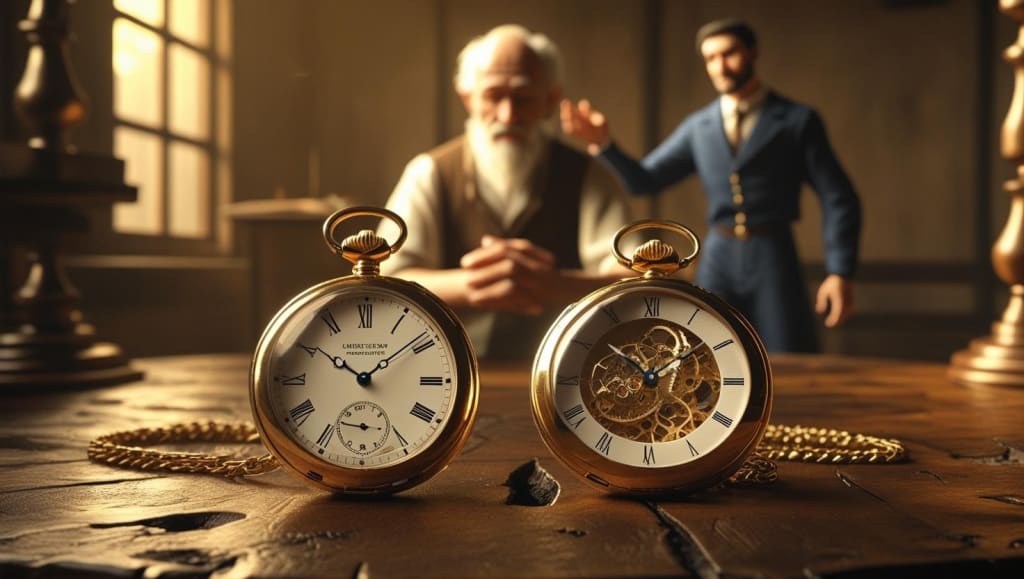
A story of instincts, quiet observation, and the subtle signals of character.
---
In the heart of the valley, where the hills rolled like sleeping giants and the river carved stories through the land, stood a village called Eldenbrook. It was a quiet place—steady, honest, unhurried. Life moved to the rhythm of the seasons, and the people valued truth like gold.
Eli, the village watchmaker, was a quiet man. His workshop, tucked between the cobbler’s and the baker’s, smelled of oil, brass, and old wood. Eli was known not just for his craftsmanship, but for something harder to name. People said he had “a feel” for others. If Eli said someone could be trusted, the village listened.
One autumn, a stranger named Marek arrived. He wore a polished coat, boots with foreign buckles, and spoke with the ease of someone used to being listened to. Marek carried a satchel full of trinkets and a mouth full of promises. He said he had traveled far, done business with important people, and now wanted to invest in small towns “on the rise.”
He was charming. Too charming, Eli thought.
The villagers, hungry for growth and dazzled by Marek’s confidence, welcomed him with open arms. He offered to help the blacksmith buy new tools, promised to bring books to the school, and even offered to “modernize” Eli’s watch shop by turning it into a franchise. He spoke in big words—“scaling,” “capital,” “partnership.” Most villagers didn’t understand the terms, but they nodded along, hopeful.
Marek gave out shiny pocket watches as gifts. He handed one to the mayor, another to the schoolteacher, and even left one on Eli’s counter.
Eli opened the watch and observed its movement. The hands ticked, but unevenly. The gears were shiny but loose. The mechanism looked right but didn’t feel right.
The next day, as Marek spoke to a crowd in the town square about “transforming Eldenbrook,” Eli stood in the back, silent. He wasn’t drawn in by Marek’s words. He was watching something else: how Marek reacted when interrupted (with irritation), how he dismissed questions he didn’t like, how he smiled without his eyes.
That evening, Eli invited the mayor and a few others for tea.
“Do you trust him?” Eli asked simply.
“He’s offering help,” said the mayor. “Isn’t that what we need?”
“He’s confident,” said the schoolteacher. “But when I asked about the books, he changed the subject.”
Eli placed two watches on the table. One was Marek’s. The other was his own.
“Same design,” he said. “But only one keeps time.”
He opened both. His own ticked with calm precision. Marek’s raced, then stalled, then spun again. The difference was clear.
“People can be like this,” Eli said. “Some tick smoothly, quietly, day after day. Others shine on the surface, but inside, their parts don’t fit.”
“But how can you know who to trust?” the mayor asked.
“Time,” Eli said. “Watch how someone acts when they’re not trying to impress you. Notice if they keep their word in small things. Trust isn’t built with promises. It’s built with patterns.”
In the following days, people began paying attention. Marek was still charming, still generous with words, but inconsistencies began to surface. He promised donations but never followed through. He offered help but never asked what people actually needed. He didn’t remember names, repeated stories, and when someone questioned him, he laughed it off or changed the subject.
Then, as quickly as he had come, Marek disappeared. No goodbye, no explanation. Just gone.
In his wake, a few villagers felt foolish. But Eli reassured them.
“Being open isn’t weakness,” he said. “Wanting to trust is human. But now we’ve learned to look deeper.”
Years passed. Eldenbrook didn’t become a booming town, but it grew steadily. New ideas came—some worked, some didn’t—but the people were wiser now. They didn’t judge by charm or promises alone. They watched actions. They trusted slowly.
Eli continued fixing watches until his hands grew too shaky. On his last day in the shop, a young girl named Mira brought in a broken clock. She had heard the story of Marek and the two watches.
“Is it true?” she asked. “That you can tell if someone’s good like you can tell if a clock will work?”
Eli smiled, handing her the repaired clock.
“Not always,” he said. “But most of the time, the truth is in the rhythm. Just listen.”
---
Moral:
Trust is not a product of words, appearances, or charisma. It’s earned through consistency, honesty, and time. In a world full of ticking sounds, the true ones keep time quietly, day after day.
About the Creator
Reader insights
Outstanding
Excellent work. Looking forward to reading more!
Top insight
Heartfelt and relatable
The story invoked strong personal emotions
Keep reading
More stories from Waleedkhan and writers in Psyche and other communities.
Do You have a Support Network?
Life is harder when you’re on your own. Human beings are social creatures, and we usually feel better when we have support from a strong social network around us. For most people, it’s our families that hold us together like glue.
By Elizabeth Woodsabout 14 hours ago in Psyche




Comments (1)
Amazing 😍